

Quick links (related guides):
Ghana’s fuel price cut took effect April 16, 2026, after Cabinet approved a government intervention to absorb part of the cost of petrol and diesel at the pump. Global oil prices pushed ex-pump costs higher across the country, prompting Government Communications Minister Felix Kwakye Ofosu, MP, to issue a formal announcement on behalf of the presidency on April 15, 2026.
The practical meaning: pump prices will not rise as sharply as international market conditions would otherwise dictate. The government is stepping in to cover part of the gap between what global oil prices now demand and what consumers pay at filling stations.
For households, transport operators, and businesses running diesel-powered generators or delivery fleets, the Ghana fuel price cut offers short-term cost relief at a moment when pump prices were widely expected to climb steeply going into the new pricing window. The measure is temporary, set to run for one month, after which the government says it will reassess the situation.
What Was Announced: Ghana Fuel Price Cut Details
The announcement, issued on Wednesday April 15, 2026, confirmed that the Ghana government will absorb GH¢2.00 per litre on diesel and GH¢0.36 per litre on petrol during the April 16, 2026 pricing window. The intervention is described as a temporary cushioning measure in response to rising international petroleum prices, which have significantly fed into higher ex-pump prices locally.
The statement cited three groups as the primary targets of the relief: households, transport operators, and businesses. Government said it remains committed to “maintaining price stability, protecting livelihoods, and supporting Ghana’s economic recovery in the face of external shocks,” according to the Presidency Communications statement.
What the Fuel Price Subsidy Covers
The intervention is narrow and specific. It applies to diesel and petrol only, and covers the amounts the government has committed to absorbing per litre during the one-month window. The table below summarises what has been confirmed.
| Fuel Type | Government Absorption per Litre | Duration |
|---|---|---|
| Diesel | GH¢2.00 | 1 month from April 16, 2026 |
| Petrol (Gasoline) | GH¢0.36 | 1 month from April 16, 2026 |
| LPG | Not included in this intervention | – |
Diesel receives the larger subsidy, which tracks with its greater exposure to price swings on international markets. Petrol gets a smaller cushion. LPG is not part of this specific package, though it falls under the NPA’s separate pricing floor adjustments.
The NPA Price Floor for April 16, 2026
Separately from the government’s absorption announcement, the National Petroleum Authority (NPA) has set the official minimum price floor for petroleum products for the April 16 window. These are the floors below which no Oil Marketing Company (OMC) may sell.
| Product | Previous Price Floor | New Price Floor (April 16) | Change |
|---|---|---|---|
| Petrol | GH¢13.30/litre | GH¢13.27/litre | -GH¢0.03 |
| Diesel | GH¢17.10/litre | GH¢16.10/litre | -GH¢1.00 |
| LPG | GH¢10.71 | GH¢10.79 | +GH¢0.08 |
These floors exclude premiums charged by international oil trading companies, as well as the operating margins of bulk importers, distributors, and the OMCs themselves. The actual price paid at the pump will be higher once those additional charges are layered in. The NPA’s Petroleum Products Pricing Guidelines (PPPG) require all OMCs and LPG Marketing Companies to comply with the announced floors for the window running April 16 to May 1, 2026.
The diesel floor drop of GH¢1.00 per litre is the single largest reduction recorded by Joy Business in recent pricing windows, and it comes on top of the government’s additional GH¢2.00 absorption commitment. Diesel is the fuel most widely used by trucks, trotros, and heavy transport, which is why it dominates both the subsidy and the NPA’s floor revision this window.
Transport Sector Response to the Ghana Fuel Price Cut
The Ghana Private Road Transport Union (GPRTU) has welcomed the government’s announcement, saying it will hold off on any upward fare adjustment that had been in planning. The GPRTU’s Public Relations Officer, Abass Imoro, confirmed that operators had already been warned to expect a fuel price hike going into the April 16 window.
“We were to come up with an upward adjustment. When the government signalled, we were asked to give them two days. This result that has come up today, we are happy,” Imoro said. The union has instructed members across the country to pause any planned fare increases while they assess the impact of the new pricing measures on operational costs.
This matters directly to commuters in Accra, Kumasi, Takoradi, and every city where trotro fares track diesel prices. Fare increases have been a consistent pressure point throughout 2025 and into 2026, with international oil market volatility feeding through to pump prices and then to fares within days. The temporary freeze on fare adjustments is an immediate, tangible outcome of the subsidy announcement.
Cost and Sustainability Questions
The Ghana fuel price cut is estimated to cost the government approximately GH¢553 million over the four-week window, according to figures cited in parliamentary commentary. That is a significant outlay against a fiscal backdrop already shaped by Ghana’s ongoing IMF-supported recovery programme.
Collins Adomako-Mensah, Deputy Ranking Member on Parliament’s Energy Committee and MP for Afigya Kwabre North, acknowledged the intervention as necessary but raised a practical question about the funding source. Speaking on Joy FM’s Middaynews on April 15, he pointed to one plausible offset: crude oil export revenues. Ghana’s national budget benchmarked crude oil at $76.22 per barrel. With crude now tracking above $100 per barrel on international markets, the government is receiving unanticipated revenues from its own oil production.
The argument he advanced is that the windfall from higher export prices – revenue not projected in the budget – could fund the subsidy without necessarily requiring borrowing. Whether that calculation holds for the full month will depend on how long crude stays elevated and how much of the windfall flows back into government accounts within the timeframe. The government has not yet publicly detailed the specific taxes and levies that were adjusted to facilitate the absorption, which limits a full accounting of the fiscal mechanics.
Economists and civil society groups had been calling for a fuel price reduction for several months before this announcement, with some organisations proposing a GH¢1.65 per litre cut as a starting point. The government’s intervention on diesel exceeds that figure, while petrol relief is more modest.
Official Government Statement
The announcement was formalised through a signed statement from the Presidency. The statement is dated Wednesday, April 15, 2026, and bears the signature of Felix Kwakye Ofosu, MP, Spokesperson to the President and Minister for Government Communications.
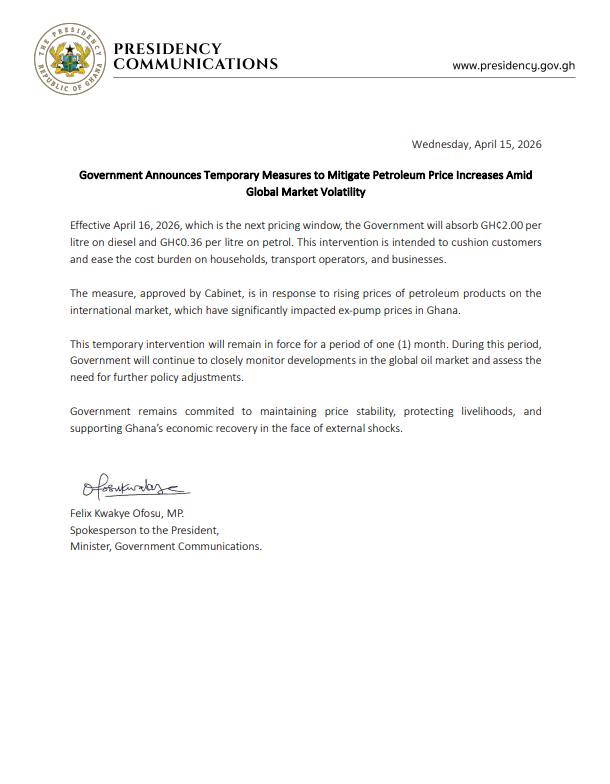
The full text of the statement confirms the GH¢2.00 per litre diesel and GH¢0.36 per litre petrol absorption, the one-month duration, and the government’s stated commitment to monitoring global oil market developments before any further policy decision is taken.
What Happens Next
The measure runs from April 16 to mid-May 2026. After that, the government says it will review whether the global oil market has stabilised sufficiently to allow the subsidy to expire, or whether further action is needed. There is no automatic extension built into the current announcement.
For diaspora members, foreign residents, and investors tracking Ghana’s fiscal position, the key variables to watch are: how long global crude prices remain above the $100 mark, whether the IMF programme allows sustained subsidies of this scale, and whether fare freezes in the transport sector hold if the subsidy is not renewed after May.
For expats and foreign nationals living in Ghana, the immediate effect is that the anticipated fuel price spike going into the April 16 window has been partially offset. Transport costs, grocery delivery charges, and any business cost line item tied to diesel logistics should see some relief for the next four weeks.
Those planning to relocate to Ghana or currently assessing the cost of living in Ghana versus the United States should note that fuel subsidy policies are by nature temporary and can change within a single pricing window. They are not a reliable long-term cost variable. The broader picture of Ghana’s economic direction in 2026 is covered in the Ghana Economy 2026 guide.
250 Things to Know Before Moving to Ghana
Sources
- Ghana Presidency Communications: Official Statement on Petroleum Price Measures (April 15, 2026)
- MyJoyOnline: “Gov’t cuts fuel costs, absorbs GH¢2 per litre on diesel and GH¢0.36 per litre on petrol” (April 15, 2026)
- MyJoyOnline / Joy Business: “NPA slashes Fuel Price Floor for April 16 window; petrol now GH¢13.27, diesel at GH¢16.10” (April 15, 2026)
- MyJoyOnline: “GPRTU welcomes fuel price cut, suspends planned fare increases” (April 15, 2026)
- MyJoyOnline: “Fuel relief welcome, but sustainability hinges on oil windfall – Adomako-Mensah” (April 15, 2026)