

The Tema Motorway, officially designated the N1 Highway, is a 19.5-kilometer freeway connecting Ghana's capital city, Accra, to the industrial port city of Tema. Opened in 1964, it is often described as the only motorway in Ghana. The road serves as a critical economic artery, facilitating the movement of goods and services between Accra and the Tema Port, Ghana's main seaport. After more than five decades of service, the motorway is currently undergoing a major reconstruction and expansion project designed to transform it into a modern, multi-lane urban highway capable of meeting the demands of the Greater Accra Region's rapid growth.
Location
Names and Route Classification
The road is officially known as the N1 Highway, though it is widely referred to as the Accra-Tema Motorway or simply the Tema Motorway. The N1 designation places it within Ghana's national road network as a major trunk road. The motorway forms part of the broader N1 corridor, which extends beyond the motorway itself to include connecting highways that link Accra to other parts of the country.
The road is classified as a freeway, meaning it is a controlled-access highway designed for high-speed through traffic. It is the only road in Ghana that holds the distinction of being called a motorway, a term that reflects its construction standards and limited-access design. The N1 corridor, of which the motorway is the central section, connects to other major national routes, including the N2 and N6 highways, making it a vital component of Ghana's transportation network.
History and Construction
The Tema Motorway was opened to traffic in 1964, during the administration of Ghana's first president, Dr. Kwame Nkrumah. Its construction was part of a broader vision to build a network of motorways that would link major towns and cities across Ghana. The design was reportedly inspired by the Autobahn system in Germany, reflecting the ambitious infrastructure plans of the early post-independence era.
The motorway was built to connect Accra with the newly developed industrial city of Tema, where Ghana's main port is located. The reinforced concrete pavement was designed with an intended service life of 20 years. However, the road has remained in continuous use for more than 50 years, far exceeding its original design life. According to the Ministry of Finance's PPP Portal, after 53 years of use with inadequate maintenance, the pavement has outlived its terminal level of serviceability, showing visible fatigue cracking, joint failures, and pumping under wheel load.
The original construction was intended to be the first in a series of motorways that would eventually connect major towns and cities throughout Ghana. While that broader vision was not fully realized, the Tema Motorway remains a testament to the country's early infrastructure ambitions and continues to serve as a vital transportation link.
Route and Communities Served
The Tema Motorway runs between the Tetteh Quarshie Interchange in Accra and the Tema Roundabout in Tema, covering a distance of 19.5 kilometers. The route passes through the Greater Accra Region, serving a densely populated and rapidly growing urban corridor.
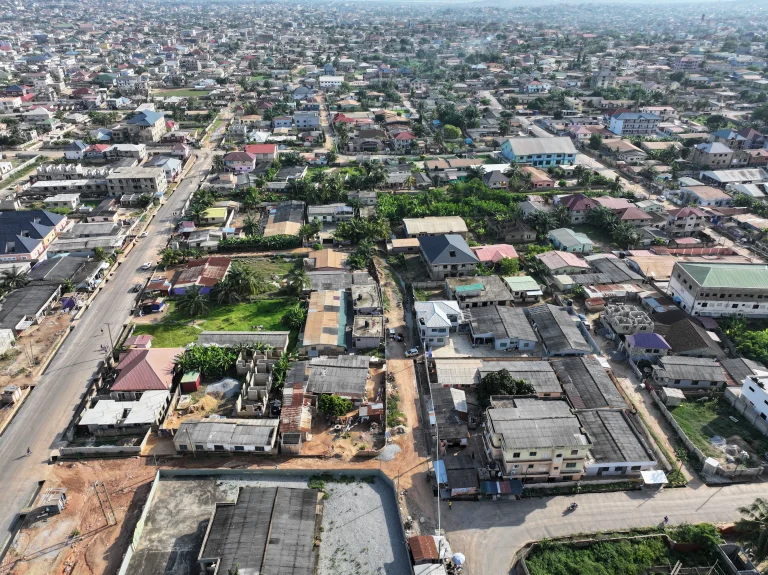
Over the years, urban sprawl has transformed the areas along the motorway. Communities such as Spintex, Lashibi, Ashaiman, and Community 18 have grown significantly, turning the road from a limited-access highway into a heavily used urban artery. The motorway now carries commuters, heavy trucks, and local traffic far beyond its original design capacity. This growth has contributed to the congestion and deterioration that the current reconstruction project aims to address.
The motorway's influence extends beyond its immediate corridor. Its performance is affected by the efficiency of junctions and road sections that lead up to it in both directions. On the Accra end, the Neoplan Junction on the N6 and the George W. Bush Highway, which forms part of the N1 between Apenkwa and Tetteh Quarshie, are key feeder routes. On the Tema end, the Ashaiman Junction on the N2 leading to the Tema Roundabout is another area of influence. These connecting sections experience traffic bottlenecks that impede the movement of vehicles carrying goods to and from major cities like Kumasi and Tamale.
Physical Design and Capacity
The Tema Motorway was originally constructed as a four-lane dual carriageway with a reinforced concrete surface. This design was considered advanced for its time and was intended to provide a high-capacity, durable link between Accra and Tema. The concrete pavement was chosen for its strength and longevity, though it has required significant maintenance over the decades.
The current reconstruction project is dramatically expanding the road's capacity. The existing dual carriageway will be retained and completed with a concrete surface, while new three-lane urban highways will be provided on either side of the existing carriageway. These new lanes will be paved with asphaltic concrete and will serve local traffic, easing pressure on the expressway.
The completed project will result in a 10-lane divided highway, with full access-controlled express lanes dedicated to through traffic and partially access-controlled urban highways for local community traffic. This design represents a significant upgrade from the original four-lane configuration and is intended to accommodate the heavy traffic volumes that have overwhelmed the motorway in recent years.
Interchanges and Connections
The Tema Motorway features several major interchanges that connect it to other roads and communities. The western terminus is the Tetteh Quarshie Interchange, which connects the motorway to the George W. Bush Highway and other Accra roads. The eastern terminus is the Tema Roundabout Interchange, which provides access to Tema and the port area. The Ashaiman Interchange connects the motorway to the N2 highway, which leads toward Akosombo and other destinations.
The current expansion project includes improvements to existing interchanges and the construction of new ones. Planned improvements include upgrades to the Tetteh Quarshie Interchange, the Ashaiman Interchange, and the Tema Motorway Roundabout Interchange. New interchanges are being constructed at Teshie Link, Community 18, and Lashibi. The project also includes the integration of the Flower Pot Interchange.
Beyond the motorway itself, the broader Accra-Tema Motorway and Extensions Project includes improvements to connecting roads. These include a new N6 viaduct to Neoplan Junction, an improved N1 Apenkwa Interchange, a new N1 Dzorwulu Interchange, and a new N2 Ashaiman Interchange along the Akosombo Road. These connections are essential to the overall performance of the corridor, as traffic bottlenecks on feeder roads can significantly impact the motorway's efficiency.
Ownership and Management
The Tema Motorway is owned and managed by the Government of Ghana, with the Ministry of Roads and Highways serving as the contracting authority. The road is part of Ghana's national road infrastructure and falls under the responsibility of the government to provide and maintain.
The current reconstruction project is being undertaken under a Public-Private Partnership (PPP) arrangement. The Government of Ghana seeks to engage a private party under a contractual arrangement to design, finance, construct, manage, and upgrade the Accra-Tema Motorway. This approach is intended to leverage public assets and funds with private sector resources from local and international markets to accelerate needed investment in infrastructure and services.
The upgrade contractor for the current project is Maripoma Enterprise Limited, a wholly Ghanaian-owned firm. The project is being delivered under a PPP model, with the private sector party expected to perform government service delivery functions, including financing, designing, and building the public infrastructure, while assuming associated operation and management risks for a significant period. In return, the private party receives financial remuneration derived from end-user charges such as road tolls, payments made by the government, or a combination of both.
Traffic and Economic Importance
The Tema Motorway is of critical economic importance to Ghana. It serves as the primary link between Accra, the capital and largest city, and Tema, the country's main industrial and port city. The road facilitates the efficient movement of goods and services from the Tema Port, which handles a significant portion of Ghana's international trade.
The motorway carries a heavy volume of traffic, including commuters traveling between Accra and Tema, heavy trucks transporting goods to and from the port, and local traffic from the rapidly growing communities along the corridor. Over the years, rapid population growth in the Greater Accra Region, coupled with a sharp rise in vehicle ownership, has severely overstretched the motorway. The original four-lane configuration has proven inadequate for the current traffic volumes.
The economic impact of congestion on the motorway extends beyond the road itself. Traffic bottlenecks impede the movement of vehicles carrying valuable goods to and from major cities like Kumasi and Tamale, causing delays that affect supply chains and economic productivity. The current expansion project is designed to ease congestion on the 19-kilometer stretch and improve the movement of goods and services, with the enhancement in road condition and capacity expected to have a multiplier effect on economic benefits.
Rehabilitation and Current Projects
The Tema Motorway has undergone several rehabilitation efforts over the years. In August 2009, rehabilitation work began on the road at a cost of 500,000 cedis. Part of the motorway was to be reconstructed using epoxy cement. The rehabilitation work took eight weeks and involved the removal and replacement of concrete slabs that had developed potholes, as well as the repair of the asphalt surface on the shoulders of the road.
The current major project is the Accra-Tema Motorway and Extensions Project, which involves the reconstruction and expansion of the motorway into a modern, multi-lane divided highway. The project cost is listed as GHS 650 million (US$ 500 million) on the Ministry of Finance PPP Portal. The project is being undertaken under a PPP arrangement by Maripoma Enterprise Limited.
As of the latest available reports, the project is about 35% complete (Ghanaian Times). The project includes the reconstruction of the Tetteh Quarshie Interchange, the construction of new interchanges at Teshie Link, Community 18, and Lashibi, and the integration of the Flower Pot, Ashaiman, and Tema interchanges. Ten pedestrian footbridges are being constructed at various locations along the corridor to enhance safety for road users and surrounding communities.
The project involves the construction of a 10-lane divided highway. The first section currently under construction runs from Tema to Tetteh Quarshie, covering 19.5 kilometers. The broader project scope includes additional extensions linking Tetteh Quarshie to Apenkwa and Apenkwa to Neoplan, though these are not part of the current phase.
The construction phase has significantly affected daily travel and living conditions for commuters and residents along the corridor. Frequent diversions, heavy vehicular traffic during peak hours, dust from construction activities, noise from heavy machinery, and restricted access to homes and businesses have become part of daily life. The contractor has implemented measures to minimize inconveniences, including regular watering of dusty sections, asphalting of critical areas, and blocking unauthorized access to uncompleted sections of the roads.
Safety and Operating Context
The Tema Motorway has faced a range of safety and operational challenges throughout its history. One of the most persistent issues has been the lack of functioning streetlights. The motorway had no streetlights when it was completed in 1964. In June 2002, the Ghana News Agency reported that the Government of Ghana was to spend 1.95 million cedis to light up the motorway, a project intended to commemorate the country's Golden Jubilee in 2007. However, the project faced challenges that delayed its completion, including cable thefts. The problem led to plain-clothed policemen patrolling the motorway, and not all of the mounted streetlights on the motorway are functional.
In 2009, Adom FM, an Accra-based private radio station, embarked on a campaign to educate users of the motorway about dangers facing commuters. The education campaign highlighted rampant criminal activities on the motorway, unsafe bridges, potholes, stolen side-rails, malfunctioning streetlights, lack of reflectors, broken-down vehicles, and road safety concerns.
During the current reconstruction, safety remains a key concern. The motorway is an active construction zone, and the Chief Resident Engineer has cautioned motorists against illegal U-turns and paying money to individuals posing as road workers. Motorists are urged to observe road signs and reduce speed. The project includes the construction of pedestrian footbridges to enhance safety for road users and surrounding communities, addressing the challenge of informal access points and encroachment on the motorway's right-of-way.
Significance in Ghana
The Tema Motorway holds a unique place in Ghana's infrastructure landscape as the only motorway in the country. Its significance extends beyond its role as a transportation link; it represents a landmark achievement in Ghana's post-independence development and remains a vital component of the nation's economic infrastructure.
The motorway was built under the administration of Kwame Nkrumah, Ghana's first president, as part of a vision to modernize the country's transportation network. Its construction was fashioned after the Autobahn in Germany and was intended to be the first in a system of motorways that would link major towns and cities in Ghana. While the broader motorway network was never fully realized, the Tema Motorway stands as a monument to that vision.
Today, the motorway is essential to Ghana's economy, serving as the main gateway to the Tema Port and facilitating the movement of goods and services that drive trade and logistics. The current expansion project reflects the government's commitment to maintaining and upgrading this critical infrastructure to meet the demands of a growing economy and population. The successful completion of the project will not only improve transportation efficiency but also support trade, logistics, and economic growth for years to come.
Related Infrastructure
The Tema Motorway is part of a broader network of roads and highways that serve the Greater Accra Region and connect it to the rest of Ghana. Key related infrastructure includes:
The George W. Bush Highway, which forms part of the N1 between Apenkwa and Tetteh Quarshie, serves as a western extension of the motorway corridor. The N2 highway connects the Tema Roundabout to Akosombo and other eastern destinations, while the N6 (Nsawam Road) connects the corridor to Kumasi and the northern regions.
The motorway's interchanges connect it to several important roads. The Tetteh Quarshie Interchange is a major junction that links the motorway to Accra's road network. The Tema Roundabout Interchange provides access to Tema and the port. The Ashaiman Interchange connects to the N2 highway.
The current expansion project includes improvements to these connecting roads and interchanges, recognizing that the performance of the motorway is influenced by the efficiency of the junctions and road sections that lead up to it. The broader project scope includes improvements to the N6, N2, and George W. Bush Highway sections, as well as new interchanges at key locations along the corridor.
Other major roads in Ghana's network include the Accra-Winneba Highway, the Tarkwa-Bogoso-Ayamfuri Road, and the Akosombo-Tema Highway. The country also has a growing network of interchanges, including the Ako Adjei Interchange, Apenkwa Interchange, Kwame Nkrumah Interchange, and Pokuase Interchange, among others.
Related Entries
Search the Ghana Knowledge Database
Sources
- PPPPortal - Accra Tema Motorway Project
- Tema Motorway - Wikipedia
- Tema Motorway expansion, 35% complete …contractor implements measures to minimise inconvenience - Ghanaian Times
- Accra-Tema Motorway Reconstruction: Stakeholders Review Progress, Challenges, and Next Steps - Ghana Institution of Engineering
- ghanaiantimes.com.gh
- www.citinewsroom.com
- www.modernghana.com
- www.facebook.com
- www.facebook.com