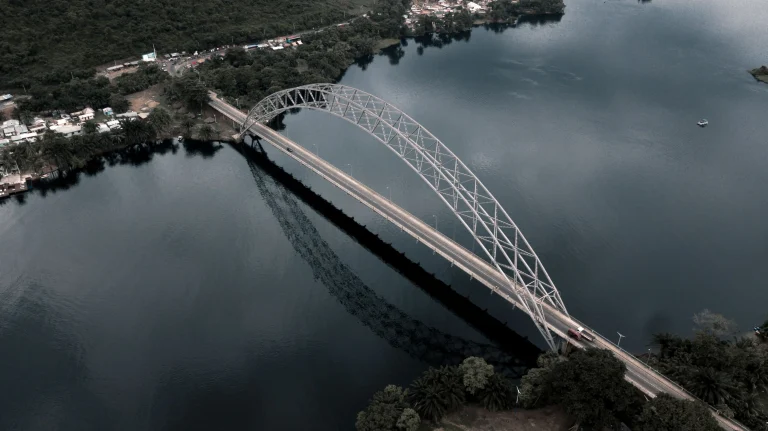

The Akosombo Dam, also known as the Volta Dam, is a hydroelectric dam on the Volta River in southeastern Ghana. Located in the Akosombo gorge within the Asuogyaman District of the Eastern Region, it is owned and operated by the Volta River Authority (VRA). The dam is the centerpiece of Ghana’s post-independence industrialization drive and is responsible for creating Lake Volta, the largest artificial lake by surface area in the world. Beyond its role as a power generator, the Akosombo Dam is a defining feature of Ghana’s geography, economy, and modern history.
Location
Overview
The Akosombo Dam is a rock-fill embankment dam impounding the Volta River. Its construction, completed in 1965, flooded a substantial portion of the Volta River Basin and created Lake Volta. The reservoir covers 8,502 square kilometers, which represents approximately 3.6% of Ghana’s total land area. By surface area, this makes Lake Volta the largest artificial lake in the world. Lake Volta has a storage capacity of about 148 cubic kilometers. It is commonly described as the world’s third-largest artificial reservoir by volume, after Lake Kariba and the Bratsk Reservoir.
The dam was conceived as the engine of Ghana’s economic modernization. Its primary purpose was to provide electricity for the aluminum industry, specifically to power a smelter at Tema. Over time, it has become the backbone of the national electricity grid and a major supplier of power to neighboring West African countries. The Akosombo Dam has been described as the largest and most ambitious project built in Ghana since independence in 1957, and it represented the largest single investment in the country’s economic development plans at the time.
Planning and Construction
The idea for damming the Volta River dates back to 1915, when geologist Albert Kitson first conceived the project. However, detailed plans were not drawn until the 1940s. The development of the Volta River Basin was formally proposed in 1949, but insufficient funds delayed progress. After years of financing negotiations, Ghana secured support for the Volta River Project from the World Bank, the United States, the United Kingdom, and private aluminum interests. VALCO became the project’s principal industrial power customer through the Tema aluminum smelter, and President Kwame Nkrumah adopted the Volta River hydropower project as a national priority.
In May 1960, the Ghana government called for tenders for the dam’s construction. The following year, an Italian consortium, Impregilo, won the contract. Impregilo had just completed the Kariba Dam in Southern Africa, giving it relevant experience with large-scale hydroelectric projects. In 1961, the Volta River Authority was established by Ghana’s Parliament through the Volta River Development Act, with the mandate to manage the development of the Volta River Basin, including construction and supervision of the dam, the power station, and the transmission network.
Construction ran from 1961 to 1965. The project faced significant challenges, including the need to excavate extremely hard quartzite ground, which was then used to build the dam. In 1963, massive flooding interrupted work for more than three months during one of the most delicate phases of the project. Despite this setback, the dam was completed one month ahead of schedule. The total cost of the project at completion was $196 million, with funding from the Ghana Government, the International Bank for Reconstruction and Development, the United States, the United Kingdom, and the Export-Import Bank.
Location and Physical Structure
The Akosombo Dam is situated in the Akosombo gorge in the Asuogyaman District of Ghana’s Eastern Region. The main dam is a high rock-fill embankment structure with a clay core. It measures 660 meters in length at the crest and stands 114 meters high from its foundation. The dam has a base width of 366 meters and a structural volume of approximately 7.9 million cubic meters.
The project consists of several components: a main dam, a secondary saddle dam, intakes, a power station on the right bank, and two spillways on the left. The saddle dam, located about one kilometer east of the main dam, is also a rock-fill embankment dam with a central clay core. It has a crest length of 355 meters and stands 37 meters high.
The power station houses the generating units and is fed by penstocks, one per turbine, each measuring 7.2 meters in diameter. The dam’s design allows for a maximum hydraulic head of 68.8 meters. The two spillway structures are constructed in concrete and founded on rock, each containing six steel floodgates.
Reservoir and Hydrology
The Akosombo Dam impounds the Volta River, creating Lake Volta, one of the largest artificial basins in the world. The reservoir has a surface area of 8,502 square kilometers and a storage capacity of 148 cubic kilometers, equivalent to 120 million acre-feet. The lake stretches approximately 400 kilometers in length and has a shoreline of about 7,250 kilometers.
The lake’s maximum operating level is 84.73 meters, while the minimum operating level is 73.15 meters. The highest water level ever recorded at the dam was 84.59 meters on November 8, 2010. The lowest recorded level was 71.62 meters on July 21, 2007. Lake Volta receives inflow from the wider Volta River Basin, which covers roughly 394,000 to 400,000 square kilometers across Ghana, Burkina Faso, Côte d’Ivoire, Mali, Togo, and Benin.
The creation of Lake Volta fundamentally altered the hydrology of the region. The reservoir covers 3.6% of Ghana’s total land area, and its formation required the flooding of a substantial portion of the Volta River Basin, including upstream fields and settlements. The lake supports fishing, lake transportation, and new farming activities along its shoreline, though it also brought significant environmental and social changes.
Power Generation and Grid Role
The Akosombo Hydroelectric Power Station is the generating facility associated with the dam. The power plant contains six Francis-type turbines, each with a rated output of approximately 170 megawatts. The dam’s original electrical output was 912 megawatts, which was later upgraded to 1,020 megawatts through a retrofit project completed in 2006.
The dam provides electricity to Ghana and neighboring West African countries, including Togo and Benin. Historically, the dam has been significant for providing the majority of electricity for both Togo and Benin. Within Ghana, the dam initially served a dual role: part of its output was directed to the Valco aluminum smelter, while the remainder served domestic demand. In the early years, 20% of the dam’s electric output served 70% of national demand, with the remaining 80% generated for Valco. Over time, production from the Valco plant declined, allowing more capacity to be directed toward growing domestic demand.
The dam’s power generation has faced challenges related to water levels in Lake Volta. Lower lake levels, sometimes below the level required for generator operation, have contributed to rolling blackouts and major power outages. In early 2007, concerns were raised about electricity supply due to low water levels, though heavy rains in the latter half of that year alleviated much of the concern.
Ownership and Operations
The Akosombo Dam and generating station are operated by the Volta River Authority (VRA), a state-owned authority established in 1961 under the Volta River Development Act. The original Act assigned VRA broad Volta River Project responsibilities, including construction of the dam, creation of the lake, resettlement functions, generation, and transmission. Following Ghana’s 2005 power-sector reforms, VRA’s role has been largely focused on electricity generation, while GRIDCo operates the national transmission system.
The dam’s operations are overseen by the VRA, which coordinates generation, reservoir management, and spillway operations. The VRA also manages other generating facilities across Ghana, including the Kpong Hydro Plant, thermal plants, and solar installations.
In 2026, the dam faced a significant operational challenge when a fire swept through the switchyard control room. Engineers from the VRA and the Ghana Grid Company Limited (GRIDCo) worked together to bypass the burnt-out control room and restart all six turbines, restoring the dam to full operational capacity. President John Dramani Mahama publicly commended the engineers for their work, noting that the restoration significantly improved the national grid and reduced the crisis triggered by the fire.
Resettlement and Social Impact
The construction of the Akosombo Dam and the subsequent creation of Lake Volta necessitated the relocation of approximately 80,000 people, representing about 1% of Ghana’s population at the time. People from 700 villages were relocated into 52 resettlement villages, a program directed by the Volta River Authority. The resettlement took place between 1962 and 1966 as the lake formed, with the dam completed in 1965.
The resettlement program proved complex and, in some cases, unsuccessful. Most of the displaced people were subsistence farmers, with about 2% being riparian fishers. The loss of land meant the loss of primary economic activities, homes, family grave sites, community stability, and important social values. Traditional farming practices disappeared as communities were moved to areas that did not suit their former way of life. The naturally fertile soils beneath the lake were lost, and poverty increased among the displaced populations.
Some resettlement villages experienced significant population declines in the years following relocation. One village recorded a population reduction of more than 50% in the 23 years following resettlement. The districts of Manya Krobo and Yilo Krobo in the southwest portion of the Volta Basin were among the most affected, with local factors contributing to disproportionate impacts on these predominantly indigenous communities.
Environmental Impact
The Akosombo Dam has had profound environmental consequences, both upstream and downstream. Reservoir-induced seismicity has been recorded due to crustal re-adjustments from the added weight of water in Lake Volta. By trapping sediment, the dam substantially reduced sediment delivery to the lower Volta and contributed to coastal erosion in some downstream and downdrift areas. Coastal change in the Volta Delta and eastern Ghana is also influenced by natural shoreline dynamics, historical river-mouth shifts, ports, and other human interventions. The altered hydrology has changed the local heat budget, resulting in microclimatic changes such as decreased rainfall and higher mean monthly temperatures.
Downstream agricultural systems have lost soil fertility because the dam halts the periodic floods that previously brought nutrients to the soil. The land surrounding Lake Volta is less fertile than the land beneath it, and heavy agricultural use has required fertilizers. Fertilizer runoff, along with runoff from cattle and sewage pollution, has caused eutrophication of the river waters. This nutrient enrichment, combined with low water movement, has allowed the explosive growth of invasive aquatic weeds, particularly Ceratophyllum. These weeds render water navigation and transportation difficult.
The environmental changes have also affected human health. The aquatic weeds provide habitat for black-flies, mosquitoes, and snails, which are vectors for water-borne illnesses such as bilharzia, river blindness, and malaria. The reservoir and altered flows changed habitats for disease vectors and created important public-health risks. Research has linked the project to increased urinary schistosomiasis and malaria in some affected areas, while river-blindness transmission and prevalence followed a different pattern and declined in some downstream locations after flow changes and construction of the Kpong Dam. The degradation of aquatic habitat has also led to declines in shrimp and clam populations, which were an essential source of dietary protein for local communities.
Spillway Events and Safety
The Akosombo Dam is equipped with two adjacent gate-controlled spillways on the east side of the structure. Each spillway contains six steel floodgates, each measuring 11.5 meters wide and 13.7 meters tall. The combined spillway capacity is approximately 34,000 cubic meters per second. The spillway crest elevation is 236 feet, and the top of the exclusive flood control pool is at elevation 278 feet.
In 2010, Lake Volta reached its highest recorded level. VRA began controlled releases on November 1, 2010, and the releases continued until November 24; VRA reported limited downstream inundation of some houses and farmland during the event.
On September 15, 2023, the Volta River Authority initiated a controlled spillage of water from the Akosombo and Kpong dams in the Eastern Region. This controlled spillage led to flooding in communities along the lower Volta Basin, causing power interruptions and significant losses. Many victims lost farmlands, houses, and properties destroyed by the floods.
Upgrades and Rehabilitation
The Akosombo Dam has undergone significant upgrades since its original construction. The dam’s original electrical output was 912 megawatts. A retrofit project, completed in 2006, upgraded the installed capacity to 1,020 megawatts. The retrofit involved replacing or upgrading the turbine units, with each retrofitted unit capable of producing 173.1 megawatts.
The turbine units are Francis-type with vertical shafts, manufactured by VA Tech Voest Alpine of Austria. The generators, rated at 179.5 MVA, were manufactured by General Electric of Canada. The excitation system uses GE EX2100e technology, and the governors are digital/hydraulic units manufactured by Andritz Hydro of Austria. The unit transformers are outdoor three-phase units rated at 200 MVA, manufactured by Areva of Turkey.
In 2026, following a fire in the switchyard control room, engineers from the VRA and GRIDCo worked to bypass the damaged control room and restart all six turbines. The restoration of the dam to full operational capacity was announced by President Mahama on May 1, 2026, during the May Day celebration in Koforidua.
Tourism and Significance in Ghana
The Akosombo Dam is the largest and most ambitious project built in Ghana since independence in 1957. It represented the largest single investment in the economic development plans of Ghana and was a symbol of the country’s modernization aspirations under President Kwame Nkrumah. The dam was multi-purpose: in addition to generating electricity, it enabled large-scale irrigation, the modernization of agriculture, the development of factories and industries, and the creation of tourism.
The dam and Lake Volta are important visitor attractions, and VRA has historically offered visits to its facilities. Visitors should confirm current access arrangements directly with VRA, because its published tour page states that visits to generating facilities were suspended until further notice. The Volta Hotel, situated on a hill overlooking the dam, offers views of the structure and the lake. The lake itself supports recreational activities and lake transportation, contributing to the local tourism economy.
The dam’s significance extends beyond its physical infrastructure. It is a landmark of Ghanaian engineering achievement and a reminder of the country’s post-independence ambitions. The dam appears on the reverse of a 2007 1 Cedi specimen banknote, underscoring its place in the national identity.
Related Infrastructure
The Akosombo Dam is part of a broader network of hydroelectric infrastructure on the Volta River. A smaller hydroelectric dam was built at Kpong downstream of Akosombo. The project was inaugurated in 1982, and all generating units were commissioned in December 1982. The Kpong Hydro Plant is also owned and operated by the Volta River Authority and works in conjunction with the Akosombo facility.
The dam’s original purpose was closely tied to the aluminum industry. The final project proposal outlined the building of an aluminum smelter at Tema, powered by the Akosombo Dam, along with a network of power lines through southern Ghana. The smelter was overseen by the American company Kaiser Aluminum and operated by Valco. The aluminum smelter was expected to eventually provide revenue for establishing local bauxite mining and refining, though this vision was only partially realized.
The Volta River Authority operates thermal plants in Aboadze, Tema, Kpone, and Anwomaso, as well as solar plants at Navrongo, Lawra, and Kaleo with a combined installed capacity of about 37 MW. The Akosombo Dam remains the flagship of this portfolio and the cornerstone of Ghana’s electricity generation capacity.
Related Entries