

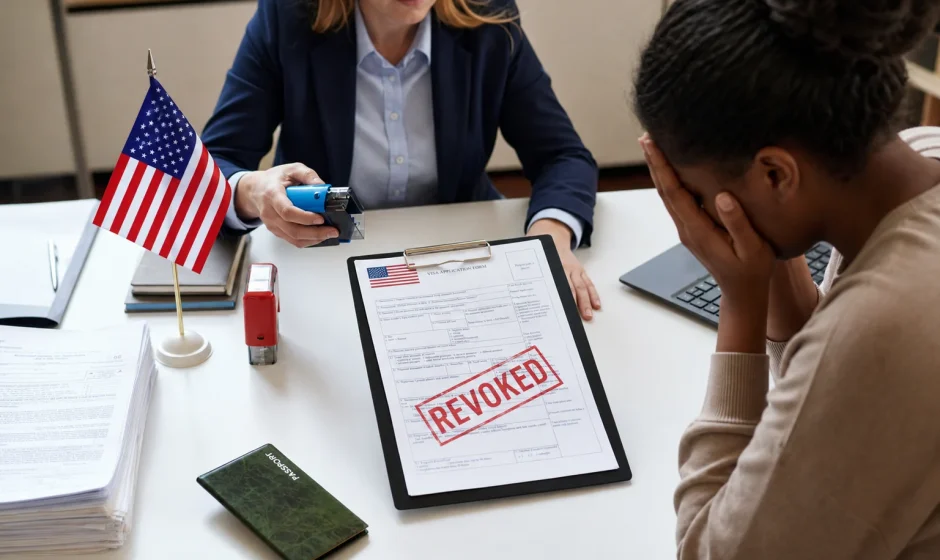

The United States is moving to revoke certain nonimmigrant visas held by foreign nationals who entered or sought entry as temporary visitors and subsequently applied for asylum in the United States.
The developing policy is particularly relevant to holders of B-1 and B-2 visitor visas, the categories commonly used for temporary business and tourism travel. The U.S. Department of State has publicly said that it is coordinating with the Department of Homeland Security to identify nonimmigrant visa holders who entered the United States as short-term visitors and later filed asylum claims to remain in the country.
For Ghanaians, the most important point is that this is not a general cancellation of U.S. visitor visas held by Ghanaian citizens. A Ghanaian with a valid B-1/B-2 visa who travels temporarily to the United States and follows the conditions of that visa is not automatically affected simply because this new enforcement effort exists.
The policy instead raises serious questions for people who obtained temporary visitor visas and subsequently sought asylum in the United States.
It is also important to separate confirmed government policy from figures circulating in news reports. Reports have suggested that the number of potentially affected visas could reach approximately 200,000. As of August 25, 2026, however, GhanaCitizenship.com has not located a publicly released State Department or Department of Homeland Security document confirming that exact number.
This article therefore focuses on what can be established from U.S. government sources, federal immigration law and official U.S. immigration guidance.
Table of Contents
- What Is Happening With U.S. Visitor Visas?
- What Are B-1 and B-2 Visas?
- Why Asylum Applications Matter
- Can the United States Revoke an Existing Visa?
- Does Visa Revocation Mean Deportation?
- What Happens to a Pending Asylum Case?
- What This Means for Ghanaians
- Could It Affect Future U.S. Travel?
- What About the Reported 200,000 Visas?
- The Broader U.S. Immigration Crackdown
- What Travelers Should Do
- Official Sources
What Is Happening With U.S. Visitor Visas?
The U.S. Department of State has confirmed that it is working with the Department of Homeland Security to identify certain foreign nationals who entered the United States as temporary visitors and subsequently filed applications for asylum.
The government’s position is based on the distinction between temporary travel and an attempt to remain permanently or for an indefinite period.
B-1 and B-2 visas are nonimmigrant visas. They are generally issued to people seeking temporary admission for purposes such as business, tourism, visiting family or obtaining medical treatment.
An asylum application is fundamentally different. It is a request for protection based on a person’s claim that returning to his or her country would expose that person to qualifying persecution or a well-founded fear of persecution.
That difference is at the center of the new enforcement action.
What Are B-1 and B-2 Visas?
The U.S. Department of State classifies B visas as temporary visitor visas.
| Visa | Primary Purpose | General Character |
|---|---|---|
| B-1 | Temporary business travel | Nonimmigrant |
| B-2 | Tourism, vacations, family visits and certain medical treatment | Nonimmigrant |
| B-1/B-2 | Combined business and tourism visitor visa | Nonimmigrant |
Receiving one of these visas does not guarantee admission into the United States.
A visa generally permits the traveler to travel to a U.S. port of entry and request admission. U.S. Customs and Border Protection makes the admission decision at the border or port of entry.
That distinction is important. A visa and immigration status inside the United States are related concepts, but they are not the same thing.
Why Does Applying for Asylum Matter?
U.S. asylum law exists to protect people who meet specific legal requirements.
Official U.S. government guidance explains that a foreign national who is physically present in the United States may seek asylum regardless of immigration status, subject to the applicable eligibility requirements.
In general, asylum is available to someone who can establish persecution or a well-founded fear of persecution connected to a protected ground under U.S. law.
Those grounds include race, religion, nationality, political opinion and membership in a particular social group.
This creates an important distinction in the current debate.
A person can legally become eligible to seek asylum after entering the United States. The fact that someone arrived on a visitor visa does not, by itself, eliminate the legal ability to seek asylum.
At the same time, the State Department is responsible for determining whether someone remains eligible to hold a nonimmigrant visa.
The administration’s position is that a temporary visitor visa should not function as a route for someone whose actual intention is to enter the United States and remain through the asylum system.
Those two principles can exist at the same time: a person may have a legal right to seek asylum while the State Department separately considers whether the person’s existing visitor visa should remain valid.
Can the United States Revoke an Existing Visa?
Yes.
The authority to revoke visas is not something created specifically for this policy.
Section 221(i) of the Immigration and Nationality Act provides statutory authority for visa revocation. The law authorizes the Secretary of State and, in specified circumstances, consular officers to revoke a visa or other documentation.
The statutory language is significant because the authority applies after a visa has already been issued.
Visa revocation has therefore existed as part of U.S. immigration law long before the current enforcement initiative.
The State Department has historically used revocation when information becomes available after issuance that raises questions about the visa holder’s eligibility.
That means a visa that was valid when placed in someone’s passport should not automatically be assumed to remain valid until its printed expiration date.
A later government determination can change its validity.
Does Visa Revocation Mean Immediate Deportation?
Not necessarily.
This is one of the most important distinctions for readers to understand.
A visa primarily concerns a foreign national’s ability to travel to a U.S. port of entry and seek admission in the visa classification shown on the document.
Someone already physically present in the United States can have additional immigration issues involving admission, authorized stay, immigration status, asylum proceedings, employment authorization or removal proceedings.
Revoking a person’s B-1/B-2 visa therefore does not automatically answer every question about that person’s legal position inside the United States.
For example, USCIS recognizes asylum applications filed by people who are physically present in the United States, and asylum cases can also be considered defensively during removal proceedings before an immigration judge.
The outcome will depend on the individual’s circumstances.
A person should therefore not interpret “visa revoked” and “ordered deported” as interchangeable phrases. They are not.
What Happens to a Pending Asylum Application?
The existence of a pending asylum application introduces another important distinction.
USCIS recognizes pending asylum cases as a specific immigration circumstance, including for purposes of certain applications for employment authorization.
But filing an asylum application does not automatically create or extend ordinary nonimmigrant status.
A person might originally enter as a B-2 visitor, for example, and later have an asylum application pending. The person’s original visitor status, authorized period of stay, pending asylum application and employment authorization can involve separate legal questions.
USCIS administrative decisions have expressly recognized this distinction. The pendency of an asylum application does not itself convert the applicant into another nonimmigrant status.
This is why people affected by the new visa policy should not rely on general social media explanations of what a revoked visa supposedly means for their case.
Individual immigration histories matter.
What Do the U.S. Visa Revocations Mean for Ghanaians?
For most Ghanaian holders of ordinary U.S. visitor visas, the immediate message is simple: there is no official announcement canceling B-1/B-2 visas held by Ghanaian citizens generally.
Ghana is also not among the countries listed in the State Department’s current partial suspension of B-1/B-2 visa issuance under the broader nationality-based restrictions that took effect in 2026.
The new asylum-related action is different.
It focuses on the relationship between temporary visitor visas and subsequent asylum claims.
The practical situation can be divided into several groups.
| Situation | Likely Relevance of New Policy |
|---|---|
| Ghanaian with B-1/B-2 visa who travels temporarily and returns to Ghana | No general cancellation has been announced for this group. |
| Ghanaian with valid B-1/B-2 visa who has never sought U.S. asylum | The asylum-related revocation initiative does not appear to target this person merely for holding the visa. |
| Ghanaian who entered as a visitor and subsequently filed for asylum | This is the type of situation potentially affected by the announced initiative. |
| Ghanaian with a pending asylum case who receives a revocation notice | The visa issue and asylum case must be considered separately. Legal advice may be appropriate. |
| Ghanaian who has already been granted asylum | Granted asylum is a different immigration position from merely holding a B-1/B-2 visitor visa. |
The policy should therefore not cause ordinary Ghanaian business travelers, tourists or people visiting relatives in the United States to assume that their visas have suddenly been canceled.
Anyone who actually receives a notice from the U.S. government should take that notice seriously and review the specific facts of the case.
Could an Asylum Application Affect Future U.S. Travel?
Potentially.
Nonimmigrant visa applicants generally must qualify for the visa classification they are requesting.
The State Department explains that visa applications are reviewed under standards established in U.S. immigration law and can be denied when an applicant does not qualify for the requested category or falls under a statutory ground of ineligibility.
A previous asylum application may therefore become relevant when a person later applies for another temporary visa, particularly where the government is assessing the person’s intended purpose of travel.
That does not mean every former asylum applicant is permanently prohibited from receiving a U.S. visa.
It means that immigration history matters and must be disclosed truthfully when required.
Providing false information to U.S. immigration authorities can create substantially more serious immigration consequences than simply having filed an asylum application.
Are 200,000 U.S. Visas Really Being Revoked?
This requires careful wording.
The State Department has publicly confirmed that it is coordinating with the Department of Homeland Security to identify and revoke certain nonimmigrant visas connected to people who entered as temporary visitors and later filed asylum claims.
However, as of August 25, 2026, GhanaCitizenship.com has not identified a publicly available State Department, DHS, USCIS or White House document stating that exactly 200,000 visas will be revoked.
The widely reported figure of “up to 200,000” has been attributed to internal State Department documents and U.S. officials.
That makes the figure important, but it should not yet be treated as the same thing as a published government total.
The actual number could also change as the government identifies cases and implements the policy.
Readers should therefore distinguish between these two statements:
Confirmed: The U.S. government is pursuing visa revocations involving certain temporary visitors who subsequently sought asylum.
Not yet officially established in a public government document: Exactly 200,000 visas will ultimately be revoked.
That distinction is particularly important while the policy is still developing.
This Is Part of a Much Broader U.S. Immigration Shift
The asylum-related visa action is not occurring in isolation.
During 2026, the U.S. government has implemented or announced several major immigration and visa measures.
The State Department currently maintains nationality-based visa issuance restrictions affecting citizens of multiple countries.
Effective January 1, 2026, the Department partially suspended B-1/B-2 and certain other visa issuance for nationals of 19 countries, subject to specified exceptions.
Ghana is not included among those 19 countries.
The White House has also ordered additional enforcement against “birth tourism,” including potential visa revocation and future entry restrictions for foreign nationals determined to have entered or attempted to enter the United States for that purpose.
These measures demonstrate a broader policy direction: U.S. authorities are placing greater emphasis on whether foreign nationals use visas consistently with the purpose for which those visas were issued.
Is Ghana Under a U.S. Travel Ban?
No general U.S. travel ban on Ghana is established by the current State Department nationality-based visa suspension.
The State Department’s 2026 guidance identifies countries subject to full or partial visa issuance suspensions. Ghana is not on the current list of countries subject to the partial B-1/B-2 suspension.
That distinction is worth emphasizing because several separate U.S. immigration policies are currently being discussed at the same time.
A mass review or revocation involving certain asylum applicants is not the same thing as imposing a nationality-based travel ban on Ghana.
What Should Ghanaian Travelers and Visa Holders Do?
Ordinary travelers do not need to panic, but the changing enforcement environment makes careful compliance increasingly important.
If you hold a U.S. visitor visa, use it for the purpose for which it was issued. Follow the admission period granted when entering the United States and answer questions from immigration and consular authorities truthfully.
Do not assume that the expiration date printed on a visa guarantees that the visa remains usable. Visa validity can change if the U.S. government revokes it.
If you receive an official notice stating that your visa has been revoked, do not attempt to travel based solely on the visa sticker remaining in your passport.
If you are physically present in the United States with a pending asylum application and receive a visa revocation notice, the situation is considerably more complicated. The validity of the visitor visa, the person’s immigration status or authorized stay, the asylum application and any removal proceedings can involve different parts of U.S. immigration law.
That is a situation in which individualized advice from a qualified U.S. immigration attorney may be appropriate.
What Happens Next?
The most important development to watch is formal implementation guidance from the U.S. Department of State and Department of Homeland Security.
Several questions remain unresolved publicly, including the final number of visas that will actually be revoked, how affected individuals will be notified, whether particular categories of asylum applicants will be treated differently and how quickly the review will proceed.
Any court challenges could also affect implementation.
Until additional official guidance is published, travelers should be cautious about claims that every asylum applicant, every B-1/B-2 holder or every foreign visitor is automatically subject to the same outcome.
The confirmed policy is significant, but its scope should not be exaggerated beyond what the U.S. government has actually established.
Bottom Line for Ghanaians
The United States is tightening enforcement surrounding temporary visitor visas and asylum claims, but this is not a blanket cancellation of U.S. visas held by Ghanaians.
The people most directly affected are those whose immigration histories combine temporary B-1/B-2 visitor visas with subsequent asylum applications.
The United States already has broad statutory authority to revoke visas, while U.S. law separately provides a process through which qualifying people physically present in the country can seek asylum.
Those two legal systems are now intersecting in a significant new enforcement effort.
For Ghanaian travelers who use their visitor visas normally for business, tourism, family visits or other permitted temporary purposes, there is currently no official announcement saying that their visas are being canceled because of this initiative.
GhanaCitizenship.com will update this guide if the State Department or Department of Homeland Security publishes additional implementation rules, affected-country information or official revocation totals.
Official Sources
- U.S. Department of State – Visitor Visa Information
- U.S. Department of State – Visa Denials and Ineligibilities
- U.S. Government Publishing Office – Immigration and Nationality Act, including 8 U.S.C. § 1201
- U.S. Citizenship and Immigration Services – Asylum
- USCIS – Immigration Benefits in EOIR Removal Proceedings
- U.S. Department of State – 2026 Visa Issuance Suspensions
- The White House – Executive Order on Ending Birth Tourism