

Ghana is making another attempt to move the Accra Marine Drive Project forward after years of delays. Tourism, Culture and Creative Arts Minister Abla Dzifa Gomashie said on August 10, 2026 that a new project board and steering committee are in place and that the government is engaging financial institutions and prospective investors to reopen funding channels.
The plan is ambitious. Marine Drive covers about 241 acres of prime Accra waterfront and has been valued at approximately US$1.2 billion. The vision includes hotels, restaurants, shopping areas, cultural facilities, public promenades, entertainment venues and new public spaces stretching along a major section of Accra’s coastline.
But there is an important distinction for anyone looking at the project as an investment story. Ghana has not announced that it has secured US$1.2 billion in new funding. That figure is the approximate value attached to the overall development. The latest announcement is about finding investors, structuring public-private partnerships and getting the stalled project moving again.
Table of Contents
- What changed in August 2026?
- What is the Accra Marine Drive Project?
- Why has the project taken so long?
- How the government plans to revive it
- How much is Marine Drive worth?
- Why Ghana wants a major waterfront destination
- Can foreign and diaspora investors participate?
- What investors should watch carefully
- What happens next?
What Changed With the Accra Marine Drive Project in August 2026?
The latest development came during the Government Accountability Series on August 10, when Tourism Minister Abla Dzifa Gomashie gave an update on efforts to revive Marine Drive.
According to the Minister, the government has reconstituted the project’s board and established a steering committee intended to speed up implementation. The Ministry is also talking to financial institutions and potential investors about public-private partnerships, co-financing and other ways of bringing capital into the development.
The new board has been told to focus on transparency, discipline and measurable results. The government also wants to simplify regulatory approvals and improve coordination among the agencies involved.
This follows a wider review of the project that became public earlier in 2026. In May, the Ghana News Agency reported that officials were revising major parts of the project and expected to have a clearer direction within roughly three months.
The timing of the August announcement is therefore important. It appears to mark the transition from reviewing what went wrong to trying to attract capital and restart implementation.
What Is the Accra Marine Drive Project?
Marine Drive is one of the largest proposed tourism and urban redevelopment projects in Ghana.
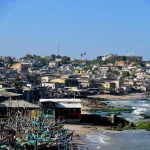
The current project covers approximately 241 acres of Accra’s coastline, extending from the Osu Castle enclave toward the Arts Centre and central Accra waterfront.
Plans reported by the Ghana News Agency include waterfront promenades, hotels, shopping centres, restaurants, cultural pavilions, recreational facilities, an aquarium and a national amphitheatre.
Other proposed cultural components include an African Heritage Walk, a National Concert Hall and the Ghana National Museum of Contemporary Arts.
The concept is much older than the current administration. Plans for a major waterfront development date back to the era of Ghana’s first President, Dr. Kwame Nkrumah. By 2015, the government was again engaging stakeholders on a Marine Drive Tourism Development Plan covering the coastline from Osu Castle toward the Arts Centre.
President Nana Addo Dankwa Akufo-Addo eventually cut the sod for the modern Marine Drive Tourism Investment Project on December 15, 2017.
Nearly nine years later, Ghana is still trying to turn that vision into a completed waterfront district.
Why Has the Accra Marine Drive Project Taken So Long?
The long history is one reason the latest announcement deserves some caution.
Marine Drive has repeatedly attracted government attention, investor interest and ambitious timelines without reaching anything close to its planned final form.
Land issues, stakeholder arrangements, financing, relocation of existing occupants, infrastructure works and coordination across numerous government institutions have all formed part of the project’s history.
Even after the 2017 sod-cutting ceremony, much of the early work focused on clearing structures, preparing the site, relocating occupants and creating the infrastructure needed before large private developments could begin.
In May 2026, GNA reported that site clearing, foundation work and construction involving roads, drainage and utility infrastructure were still taking place in parts of the development area.
The government has now created a 17-member technical committee with representatives from institutions involved in planning, land administration, utilities, finance, local government and legal matters. The committee was given an 18 to 24-month period to help resolve technical bottlenecks and accelerate implementation.
That does not mean the entire Marine Drive project will be completed within 18 to 24 months. The timeframe relates to the committee’s work and efforts to move implementation forward.
How Ghana Plans to Revive Marine Drive
The biggest change in the 2026 strategy is the emphasis on phased development and private capital.
Rather than waiting for every component of the massive development to move at the same time, the government says implementation will take place in phases.
Early attention is expected to go toward public promenades, cultural spaces and mixed-use precincts. The idea is to create visible progress that can make the wider development more attractive to prospective investors.
The Ministry is simultaneously seeking financial institutions and private investors that could participate through public-private partnerships and co-financing arrangements.
Ghana already has a statutory framework for these arrangements through the Public Private Partnership Act, 2020 (Act 1039).
Tourism Minister Gomashie has also been promoting Ghanaian tourism opportunities internationally. She said in July that the government was seeking private investment for tourism projects through structures including Build-Operate-Transfer arrangements and other PPP models.
For Marine Drive specifically, she told the Government Accountability Series that she had personally pitched the project to the business community while accompanying President John Dramani Mahama during business engagements in London.
How Much Is the Accra Marine Drive Project Worth?
The project is currently described by Ghana News Agency as being valued at approximately US$1.2 billion.
Using exchange rates around August 2026, that is approximately:
| Currency | Approximate Project Value |
|---|---|
| Ghana Cedi | GHS 14.1 billion |
| US Dollar | US$1.2 billion |
| British Pound | GBP 888 million |
| Chinese Yuan / RMB | RMB 8.1 billion |
These conversions are approximate and exchange rates change daily. At exchange rates around August 2026, US$1.2 billion was equivalent to roughly GHS 14.1 billion.
More importantly, the US$1.2 billion number should not be confused with money already sitting in a project account. Public information available as of August 10 does not show that the full financing requirement has been secured.
The government’s current effort is specifically aimed at attracting the capital needed to develop the project.
Why Ghana Wants a Major Waterfront Tourism District
Ghana’s tourism industry gives the government a reason to keep pursuing Marine Drive despite the project’s troubled history.
The Ghana Tourism Authority recorded 1,306,962 international tourist arrivals in 2025, up 1.4 percent from 1,288,804 in 2024. Domestic tourism also generated more than 1.79 million visits to 55 tracked tourist sites.
Business travel accounted for 31 percent of international arrivals, while the number of licensed tourism enterprises increased from 6,702 in 2024 to 7,109 in 2025.
Accra is already the country’s main international gateway, but much of its Atlantic coastline has not been developed into the type of continuous public waterfront district found in some major tourism cities.
Marine Drive is intended to change that by connecting hospitality, culture, recreation, retail and public space within one coastal zone.
For visitors, it could eventually create another major destination alongside places such as Independence Square, Osu Castle and other tourist attractions in Ghana.
For Ghanaian businesses, the economic opportunity would extend beyond hotels. Restaurants, event companies, transport operators, tour businesses, retail stores, entertainment companies, maintenance firms and suppliers could all benefit if the development eventually reaches the scale envisioned.
Can Foreign or Diaspora Investors Invest in Marine Drive?
The government is openly seeking private investors, but that does not mean an individual can currently go online and buy a piece of the Marine Drive Project.
As of August 10, 2026, the public announcements reviewed by GhanaCitizenship.com do not identify a retail investment product, publicly traded Marine Drive company, individual investor bond or crowdfunding programme connected to the project.
The current push appears aimed primarily at institutional investors, developers, hotel operators, infrastructure companies, financiers and other businesses capable of participating in specific components of a large PPP development.
That distinction matters for diaspora investors.
If you see someone advertising private “Marine Drive shares,” plots, guaranteed returns or unofficial investment packages, do not assume the offer is connected to the government project simply because it uses the Marine Drive name.
Prospective investors should verify opportunities through the Ministry of Tourism, Culture and Creative Arts, the relevant project authorities and Ghana’s official investment and PPP institutions before transferring money.
Foreign investors considering opportunities elsewhere in the country can also read our guide to foreign investment in Ghana.
What About the 150,000 Jobs and One Million Tourists?
Government officials have projected that a fully developed Marine Drive could create more than 150,000 direct and indirect jobs and attract more than one million tourists annually.
Those figures are targets and projections, not recorded outcomes.
They depend on the project actually being financed, constructed and occupied at something close to the scale currently envisioned.
The jobs figure is also broader than permanent jobs located inside Marine Drive. Past descriptions of the project have included employment generated during construction as well as activity across the wider tourism and commercial value chain.
For that reason, the figures are useful for understanding the government’s ambition, but they should not be treated as guaranteed economic benefits.
What Investors Should Watch Before Getting Excited
Marine Drive has obvious potential. It also has a history long enough to justify skepticism.
The most useful indicators over the next year will not be new artist impressions or another announcement that investors are interested. Watch for actual transactions.
That means signed PPP agreements, named developers, financing commitments, completed procurement processes, clearly defined project phases and visible construction on specific components.
It will also be worth watching how the government handles land, existing communities, public access to the waterfront, environmental requirements and the balance between private commercial development and public cultural space.
The new emphasis on transparency is encouraging, but investors should judge that promise by the information eventually made public.
A large coastal project can take years to develop even when financing is available. Marine Drive’s scale makes phased construction much more realistic than expecting the entire 241-acre district to appear at once.
What Happens Next for the Accra Marine Drive Project?
The immediate challenge is converting investor discussions into financing and signed development agreements.
The newly constituted board and technical committees now have to resolve outstanding administrative and regulatory problems while the Ministry continues courting private capital.
The government’s decision to prioritize promenades, cultural areas and mixed-use precincts could also give the public an early test of whether the latest revival is producing physical results.
Marine Drive has been discussed in Ghana for generations. The 2017 sod cutting was supposed to represent a major breakthrough, yet the project remained unfinished years later.
The 2026 revival should therefore be judged differently. The question is no longer whether Ghana has an impressive plan for its waterfront. It clearly does.
The question is whether the government can put together the financing, contracts, infrastructure and private-sector partners needed to finally build it.
That is what investors, Accra residents and Ghana’s tourism industry should watch next.
Sources
-
- Citi Newsroom: Government targets PPPs, new funding to revive Marine Drive project – August 10, 2026
- Ghana News Agency: Marine Drive Project Undergoing Revision – May 16, 2026
- Ghana News Agency: Marine Drive Technical Committee inaugurated to accelerate tourism investment project – April 2026
- Ghana News Agency: Tourism Ministry outlines private investment and PPP strategy – July 19, 2026
- Ghana News Agency: GTA releases 2025 Tourism Report – June 8, 2026
- Ministry of Finance: Public Private Partnership Act, 2020 (Act 1039)
- Bank of Ghana: Daily Interbank Foreign Exchange Rates
- Graphic Online: Accra Marine Drive Project engages Parliamentary Select Committee – 2023