


Related Ghana guides:
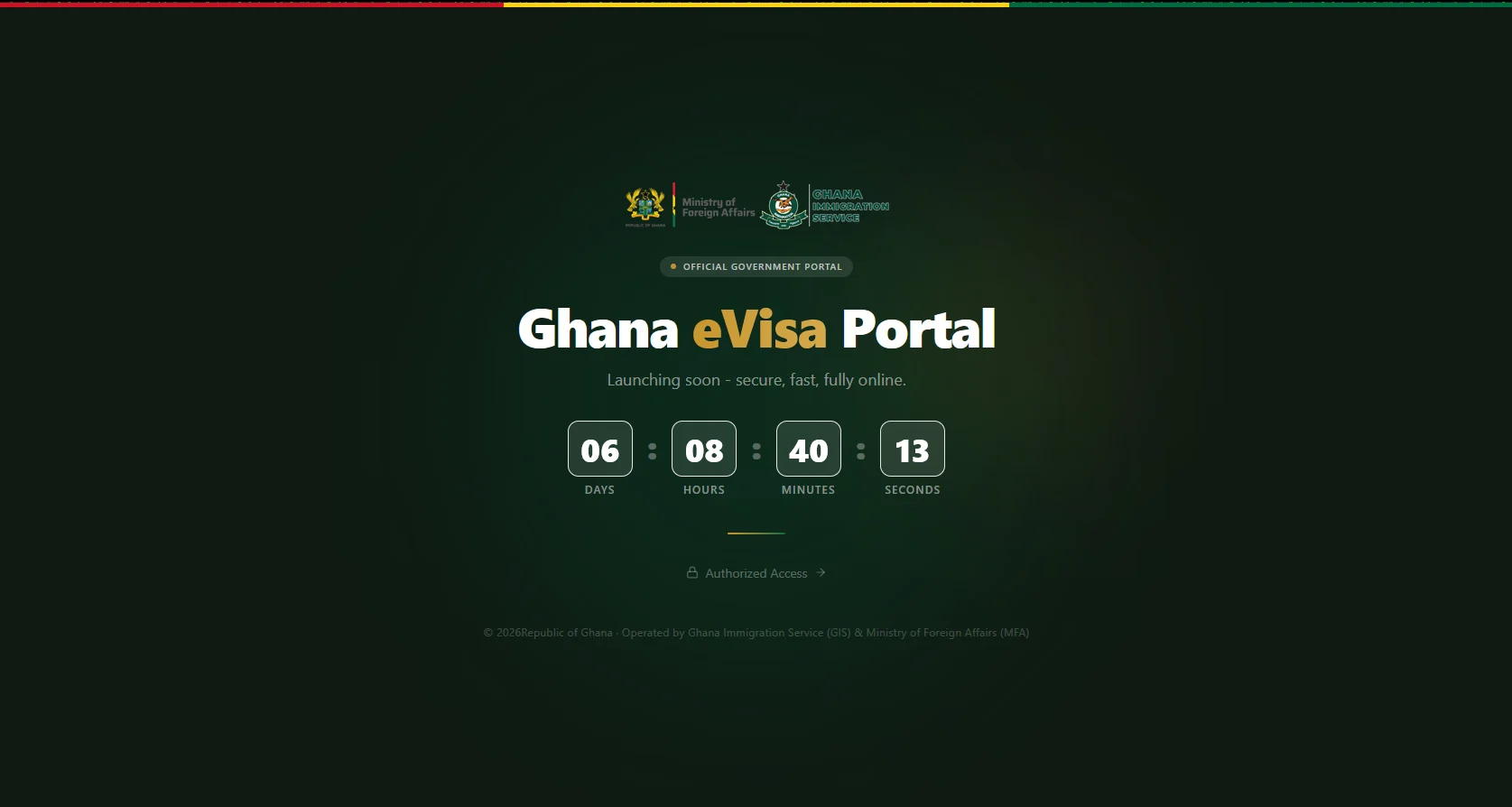
Ghana e-Visa fees 2026 are already drawing attention because Ghana’s official electronic visa portal is accessible online ahead of the expected May 25, 2026 rollout. The portal currently shows a “Launching soon” notice, so travelers should treat the system as pre-launch until public applications are fully open.
Some travelers and visa monitors appear to have seen the portal during a pre-launch access window before the site was placed behind the current “Launching soon” notice. In other words, the fee screenshots circulating online may have come from an early portal view, a temporary soft-launch window, direct internal pages that were briefly reachable, or screenshots captured before the public-facing gate was restored.
The reform itself makes sense. A digital visa system can reduce embassy visits, mailing delays, and confusion for travelers. It can also help Ghana modernize its immigration process and make travel easier for tourists, business visitors, diaspora families, students, and conference attendees.
The concern is price. VisasNews documented portal-displayed fees of $260 for a standard single-entry e-Visa, $338 for priority processing, and $442 for express processing. For multiple-entry e-Visas, the reported prices rise as high as $796. Those figures are much higher than Ghana’s current visa fees listed by the Embassy of Ghana in Washington, D.C.
Table of Contents
Is Ghana’s e-Visa System Live?
Ghana’s official e-Visa portal is accessible online, but it is not yet fully open for ordinary public applications. As of this update, the portal at evisa.immigration.gov.gh redirects to a “Launching soon” page that describes the system as secure, fast, and fully online.
The portal identifies itself as an official government portal operated by the Ghana Immigration Service and the Ministry of Foreign Affairs. That supports the legitimacy of the site, but travelers should not assume they can complete a full application until the public launch is active.
The safest wording is this: Ghana’s official e-Visa portal is online ahead of launch, but the public application system should be treated as pending until the May 25, 2026 rollout is fully in effect.
Ghana e-Visa Fees 2026: Reported Portal Prices
The most important reported number is the $260 standard single-entry e-Visa fee. As of this update, that figure should be attributed to the Ghana e-Visa portal pricing documented by VisasNews, not to the general Ghana Immigration Service fees-and-charges page.
VisasNews reported that the portal displayed the following prices ahead of the May 25, 2026 rollout. These should be monitored again once the system is fully open to confirm whether Ghana keeps the same pricing.
| Visa Type | Processing Speed | Reported Fee | Verification Status |
|---|---|---|---|
| Single-entry e-Visa | Standard processing, reported as 72 hours | $260 | Reported from portal pricing documented by VisasNews ahead of launch |
| Single-entry e-Visa | Priority processing, reported as 48 hours | $338 | Reported from portal pricing documented by VisasNews ahead of launch |
| Single-entry e-Visa | Express processing, reported as 5 hours | $442 | Reported from portal pricing documented by VisasNews ahead of launch |
| Multiple-entry e-Visa | Standard processing, reported as 72 hours | $468 | Reported from portal pricing documented by VisasNews ahead of launch |
| Multiple-entry e-Visa | Priority processing, reported as 48 hours | $608 | Reported from portal pricing documented by VisasNews ahead of launch |
| Multiple-entry e-Visa | Express processing, reported as 5 hours | $796 | Reported from portal pricing documented by VisasNews ahead of launch |
The prices matter because Ghana is trying to make travel easier. A faster online system is useful, but a high fee can still discourage some visitors, especially people planning short trips, family visits, student travel, transit stops, or budget tourism.
How Ghana’s e-Visa Fees Compare to Embassy Visa Fees
The fee debate becomes clearer when the reported e-Visa prices are compared with the visa fees listed by the Embassy of Ghana in Washington, D.C. The embassy currently lists a standard single-entry visa at $100 and an expedited single-entry visa at $140. It also lists a standard multiple-entry visa at $180 and an expedited multiple-entry visa at $250.
| Visa Type | Embassy Fee in Washington, D.C. | Reported e-Visa Fee | Difference |
|---|---|---|---|
| Single-entry visa, standard | $100 | $260 | Reported e-Visa is $160 higher |
| Single-entry visa, expedited or priority | $140 | $338 priority or $442 express | Reported e-Visa is $198 to $302 higher |
| Multiple-entry visa, standard | $180 | $468 | Reported e-Visa is $288 higher |
| Multiple-entry visa, expedited or priority | $250 | $608 priority or $796 express | Reported e-Visa is $358 to $546 higher |
| Transit visa | $90 for single transit standard; $130 standard and $150 expedited for multiple transit | Final e-Visa transit pricing needs confirmation after launch | This is a key unresolved issue for short-stop travelers |
Note on transit fees: The Embassy of Ghana in Washington also lists expedited single transit at $0. This is an unusual data point and travelers planning a transit stop should confirm the current fee directly with the embassy or consulate responsible for their country before booking.
This comparison explains why some travelers are upset. If the digital system costs far more than the embassy route, people may see the e-Visa as a major fee increase rather than only a convenience upgrade.
Benefits of Ghana’s New e-Visa System
The key issue is not whether Ghana should modernize its visa process. A digital visa portal is a useful reform. The question is whether the displayed pricing supports Ghana’s tourism, business, and diaspora goals.
1. Easier applications for travelers far from an embassy
For travelers who live far from a Ghanaian embassy or consulate, an online application system is a major improvement. It can reduce the need to mail passports, schedule appointments, or rely on third-party visa handlers.
2. Faster processing options
The reported portal structure includes standard, priority, and express processing. If the five-hour express option works as advertised, it could help business travelers, conference attendees, emergency travelers, and people who discover late that they need entry authorization.
3. Digital delivery by email
The planned system is designed to let travelers receive the approved e-Visa by email and present it either digitally or printed at a Ghana port of entry. That could reduce delays caused by mailing documents or waiting for a visa sticker.
4. Application tracking
A tracking feature matters because one of the most stressful parts of visa processing is not knowing whether an application is pending, approved, rejected, or delayed because of missing documents.
5. Better screening before arrival
A centralized digital system can help immigration officials review applicants before they travel. That gives Ghana more control over eligibility screening while still making the process easier for legitimate travelers.
6. Better tourism infrastructure if pricing is reasonable
A reliable e-Visa portal can help Ghana market itself as a tourism and business destination. Travelers increasingly expect online entry systems. Ghana benefits if the process becomes faster, clearer, and more predictable.
Problems and Complaints About Ghana’s New e-Visa System
The main complaint is simple: the reported prices are high. A digital system can make travel easier, but the benefit is weaker if the fee feels too expensive for the average visitor.
1. The fees may discourage tourism
A $260 standard single-entry e-Visa could discourage people who are comparing Ghana with other destinations. This matters because Ghana attracts many types of visitors, including diaspora families, students, heritage tourists, backpackers, church groups, researchers, and short-term business travelers.
2. Transit pricing needs urgent clarification
Transit travelers usually expect lower fees because they are passing through the country, not staying for a full visit. If Ghana’s transit e-Visa pricing ends up close to tourist visa pricing, that could hurt Ghana’s ability to position itself as a convenient regional travel hub.
3. The price gap with embassy fees is hard to ignore
The Embassy of Ghana in Washington lists a standard single-entry visa at $100. A reported $260 standard e-Visa is much higher. Ghana may have operational reasons for the new pricing, but travelers will still ask what the extra cost pays for.
4. It may create a negative tourism perception
Travel decisions are not only about official policy. They are also about perception. If travelers believe Ghana is charging unusually high entry fees, some may choose another country before they ever research Ghana’s culture, history, beaches, business opportunities, or diaspora connections.
5. Fake visa websites may appear
New visa systems often attract scam websites. Travelers should use only official Ghana government websites, especially evisa.immigration.gov.gh, Ghana Immigration Service, or a Ghanaian embassy or consulate website. Third-party websites may charge extra fees or collect sensitive passport information.
6. Refund rules need to be clear
If someone pays $260, $442, or more, they need to know whether the fee is refundable if the application is denied, delayed, submitted under the wrong category, or not processed before travel.
7. Validity periods need to be clear
Travelers need to know how long each e-Visa is valid, how long they can stay in Ghana, whether validity begins on approval or arrival, and how multiple-entry validity will work.
8. The rollout may confuse travelers
Because the portal is visible before full public launch, some travelers may not know whether to use the new e-Visa portal, the embassy route, or another process. Ghana should publish a clear transition notice explaining what changes on May 25, 2026.
Free ETA for African and Caribbean Travelers
One important part of the new system is Ghana’s plan to make entry easier for African travelers. Ghana’s Presidency announced that Ghana would roll out free visa access for all Africans from May 2026.
VisasNews also reported that the portal language says ECOWAS, African Union, and Caribbean nationals qualify for a free Electronic Travel Authorisation. That detail matters because a free ETA is not necessarily the same thing as entering without any process.
In plain English, eligible travelers may not have to pay a visa fee, but they may still need to complete an online form and receive authorization before traveling. Travelers should confirm the final eligible-country list, documents required, and validity period after the system fully launches.
Gaps and Unanswered Questions Ghana Should Clarify
Before travelers can fully trust the new system, Ghana should clarify several practical issues. These details matter because the portal affects real travel plans, flight bookings, hotel reservations, and family visits.
| Question | Why It Matters |
|---|---|
| Are the reported e-Visa prices final? | The full launch is needed to confirm whether the $260 to $796 fee table remains unchanged. |
| Will embassy visa applications remain available? | Travelers need to know whether the e-Visa replaces the embassy process or exists alongside it. |
| What are the final transit visa fees? | Transit travelers need separate confirmation because short-stop travel should not be treated the same as a full visit. |
| Are children charged the same fee? | Family travel could become very expensive if every child pays the full adult e-Visa price. |
| Are fees refundable? | Refund rules matter because the reported prices are high. |
| How long is each e-Visa valid? | Travelers need to know whether the clock starts from approval, arrival, or a selected travel date. |
| Which ports of entry accept the e-Visa? | Air travelers and land-border travelers need clear instructions. |
| Will airlines accept digital approval only? | Travelers need to know whether they should print the approval or whether digital proof is enough. |
| Will payment card fees be added? | The Embassy of Ghana in Washington notes that merchant fees are added for card payments. Travelers need to know whether similar charges apply online. |
What Travelers Should Do Before Applying
If you are traveling to Ghana soon, do not rely only on social media screenshots. Check the official Ghana e-Visa portal, the Ghana Immigration Service website, and the Ghanaian embassy or consulate responsible for your country.
If you are traveling after May 25, 2026, confirm whether Ghana has published final launch rules. Save copies of your application reference number, payment receipt, approval email, passport biodata page, hotel booking, return ticket, and any official portal instructions.
If you may qualify for the free ETA, do not assume you can board a flight without completing the online process. Airlines may still require proof that your authorization has been approved before they allow you to travel.
Bottom Line
Ghana’s e-Visa system could be a strong modernization step. Online applications, digital delivery, tracking, and faster processing can make Ghana easier to visit.
The weakness is price. If the reported fee table remains unchanged after launch, Ghana’s e-Visa will cost much more than the current visa fees listed by the Embassy of Ghana in Washington, D.C. That may undercut the tourism benefits of the new system.
The balanced takeaway is this: Ghana’s e-Visa reform is useful, but the government should clarify the final prices, refund rules, transit fees, validity periods, child fees, and whether embassy applications will remain available. A digital system should make Ghana easier to visit, not simply more expensive to enter.
All money transfer services must be licensed by the Bank of Ghana.