

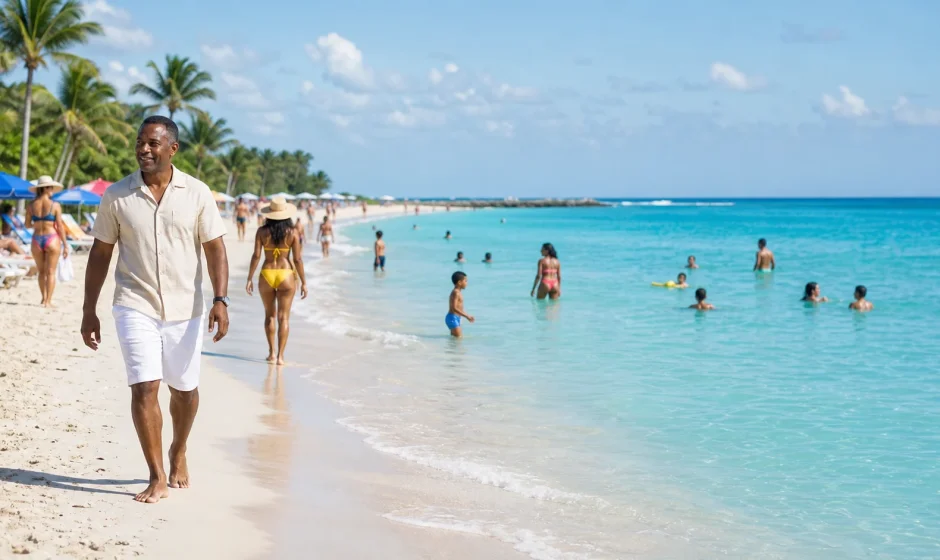

A growing number of American retirees are choosing Ghana. The country offers a lower cost of living, a stable democracy, a large English-speaking population, and a diaspora community that makes relocation feel less foreign. And unlike many countries that sound appealing on paper but come with financial complications, Ghana allows you to receive your US Social Security benefits directly from abroad.
The short answer to the most common question: yes, the Social Security Administration pays benefits to American citizens living in Ghana. Ghana is not on the list of countries where SSA payments are restricted. What changes is how you receive the money, how taxes work across two countries, and whether your monthly check actually covers a comfortable life once it hits the local economy.
This guide walks through all of it, from payment logistics and banking to the absence of a US-Ghana tax treaty, residency options, healthcare, and what $2,000 per month realistically looks like on the ground in Accra versus a smaller city.
Quick links (related guides):
Table of Contents
- Can You Collect Social Security While Living in Ghana?
- How Much Is the Average Payment, and What Does It Buy?
- How to Receive Your Payments in Ghana
- Tax Rules for American Retirees in Ghana
- Visa and Residency: How to Stay Long-Term
- Healthcare on a Fixed Income
- Practical Steps to Set Up Your Retirement
- Special Cases and Things That Often Go Wrong
Can You Collect Social Security While Living in Ghana?
The Social Security Administration maintains a list of countries where it cannot send benefit payments. Ghana is not on that list. US citizens living in Ghana are fully eligible to receive their Social Security retirement, disability, and survivor benefits just as they would from a US address. Ghana is also listed on the SSA’s International Direct Deposit roster (Country List 6), which means the SSA’s payment infrastructure officially supports direct deposit to Ghanaian banks.
The SSA reviews a recipient’s eligibility to receive payments abroad based on citizenship status and country of residence. American citizens face no restrictions when living in Ghana. Non-citizen US permanent residents may face different rules depending on their immigration history and the country where they reside, so they should contact the SSA directly to confirm their individual situation before relocating.
One practical note: the SSA requires that recipients living abroad keep their address and banking details current. The relevant SSA office for Americans in Ghana is not located at the US Embassy in Accra – it is the Federal Benefits Unit (FBU) based in London, which covers Ghana and several other West African countries. You can reach the FBU for Ghana through the SSA’s international directory at ssa.gov/foreign/foreign.htm.
The SSA also periodically mails foreign enforcement questionnaires to overseas beneficiaries to verify continued eligibility. The standard form sent to direct beneficiaries is SSA-7162 (the SSA-7161 version applies to representative payees who manage benefits on behalf of someone else). Not everyone receives this every year, but if one is sent to you, respond by the deadline. Failing to return a required questionnaire can result in suspended payments.
How Much Is the Average Payment, and What Does It Buy?
Social Security benefits increased by 2.8% in January 2026, according to the Social Security Administration. The SSA originally estimated that the average retired-worker benefit would be about $2,071 per month in January 2026. The more current SSA Monthly Statistical Snapshot for April 2026 shows the average retired-worker benefit at approximately $2,081.16 per month. Individual benefit amounts vary based on lifetime earnings, years worked, and the age at which the person claimed benefits.
For 2026, the SSA lists the maximum monthly Social Security benefit for a worker retiring at full retirement age as $4,152. Workers who delay claiming until age 70 can receive a higher maximum benefit, but only if they had maximum taxable earnings for enough qualifying years. Most retirees receive far less than the maximum, so the average retired-worker figure is the more realistic planning number for most Americans considering retirement in Ghana.
Using Bank of Ghana interbank rates from May 15, 2026, $2,000 was approximately GH₵22,825. These are planning conversions only. Exchange rates can move quickly, and the actual amount received may differ after bank spreads, ATM fees, wire fees, or card conversion charges. Always check the Bank of Ghana daily interbank exchange rates before making financial decisions.
The main takeaway is simple: Ghana can still be less expensive than many parts of the United States, but Accra is not cheap if you want furnished housing, reliable utilities, private healthcare access, good internet, imported groceries, rideshare or private transportation, and an emergency cushion. Older cost-of-living estimates often understate how expensive Accra has become for foreigners and returning diaspora retirees.
Current rental data shows why retirees should budget carefully. Meqasa lists furnished apartments in Accra with an average asking price above GH₵44,000 per month, although that figure is heavily influenced by luxury listings. Expatistan lists an 85 m2 furnished apartment in a normal Accra area at about GH₵8,393 per month and a similar apartment in an expensive area at about GH₵14,256 per month. Ghana Property Centre lists furnished apartments in East Legon at an average of about GH₵10,000 per month, with listed prices ranging from GH₵6,500 to GH₵18,000 per month. In other words, a retiree can still find cheaper housing, but comfortable furnished housing in popular Accra neighborhoods is often far above the older $400 to $900 estimate.
Here is a more conservative planning range for an American retiree. These are not official government price figures. They are practical estimates for retirees who want a comfortable, reliable lifestyle rather than the lowest possible local budget (These figures are for those who want to maintain a western lifestyle. There are much cheaper options outside of Accra).
| Expense Category | Accra Comfortable Range | Smaller City Comfortable Range |
|---|---|---|
| Rent (furnished apartment or small house) | $900 – $2,500/month | $500 – $1,200/month |
| Groceries, household basics, and some imported goods | $500 – $1,000/month | $350 – $700/month |
| Utilities, internet, phone, water, and backup power | $200 – $500/month | $150 – $350/month |
| Transportation, rideshare, fuel, driver, or car costs | $250 – $700/month | $150 – $400/month |
| Private health insurance and medical reserve | $250 – $700/month | $250 – $700/month |
| Household help, repairs, clothing, entertainment, and emergencies | $400 – $900/month | $250 – $650/month |
| Estimated monthly total | $2,500 – $6,300 | $1,650 – $4,000 |
For Accra, a retiree may be able to live below this range by choosing a smaller apartment, living outside the most expensive neighborhoods, avoiding imported goods, using local transport, and paying cash for routine healthcare. However, retirees who want East Legon, Airport Residential, Cantonments, Labone, Osu, Ringway, Roman Ridge, or similar areas should not assume that $2,000 per month will provide a comfortable margin. In those neighborhoods, rent alone can consume a large share of the average Social Security check.
For smaller cities such as Kumasi, Cape Coast, Takoradi, Sunyani, Ho, or Koforidua, the same Social Security payment generally stretches further. The tradeoff is convenience. Smaller cities may have lower housing costs and a calmer pace of life, but they may also offer fewer private hospitals, fewer international-style apartments, fewer imported grocery options, and fewer services geared toward foreign retirees.
The practical takeaway: the average retired-worker Social Security benefit of about $2,081 per month may support a modest retirement in Ghana, especially outside Accra. But for a comfortable Accra retirement with furnished housing, private healthcare planning, reliable utilities, transportation, and an emergency cushion, retirees should think closer to $3,000 to $5,000 per month. A single retiree living carefully outside Accra may be able to manage on less, but a retiree who wants a lifestyle similar to a middle-class American standard should not build the plan around Social Security alone.
How to Receive Your Payments in Ghana
The SSA strongly prefers direct deposit for overseas recipients. For Ghana, this typically means one of two setups:
Option 1 – US bank account with international ATM access. Many American retirees keep their US bank account active, receive their Social Security deposit there, and withdraw funds in Ghana using international debit cards or wire transfers. This keeps things simple on the SSA side. The downsides are ATM fees, potentially unfavorable exchange rates at the point of withdrawal, and the logistical need to maintain a US address or a trusted contact stateside.
Option 2 – Direct deposit to a Ghanaian bank account. Ghana is included on the SSA’s International Direct Deposit list (Country List 6, published at ssa.gov/international/countrylist6.htm), which means the SSA officially supports sending payments directly to Ghanaian banks. Confirm your specific bank’s routing and SWIFT details with both the SSA’s FBU for Ghana (served from London) and your Ghanaian bank before setting this up, since individual bank compatibility varies.
Whichever route you use, opening a Ghanaian bank account before you arrive gives you flexibility and avoids the cash-dependent situation many new arrivals find themselves in. Ghana’s major commercial banks – GCB Bank, Absa Ghana, Ecobank, and Stanbic – all have experience handling foreign remittances and expatriate accounts.
Tax Rules for American Retirees in Ghana
Taxation is where most retirees need to pay close attention, because two tax systems are involved and there is no treaty to simplify the overlap.
What the US Taxes
The IRS taxes US citizens on worldwide income regardless of where they live. Social Security benefits are included in that obligation. Whether your benefits are taxable – and how much – depends on your combined income, which the IRS defines as your adjusted gross income, plus any nontaxable interest, plus half of your Social Security benefits.
For single filers in 2026: if combined income stays below $25,000, your Social Security benefits are not taxable at the federal level. Between $25,000 and $34,000, up to 50% of your benefits may become taxable income. Above $34,000, up to 85% of benefits can be included in taxable income. For married couples filing jointly, those thresholds are $32,000 and $44,000. These figures have not been adjusted for inflation since the early 1990s, which means more retirees hit the taxable range every year as benefits increase with COLA adjustments.
It is worth repeating what “85% taxable” means: not an 85% tax rate, but that up to 85 cents of every benefit dollar gets added to your ordinary income, which is then taxed at your normal bracket – which might be 10%, 12%, or 22%. The IRS Publication 915 worksheet walks through the exact calculation.
What Ghana Taxes – and Why There Is No Treaty to Help
The United States does not have an income tax treaty with Ghana. The IRS maintains a public A-to-Z list of US income tax treaties, and Ghana does not appear on it. This is an important practical reality for American retirees in Ghana, because it means there is no formal agreement allocating taxing rights on various income categories between the two governments.
Ghana taxes residents on worldwide income under the Income Tax Act, 2015 (Act 896). If you live in Ghana for more than 183 days in a calendar year, you are considered a tax resident for that year. In principle, that could bring your Social Security income within Ghana’s tax net.
Because Ghana taxes resident persons on worldwide income and the United States has no income tax treaty with Ghana, retirees should not assume U.S. Social Security benefits are automatically exempt from Ghanaian tax. The treatment of U.S. Social Security benefits in Ghana should be confirmed with a qualified Ghana tax professional before relocating.
Without a treaty, American retirees in Ghana usually need to understand the Foreign Tax Credit (FTC), which may offset some U.S. tax when foreign tax has been paid. The Foreign Earned Income Exclusion (FEIE) is less relevant for Social Security because Social Security benefits are not foreign earned income. FEIE may matter only if the retiree also has qualifying earned income from work performed abroad.
Also relevant for Americans with foreign bank accounts: FBAR reporting is required if your combined foreign account balances exceed $10,000 at any point during the year. See our guide on taxes for Americans living in Ghana for a broader breakdown of obligations including FBAR and FATCA.
The cross-border tax picture for US retirees in Ghana is genuinely complex. A qualified tax professional with hands-on US expatriate and Ghanaian tax experience is not optional here – it is the difference between a clean filing and an expensive mistake.
Visa and Residency: How to Stay in Ghana Long-Term
You cannot retire in Ghana on a tourist visa indefinitely. U.S. passport holders generally need a visa to enter Ghana, and tourist visas are designed for temporary visits, not permanent relocation. Once in Ghana, visitors receive a permitted stay period, but long-term residence requires the appropriate residence permit or immigration status through the Ghana Immigration Service.
For long-term residency, retirees have a few realistic paths:
Residence permit. Ghana’s Immigration Service issues residence permits to eligible foreign nationals, including retirees. The process involves an application to the Ghana Immigration Service, supporting documentation, and fees. Permits are typically valid for one to two years and are renewable. Demonstrating sufficient income to support yourself without taking Ghanaian employment is part of the assessment.
Right of Abode. Persons of African descent who qualify under Ghana’s diaspora programs can apply for the Right of Abode, which grants long-term residency rights similar to permanent resident status. This path requires proving African heritage and meeting eligibility criteria set by the Ministry of Interior. The documentation process is strict and not automatic.
Ghana citizenship. Retirees who plan to stay permanently may eventually pursue citizenship by naturalization, which requires at least five continuous years of legal residence, among other conditions. Dual citizenship between the US and Ghana is legally permitted on Ghana’s side, and the US also allows it, though renouncing nothing means remaining subject to US tax obligations for life.
For a detailed look at the options, including what documentation the Ghana Immigration Service requires and the timelines involved, see our guide on retirement options for foreign nationals in Ghana.
Healthcare on a Fixed Income
Healthcare is one area where retirees should plan carefully rather than assume Ghana’s lower cost of living covers the gap. Medicare does not cover care received outside the United States. If you are 65 or older and living in Ghana, your Medicare coverage does not follow you there.
A note on Medigap: some Medigap supplement plans (specifically plans C, D, F, G, M, and N) do include a foreign travel emergency benefit, covering 80% of eligible emergency care abroad after a $250 annual deductible, up to a $50,000 lifetime limit. However, this benefit only applies during the first 60 days of a trip. It is designed for travelers, not for people living permanently abroad. If you are relocating to Ghana for retirement rather than visiting, you cannot rely on Medigap’s foreign travel benefit as your primary healthcare coverage after those initial 60 days. Check directly with your Medigap insurer about how they define “travel” versus “residence” before assuming coverage applies.
What Ghana does offer:
National Health Insurance Scheme (NHIS). Foreign nationals legally resident in Ghana may be able to register with the NHIS, which covers basic outpatient and inpatient services at accredited facilities. The annual registration fee is modest. However, coverage has gaps – specialist consultations, dental, vision, and many prescription drugs are often not covered or are only partially reimbursed. For routine primary care in government hospitals and clinics, the NHIS is genuinely useful as a baseline. Eligibility for foreign residents can depend on visa type and length of stay, so check directly with the National Health Insurance Authority before assuming coverage.
Private hospitals and clinics. Accra has a growing private healthcare sector capable of handling a wide range of conditions. Facilities such as Nyaho Medical Centre and Trust Hospital serve the expatriate community and handle more complex cases. 37 Military Hospital is a major Accra facility that handles a broad patient population, including foreigners. Costs at private facilities are paid out of pocket or through private insurance.
Private health insurance. For many permanent Ghana residents who are also Medicare beneficiaries, private health insurance is a practical necessity rather than a luxury. An international or Ghana-based private health insurance plan can help cover hospitalizations, emergencies, and specialist care. Premiums for a retiree in the 65-75 age range typically run $100 to $250 per month depending on coverage level and insurer. Our guide on medical insurance for Ghana expats covers the main options.
For conditions requiring advanced care, Accra’s top private hospitals can handle many situations, but some retirees also maintain a plan that includes medical evacuation coverage to a regional hub like Johannesburg or to Europe. That is a personal risk calculation that depends on age, existing conditions, and comfort with local care.
Practical Steps to Set Up Your Retirement in Ghana
Here is the sequence that most American retirees find workable:
1. Notify the SSA of your move. Contact the SSA before you leave or shortly after arriving. For Americans living in Ghana, the relevant office is the Federal Benefits Unit (FBU) that serves Ghana, based in London. You can also call the SSA’s international number at +1-410-965-0160 (Monday through Friday, 9 AM to 4 PM Eastern US time). Note that this is not a toll-free number from outside the US – international calling rates apply. The SSA’s domestic toll-free number (1-800-772-1213) does not function from abroad.
2. Decide on your payment setup. Determine whether you are keeping a US bank account active or routing payments to a Ghanaian account. Ghana is on the SSA’s International Direct Deposit list, so both options are formally supported. Set up the banking infrastructure before your first Ghana-based payment is due. Do not let your SSA payment go to a closed or inaccessible account.
3. Consult a cross-border tax professional. Before you move, get a clear picture of your US tax obligations on Social Security income, any Ghanaian tax exposure, your FTC and FEIE options, and your FBAR filing requirements. Remember: the US and Ghana have no income tax treaty, which makes professional guidance more important, not less. Doing this after the fact is more expensive and more complicated.
4. Secure your residency status. Apply for the appropriate visa or residence permit through the Ghana Immigration Service before your tourist allowance expires. Do not overstay. Ghana does enforce overstay penalties.
5. Get health insurance in place. Confirm your coverage before you arrive. Do not assume Medicare or Medigap will cover routine care in Ghana – they will not.
6. Establish local contacts and systems. Know which hospital you would go to in an emergency, have a local phone number and SIM, and have a local bank account that works for day-to-day transactions. The practical friction of daily life in Ghana is manageable, but it requires setup time and patience in the early months.
Special Cases and Things That Often Go Wrong
If you have other income in addition to Social Security. Rental income from a US property, pension income, or investment withdrawals all count toward your combined income for IRS purposes and can push a larger portion of your Social Security benefits into the taxable range. The more income streams you have, the more important it is to map out your tax picture before the move, not after.
If your spouse is not a US citizen. A non-US-citizen spouse may not be eligible for SSA spousal or survivor benefits under the same rules as a US citizen spouse. The SSA has specific country-by-country rules for non-citizen beneficiaries. Verify your spouse’s eligibility directly with the SSA before relying on those benefits as part of your retirement budget.
If the SSA suspends your payments. The SSA can suspend benefits if you fail to return a required questionnaire, if it cannot verify your address or status, or if there is a question about eligibility. If this happens, contact the FBU serving Ghana (based in London) immediately through the SSA’s international directory. Do not wait passively – the process moves slowly if you are not actively following up.
If you want to work in Ghana. Social Security retirement benefits do not prevent you from working once you have reached full retirement age. However, working in Ghana requires the appropriate work authorization. You cannot use a tourist visa or standard residence permit to take formal employment. If you plan to consult, freelance, or operate a small business in Ghana, get proper legal advice on both the Ghanaian work authorization side and any potential impact on your US filing status and self-employment tax obligations.
If you decide to return to the US. Your SSA payments will continue uninterrupted. Update your address with the SSA and shift payment routing back to a US account. There is no penalty for time spent living abroad, and your benefit amount does not change based on where you resided.
Sources
- Social Security Administration – Payments Abroad Screening Tool: ssa.gov/international/payments_outsideUS.html
- Social Security Administration – International Direct Deposit List (Country List 6): ssa.gov/international/countrylist6.htm
- Social Security Administration – 2026 COLA Announcement: ssa.gov/news/en/press/releases/2025-10-24.html
- Social Security Administration – Maximum Benefit FAQ: ssa.gov/faqs/en/questions/KA-01897.html
- Social Security Administration – Benefits Abroad (SSA Publication No. 05-10137): ssa.gov/pubs/EN-05-10137.pdf
- Social Security Administration – International Office Phone Numbers: ssa.gov/foreign/phones.html
- Social Security Administration – Service Around the World: ssa.gov/foreign/foreign.htm
- Internal Revenue Service – US Income Tax Treaties A-Z (Ghana not listed): irs.gov/businesses/international-businesses/united-states-income-tax-treaties-a-to-z
- Internal Revenue Service – Taxation of Social Security Benefits (Topic 423): irs.gov/taxtopics/tc423
- Ghana Revenue Authority – Income Tax Act, 2015 (Act 896): gra.gov.gh
- Bank of Ghana – Interbank Exchange Rates: bog.gov.gh – Daily Interbank FX Rates
- Ghana Immigration Service – Residence Permits: ghanaimmigration.org
- US Embassy Accra – Social Security Information: gh.usembassy.gov/services/social-security/
- National Health Insurance Authority – Registration: nhia.gov.gh
- Medicare.gov – Coverage Outside the United States: medicare.gov – Medicare Coverage Outside the United States