

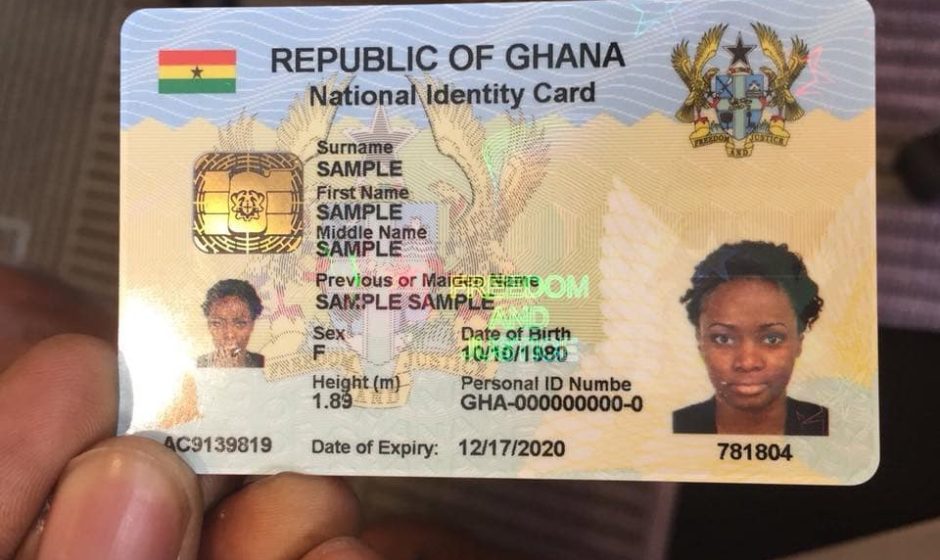

The Ghana Card is Ghana’s national biometric identity card and one of the country’s most important identity credentials.
It is used across banking, telecommunications, taxation, passports, land transactions, government services, insurance, education, pensions and many other areas where a person’s identity must be verified.
For individual taxpayers, the Ghana Card Personal Identification Number has also replaced the traditional individual Taxpayer Identification Number (TIN). The Ghana Revenue Authority states that the Ghana Card PIN is now used for individual tax-related transactions.
The Ghana Card is also central to banking, SIM registration, passport applications and many other public and private services.
This guide explains what the Ghana Card is, who qualifies, which documents are accepted, how to apply inside Ghana or abroad, the current 2026 fees, how foreign residents are registered, and common problems that can delay registration.
Table of Contents
- What Is the Ghana Card?
- Why the Ghana Card Is Important
- New 2026 Biometric Verification Rules
- Who Is Eligible for a Ghana Card?
- Documents Required for Ghana Card Registration
- How Ghana Card Vouching Works
- How to Get a Ghana Card in Ghana
- Ghana Cards for Children
- How to Get a Ghana Card Abroad
- Non-Citizen Ghana Card for Foreigners
- Ghana Card Fees in 2026
- Common Issues and Delays
- FAQs
- Sources
What Is the Ghana Card?
The Ghana Card is the national identity card issued by Ghana’s National Identification Authority (NIA).
During registration, NIA records biometric and biographical information that can include:
- Ten fingerprints.
- Iris information.
- Facial photograph.
- Signature.
- Name.
- Date of birth.
- Nationality and citizenship information.
- Residential information.
- Other information required for the National Identity Register.
Each registered person receives a unique Personal Identification Number.
For Ghanaian citizens, the card is an important official means of proving identity and citizenship.
Foreign residents registered through Ghana’s separate Foreigner Identification Management System receive a Non-Citizen Ghana Card. That card identifies the holder as a foreign resident and does not establish Ghanaian citizenship.
Why the Ghana Card Is Important
NIA states that the Ghana Card is mandatory for transactions in which an individual must establish his or her identity.
Important uses include:
- Ghanaian passport applications.
- Banking and financial services.
- SIM card registration.
- Individual tax identification and GRA transactions.
- Driver’s license applications.
- Land transactions and registration.
- Insurance services.
- Education-related identification.
- Pension and social-security transactions.
- Public and government services.
- Government benefits, approvals and permissions.
Ghana Card and Passports
The Ministry of Foreign Affairs currently lists a National ID (Ghana Card) as mandatory documentation for a new Ghanaian passport application.
Applicants must bring original documents to the Passport Application Centre for biometric processing.
Passport renewal is handled through the Ministry of Foreign Affairs passport portal. Applicants should ensure that their NIA identity records and passport information are consistent before beginning the process.
Ghana Card and Taxes
For individual taxpayers, the Ghana Card PIN has replaced the former individual TIN.
The Ghana Revenue Authority states that the Ghana Card PIN is used for:
- GRA transactions.
- Individual tax filing.
- Registering businesses where the individual’s identification is required.
- Vehicle registration.
- Passport applications.
- Land registration.
- Customs transactions.
- Driver’s license applications.
Companies and other legal entities continue to use organizational TINs.
New 2026 Ghana Card Biometric Verification Rules
One of the largest Ghana Card changes in years took effect on June 9, 2026.
The National Identity Register (Amendment) Regulations, 2026 (L.I. 2523) changed how businesses and government agencies are supposed to verify Ghana Card holders.
Under the new regime:
- Visual inspection alone is no longer sufficient for Ghana Card identity verification.
- Identity verification is intended to be performed through real-time biometric checks against NIA records or an approved verification method.
- Organizations generally must not photocopy, scan or retain copies of the Ghana Card merely for identity verification, except where permitted by law.
- Where real-time biometric verification is available, NIA says there is no requirement to present the physical Ghana Card.
The change is intended to reduce identity fraud and unnecessary copying of citizens’ personal information.
Who Is Eligible for a Ghana Card?
NIA currently identifies three broad eligible groups.
Ghanaian Citizens
Ghanaian citizens aged zero and above can be registered, including Ghanaian citizens living outside the country.
This includes qualifying citizens:
- By birth.
- By registration.
- By naturalization.
- Through another citizenship status recognized under Ghanaian law.
For people commonly described as Ghanaian “by descent,” the underlying legal citizenship is usually citizenship by birth under Ghana’s statutory framework.
Ghanaians Living Abroad
Ghanaian citizens living abroad are eligible to register through NIA’s diaspora-registration program.
Overseas registration is not free, and availability depends on NIA’s operational registration locations.
Foreign Residents
Foreign nationals in Ghana use the separate Foreigner Identification Management System (FIMS).
NIA states that a foreign national who has been cumulatively resident in Ghana for at least 90 days may apply for the Non-Citizen Identity Card.
Certain diplomats, diplomatic staff, United Nations employees and qualifying dependants are exempt.
Documents Required for Ghana Card Registration
NIA currently lists the following documents as acceptable mandatory evidence for a Ghanaian citizen registering for the Ghana Card:
- Ghana Births and Deaths Registry birth certificate, or
- Valid Ghanaian passport, or
- Evidence of acquired citizenship, such as a Naturalization Certificate or Registration Certificate, or
- Oath of Identity documentation obtained through NIA’s approved vouching process.
Additional Government Documents
If available, NIA asks applicants to bring other Ghanaian government-issued records for data harmonization.
Examples include:
- SSNIT card.
- Tax Identification Number.
- Driver’s license.
- Voter ID card.
- NHIS card.
These additional documents can help reconcile identity records, but NIA specifically states that they do not determine eligibility for the Ghana Card.
Does a Ghana Birth Certificate Automatically Prove Citizenship?
A Ghanaian birth certificate is an accepted mandatory document for Ghana Card registration, but that should not be misunderstood to mean that every person born in Ghana is automatically a Ghanaian citizen.
Citizenship itself is determined under Ghana’s Constitution and Citizenship Act.
NIA can investigate or challenge an applicant’s claimed citizenship where necessary.
How Ghana Card Vouching Works if You Have No Primary Documents
The previous version of this guide said that a person without primary documents simply needs two Ghana Card holders to act as guarantors.
The actual rules are more specific.
Option 1: One Relative
If you do not possess a birth certificate, valid Ghanaian passport or citizenship documentation, one relative aged 18 or older who already has a Ghana Card may identify you under oath.
Option 2: Two Qualified Non-Relatives
If you do not have a relative who can vouch for you, two registered Ghana Card holders who know you to be Ghanaian may vouch for you.
However, those two people must fall within categories accepted by NIA, such as:
- Practicing or retired professional teachers.
- Gazetted chiefs.
- Practicing or retired judges or magistrates.
- Licensed professionals such as doctors, nurses, lawyers, accountants, engineers or architects.
- Serving or retired civil or public servants.
- Clergy.
- Imams.
- Qualifying security-service personnel.
- Current or former Members of Parliament.
- Current or former assembly or unit committee members.
The people vouching must themselves satisfy NIA’s requirements and complete the identification under oath.
How to Get a Ghana Card in Ghana
NIA operates District Offices, Regional Offices, Premium Centres and other registration locations.
The Authority also maintains an online registration and appointment portal at:
The exact route can depend on the service and registration center.
Step 1: Choose Your Registration Location
You can use an NIA District Office, eligible Regional Office, Premium Centre, or another active registration point.
NIA also opened its first 24-hour Prestige Centre in Labone, Accra in August 2026.
Step 2: Complete the Application Process
You may begin through NIA’s online application system and book an appointment where the selected service requires or supports one.
Applicants using ordinary District Office registration can also follow the registration procedure published by the local NIA office.
Step 3: Bring Original Documents
NIA’s online application guidance says applicants must present the original copies of mandatory and supporting documents during the registration interview and biometric capture.
Photocopies alone are not accepted as substitutes for the original mandatory documents.
Step 4: Interview and Identity Verification
An NIA Registration Officer reviews your documents and confirms the personal information that will be entered into the National Identity Register.
Step 5: Biometric Capture
NIA’s normal adult registration process captures:
- Ten fingerprints.
- Irises.
- Photograph.
- Signature.
Step 6: Review Your Information Carefully
NIA prints the captured information for the applicant to review before final confirmation.
Check:
- Full name.
- Date of birth.
- Sex.
- Nationality.
- Parents’ names.
- Residential information.
- Other identifying details.
If anything is wrong, tell the Registration Officer before finalizing the registration.
Step 7: Card Issuance
NIA’s current registration procedure states that the Ghana Card is printed and issued using the applicant’s biometrics.
NIA’s FAQ says people aged 15 and older can generally receive instant issuance at centers with the necessary connectivity and equipment.
Deferred issuance can occur where infrastructure, card printing, children’s registration procedures or other operational conditions require it.
Ghana Cards for Children
Under Ghana’s national identification framework, Ghanaian citizens are eligible to be registered from birth.
But legal eligibility and operational availability at every NIA office are not always the same thing.
Children Under 6
NIA states that children below age six do not have mature fingerprints suitable for the standard biometric process.
The child’s Personal Identification Number can instead be linked to the birth-certificate number, with biometric information updated when the child reaches the appropriate age.
Children Ages 6 to 14
NIA began registration of children ages 6 to 14 at its Premium Centres nationwide in September 2025.
A nationwide mass-registration program for this age group has continued during 2026.
Some regions have already moved children’s registration into routine District Office operations. For example, NIA announced that District Offices in the Volta and Oti Regions began permanent 6-to-14 registration in July 2026.
How to Get a Ghana Card Abroad
Ghanaian citizens living outside Ghana are eligible for Ghana Card registration through NIA’s diaspora program.
The process generally includes:
- Begin the registration process through NIA’s online system.
- Complete the required application information.
- Pay the applicable diaspora fee.
- Book the registration interview or biometric appointment.
- Attend the designated overseas NIA registration center in person.
- Present original citizenship documents.
- Complete biometric capture.
- Review and approve your personal information.
- Receive the Ghana Card according to the center’s issuance procedure.
Overseas registration locations are not necessarily available at every Ghanaian mission at all times.
Check NIA’s current diaspora-registration portal or the Ghanaian mission serving your country before assuming registration is available locally.
Documents for Ghanaians Abroad
NIA currently accepts:
- Original Ghana Births and Deaths Registry birth certificate, or
- Original valid Ghanaian passport, or
- Naturalization or Registration Certificate, or
- Approved Oath of Identity documentation through the vouching process.
Ghanaians abroad should also bring other Ghanaian government identity documents they possess for data harmonization.
Can Foreigners Get a Ghana Card?
Yes, but it is important to use the correct terminology.
Foreign residents are registered through the Foreigner Identification Management System (FIMS) and receive a Non-Citizen Ghana Card.
NIA says a foreign national who has been cumulatively resident in Ghana for at least 90 days may apply.
The standard requirements currently include:
- Valid passport.
- Residence permit.
- Birth certificate certified or validated by the applicant’s country’s embassy.
- Oath of Identity documentation where the vouching process applies.
Who Is Exempt From FIMS?
NIA currently exempts certain:
- Diplomats.
- Employees of diplomatic or consular missions.
- United Nations and UN-agency employees.
- Qualifying spouses and dependants of those exempt persons.
The Non-Citizen Ghana Card is commonly required during Ghanaian residence-permit, work-permit, banking and other identification processes.
Ghana Card Fees in 2026
NIA’s current 2026 approved fee schedule lists the following charges.
| Service | Official Fee | Approximate Conversion |
|---|---|---|
| First registration at District Office, below age 25 | Free | Free |
| First registration at District Office, age 25+ | GH₵30 | About US$2.65 / GBP 1.96 / RMB 17.77 |
| First registration at Premium Centre | GH₵410 | About US$36.16 / GBP 26.78 / RMB 242.92 |
| Diaspora: ECOWAS Sub-Region | Cedi equivalent of US$55 | About GBP 40.74 / RMB 369.53 |
| Diaspora: Rest of Africa | Cedi equivalent of US$75 | About GBP 55.56 / RMB 503.91 |
| Diaspora: Countries Outside Africa | Cedi equivalent of US$115 | About GBP 85.19 / RMB 772.66 |
| Card replacement at District Office | GH₵200 | About US$17.64 / GBP 13.07 / RMB 118.50 |
| Card replacement at Premium Centre | GH₵520 | About US$45.86 / GBP 33.97 / RMB 308.09 |
| Record update only at District Office | Free | Free |
| Record update with replacement at District Office | GH₵200 | About US$17.64 / GBP 13.07 / RMB 118.50 |
| Record update only at Premium Centre | GH₵165 | About US$14.55 / GBP 10.78 / RMB 97.76 |
Conversions above use Bank of Ghana September 2, 2026 interbank mid-rates and are approximate.
Non-Citizen Ghana Card Fees
| FIMS Service | Official Fee | Approximate Conversion |
|---|---|---|
| First issuance | Cedi equivalent of US$120 | About GBP 88.89 / RMB 806.27 |
| Annual renewal | Cedi equivalent of US$78 | About GBP 57.78 / RMB 524.08 |
| Replacement | Check current NIA fee page before payment | Fee should be confirmed because NIA pages currently display inconsistent replacement figures. |
| Update of records only | Free | Free |
Fees can change through new statutory instruments or NIA administrative updates.
Common Ghana Card Issues and Delays
1. Name Mismatches
A common problem occurs when the applicant’s:
- Birth certificate.
- Passport.
- School records.
- Marriage certificate.
- Tax records.
contain different names or spelling.
Resolve major inconsistencies before registration where possible.
2. Incorrect Date of Birth
Date-of-birth errors can affect:
- Passport processing.
- Banking.
- SSNIT.
- Tax records.
- SIM registration.
- Other identity-linked government services.
Check your printed NIA registration information carefully before approving it.
3. Attempting to Register Twice
NIA warns that a person should only be registered once.
If your address, name or another record changes, use NIA’s Personal Information Update Service rather than attempting a second registration.
4. Using an Expired Passport as the Only Primary Document
NIA currently specifies a valid Ghanaian passport.
If the passport has expired and you have no acceptable birth or citizenship documentation, ask NIA whether you should use the vouching process.
5. Confusing Supporting IDs With Citizenship Evidence
A driver’s license, SSNIT card, NHIS card or voter card can help NIA harmonize records, but those documents do not replace the mandatory registration evidence listed by NIA.
6. Paying an Unofficial Agent
Use only NIA-approved payment methods and registration centers.
NIA publishes its offices, fees and payment procedures on its official website.
Frequently Asked Questions
Is the Ghana Card required for a Ghanaian passport?
The Ministry of Foreign Affairs currently lists the Ghana Card as mandatory documentation for a new Ghanaian passport application.
Renewal applicants should follow the current renewal instructions on the official passport portal and ensure their NIA and passport identity records are consistent.
Is first-time Ghana Card registration free?
Not for everyone.
NIA’s current 2026 fee schedule says District Office first registration is:
- Free for applicants below age 25.
- GH₵30 for applicants age 25 or older, approximately US$2.65 / GBP 1.96 / RMB 17.77.
Premium and overseas registration cost more.
Can foreigners get a Ghana Card?
Qualifying foreign residents can obtain a Non-Citizen Ghana Card through FIMS.
NIA currently states that a foreign national cumulatively resident in Ghana for at least 90 days can apply, subject to exemptions.
Does the Non-Citizen Ghana Card make me Ghanaian?
No.
It is an identity card for foreign residents. It does not confer Ghanaian citizenship.
Can children get Ghana Cards?
Yes.
Ghanaian citizens are legally eligible for NIA registration from birth.
Operational registration differs by age and location, particularly for children under 15. Parents should check current NIA instructions before visiting a registration center.
Can I register if I do not have a birth certificate or Ghanaian passport?
Potentially yes.
NIA allows an approved Oath of Identity and vouching procedure.
One qualifying relative with a Ghana Card may vouch for an applicant. If no relative is available, two qualifying registered persons from approved categories can perform the vouching process.
Can I use an expired Ghanaian passport to register?
NIA’s current official requirements specify a valid Ghanaian passport.
Do not rely on an expired passport as your only mandatory registration document.
Can Ghanaians abroad apply?
Yes.
NIA operates a paid registration program for Ghanaians living outside Ghana.
Current first-registration fees are the cedi equivalent of US$55 within ECOWAS, US$75 elsewhere in Africa and US$115 outside Africa.
Can I travel to Ghana using my Ghana Card?
NIA states that Ghanaians living abroad who hold Ghana Cards can travel to Ghana without a visa.
However, the Ghana Card is not a universal replacement for a passport for international travel. Travelers should verify airline, transit-country and destination-document requirements before relying on the card.
Can a business photocopy my Ghana Card?
Under the 2026 biometric-verification regime, organizations generally should not photocopy, scan or retain copies of the Ghana Card merely for identity verification unless permitted by law.
Identity is now supposed to be verified through NIA’s approved biometric-verification system where applicable.
Do I always need to carry the physical Ghana Card?
Not necessarily for every identity-verification transaction.
NIA says that where real-time biometric verification is available, there is no requirement to present the physical card.
Sources
- National Identification Authority: Registration of Ghanaians in Ghana
- National Identification Authority: Registration of Ghanaians Living Abroad
- National Identification Authority: Foreigner Identification Management System and Non-Citizen Ghana Card
- National Identification Authority: 2026 Approved Fees and Charges
- National Identification Authority: Online Registration and Appointment Portal
- National Identification Authority: L.I. 2523 Mandatory Biometric Verification Rules, 2026
- Ministry of the Interior: National Identity Register (Amendment) Regulations, 2026
- Ministry of Foreign Affairs: Ghana Passport Required Documents
- Ministry of Foreign Affairs: Official Ghana Passport Portal
- Ghana Revenue Authority: Ghana Card PIN as Individual Taxpayer Identification Number
- National Communications Authority: Ghana SIM Registration and Identity Verification Process
- Electoral Commission of Ghana: Voter Registration Identification Requirements
- Bank of Ghana: September 2, 2026 Daily Interbank Foreign Exchange Rates