

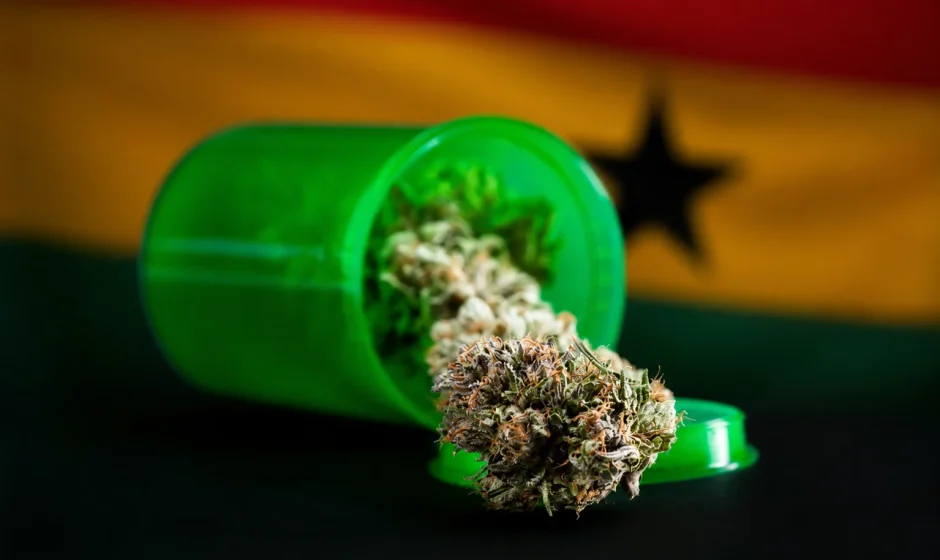

Ghana cannabis cultivation licences have officially entered a new phase after the Narcotics Control Commission granted the country’s first cultivation licences to two companies, MJ Adom Limited and Juliopta Limited. The licences allow the companies to cultivate cannabis with tetrahydrocannabinol, or THC, content of not more than 0.3 percent for medicinal and industrial purposes.
In plain English, this is not the legalisation of ordinary marijuana use. It is the start of a tightly controlled low-THC cannabis cultivation programme built around formal licensing, inspections, traceability, industrial uses, medicinal applications and possible export opportunities.
For Ghana, this is a big shift. Cannabis has long been treated mainly as a criminal enforcement issue. The new regulated model tries to separate illegal high-THC drug production from lawful low-THC industrial and medicinal use. That difference matters for farmers, investors, exporters, pharmaceutical researchers and anyone thinking about entering the sector.
What Happened?
The Narcotics Control Commission has granted Ghana’s first cannabis cultivation licences to MJ Adom Limited and Juliopta Limited. Graphic Online reported that the licences allow the two companies to cultivate cannabis with THC content not exceeding 0.3 percent for medicinal and industrial use.
The licences were not automatic. According to Graphic Online, the companies went through technical assessments, field inspections and reviews by a multi-agency technical committee before recommendations were submitted to the Minister for the Interior for approval. The licences are valid for three years, subject to compliance with regulatory requirements and renewal by NACOC.
The Director-General of NACOC, Major General Maxwell Obuba Mantey, said the licensing process was deliberately rigorous because Ghana does not want the new cannabis programme to become an open door for illegal cultivation. He also warned that licence holders could lose their licences if they exceed approved acreage, grow outside approved conditions, produce crops above the THC threshold or operate outside the terms of their authorisation.
Juliopta Limited said it plans to cultivate cannabis before expanding into seed imports and exports. MJ Adom Limited pointed to possible research and product development through collaboration with the Centre for Plant Medicine Research. That does not mean a cultivation licence automatically authorises every research or product-development activity. Research and development is a separate NACOC licence category, so any company pursuing that route would need to comply with the relevant regulatory requirements.
Key Details of Ghana Cannabis Cultivation Licences
| Issue | What Has Been Reported | Why It Matters |
|---|---|---|
| First licensed companies | MJ Adom Limited and Juliopta Limited | Graphic Online reports that these are the first two companies granted this type of cultivation licence |
| Permitted use | Cultivation of low-THC cannabis for medicinal and industrial purposes. Research and development is a separate licence category under NACOC’s broader framework. | The licences do not allow recreational cannabis sales or ordinary marijuana farming |
| THC limit | Not more than 0.3 percent THC | This separates the legal low-THC programme from illegal high-THC cannabis activity |
| Licence duration | Three years, subject to compliance and renewal | Companies must continue meeting NACOC conditions after approval |
| Approval process | Technical review, field inspections and multi-agency assessment | The sector is being treated as a controlled industry, not ordinary open farming |
| Regulator | Narcotics Control Commission | NACOC supervises licensing, monitoring and enforcement |
The Legal Framework Behind the Ghana Cannabis Cultivation Licences
Ghana’s regulated cannabis programme is based on the Narcotics Control Commission Act, 2020 (Act 1019), as amended by the Narcotics Control Commission (Amendment) Act, 2023 (Act 1100), and the Narcotics Control Commission (Cultivation and Management of Cannabis) Regulations, 2023 (L.I. 2475).
The Ministry of the Interior announced Ghana’s Cannabis Regulatory Programme in February 2026, describing it as a controlled framework for low-THC cannabis cultivation and management for medicinal and industrial purposes. The Ministry linked the programme to Act 1100 and L.I. 2475, which provide the legal foundation for regulated activities.
NACOC’s own cannabis regulations page states that Ghana’s programme permits the cultivation, processing, distribution and trade of low-THC cannabis under a licensing and monitoring system. It also makes the limits clear: recreational cannabis remains illegal, all activities require official licensing, and cannabis is restricted to low-THC varieties of 0.3 percent or less.
The official licence categories go beyond farming. NACOC lists eleven licence areas, including cultivation, breeding, processing, import, export, laboratory work, storage, transport, distribution and sale, research and development, and advertisement and promotion. That means a company may need more than one licence depending on what it wants to do in the value chain.
Who Can Apply?
NACOC’s published eligibility rules say applicants must be at least 18 years old, be a Ghanaian citizen or permanent resident, and, for corporate entities, have at least 50 percent Ghanaian ownership and a majority Ghanaian board of directors. General application requirements include property documentation, identification, financial information, police clearance, business formation documents, tax clearance, SSNIT registration, security plans, standard operating procedures and recordkeeping documentation.
This is not the kind of sector where someone simply rents land and starts planting. The rules point to a formal compliance-heavy industry, closer to controlled agriculture, regulated exports and pharmaceutical-grade supply chains than ordinary crop farming.
Why This Is Not Recreational Legalisation
The biggest public misunderstanding is the idea that Ghana has legalised weed. That is not what happened.
The legal framework applies to cannabis with THC content of 0.3 percent or less, and only for approved medicinal and industrial purposes. THC is the psychoactive compound most associated with the intoxicating effect of cannabis. Ghana’s regulated programme is designed around low-THC cannabis, not recreational marijuana.
Ghana News Agency reported in July 2026 that Interior Minister Muntaka Mohammed-Mubarak clarified before Parliament’s Assurances Committee that only industrial cannabis with THC content of 0.3 percent is permitted for cultivation, and that recreational use remains prohibited. GNA also reported that all activities require licensing through the Commission.
This distinction is not a technicality. NACOC has continued enforcement against illegal cannabis activity. In June 2026, GNA reported that NACOC disrupted a suspected cannabis and hashish oil production hub. In July 2026, GNA also reported NACOC’s warning that existing unlicensed cannabis farms remained illegal and liable to sanctions.
So the rule is simple: licensed low-THC cannabis cultivation under NACOC supervision is one thing. Unlicensed cannabis farming, recreational use, high-THC production or illegal distribution is still a criminal matter.
Business and Investment Opportunities in Ghana’s Cannabis Industry
The first licences matter because they move Ghana’s cannabis policy from paperwork to implementation. The opportunity is not just cultivation. The broader value chain includes seed development, laboratory testing, processing, storage, transport, packaging, quality assurance, pharmaceutical inputs, fibre products, industrial raw materials and exports.
For investors, the most attractive part of the programme may be the controlled nature of the market. A heavily regulated industry can be difficult to enter, but it can also reduce chaos if the rules are enforced fairly. Serious operators may prefer a system where licences, inspections, traceability and THC testing are mandatory.
For farmers, the opportunity is more complicated. Ghana’s cannabis rules are not written for casual smallholder experimentation. Applicants need land documentation, security plans, business documents, tax clearance, police clearance and compliance systems. Some farmers may participate indirectly through licensed companies, contract farming structures or supply relationships, but those arrangements will need clear approval from NACOC.
For researchers and product developers, the MJ Adom Limited reference to the Centre for Plant Medicine Research is worth watching. If Ghana can connect licensed cultivation with scientific research, plant medicine, pharmaceutical standards and export quality control, the sector could become more than a raw agricultural play. The important point is that research activity should be treated as regulated work under the relevant licence category, not as an automatic add-on to cultivation.
The export angle is also important. Juliopta Limited reportedly said it is looking at local and international markets. That does not guarantee exports will happen quickly. Export markets require strict documentation, buyer standards, laboratory testing, destination-country compliance and traceability from farm to shipment.
Risks and Compliance Issues
The biggest risk is assuming that a licence equals freedom to operate however a company wants. It does not. The licence is conditional. NACOC can inspect operations, require compliance, demand reporting and revoke licences for violations.
Companies must stay within approved acreage, approved activities and the THC limit. Graphic Online reported that NACOC officers may conduct inspections with or without prior notice, and that licence holders whose crops exceed the approved THC threshold must notify the Commission for appropriate disposal.
There is also reputational risk. A company that enters Ghana’s cannabis industry will be operating in a sector with legal, health, religious, cultural and political sensitivity. Public trust will matter. That means licence holders should avoid exaggerated health claims, unclear product marketing, informal distribution and anything that makes the programme look like disguised recreational legalisation.
There is also a farmer-risk issue. People who hear that licences have been issued may assume the market is open and start planting. That would be dangerous. Unless NACOC has issued a valid licence covering the specific activity, the cultivation remains illegal.
What to Watch Next
The next stage is implementation. Ghana needs to show that the first licences can be monitored properly and that the system can separate legal low-THC production from illegal cannabis activity.
Watch for five developments: whether additional licences are issued, whether the first licensed farms begin production without compliance problems, whether laboratory testing systems are made public, whether export buyers emerge, and whether NACOC publishes more detailed enforcement or inspection updates.
Also watch the role of the Food and Drugs Authority, Ghana Standards Authority, Ministry of Health, Ministry of the Interior and research institutions. Cannabis is not just an agriculture issue. It touches public health, export regulation, laboratory standards, law enforcement, medicine, investment and international trade.
Bottom Line
Ghana’s first cannabis cultivation licences are a milestone, but they should be understood carefully. MJ Adom Limited and Juliopta Limited are not entering a recreational marijuana market. They are entering a regulated low-THC cannabis cultivation programme for medicinal and industrial purposes.
The opportunity is real. Ghana could develop new activity in controlled agriculture, plant medicine research, laboratory testing, exports and industrial processing. But the restrictions are also real. The legal THC limit is 0.3 percent. Every activity needs the right licence. NACOC can inspect, sanction and revoke licences. Recreational cannabis remains illegal.
For investors and entrepreneurs, the safest takeaway is this: Ghana’s licensed low-THC cannabis cultivation programme has begun, but it is not a free-for-all. Anyone interested in the sector should treat it as a controlled legal business, not ordinary farming and not informal trading.
Ghana’s regulated cannabis industry is still tightly controlled, but it shows how new sectors can open when laws, licensing and investment line up. Our e-book
543 Business Ideas to Start in Ghana
covers practical business ideas across agriculture, exports, logistics, services, tourism, technology and more.
Sources
- Graphic Online: NACOC grants first licences for medicinal cannabis cultivation to two companies
- Narcotics Control Commission: Cannabis Regulations
- Ministry of the Interior: Ghana Begins Medicinal and Industrial Cannabis Cultivation
- Ghana News Agency: Farmers in Ghana can only cultivate industrial cannabis – Interior Minister
- Ghana News Agency: Eight Companies Apply to Cultivate “Weed” in Ghana
- Ghana News Agency: Government launches regulated medicinal cannabis regime
- Graphic Online: NCC opens online applications for industrial and medicinal cannabis licences
- Graphic Online: Ghana to begin issuing medicinal cannabis licences as Parliament clears final hurdle
- Ghana Business News: Ghana to start licensing for medicinal, industrial cannabis cultivation
- MyJoyOnline: NACOC to begin licensing for medicinal and industrial cannabis cultivation
- BusinessGhana: Cannabis cultivation licences open to Ghanaians aged 18 and above – NACOC