

Quick links (related guides):
Table of Contents
- What Is Galamsey in Ghana?
- Legal Small-Scale Mining vs. Galamsey: An Important Distinction
- Legal Background and History
- Why Galamsey Persists Despite Crackdowns
- Environmental and Health Impacts
- Violence, Pit Collapses, and the Security Dimension
- What This Means for Diaspora Members and Investors
- Government and Stakeholder Responses
- Reclamation: Early Signs of Progress
- Ways Forward
Galamsey in Ghana has moved beyond an environmental concern and into what Ghanaian officials, environmental groups, and citizens increasingly describe as a national emergency. Every day, illegal miners dig into riverbanks, pump mercury and cyanide into water bodies, and level forested land that communities depend on for drinking water, farming, and their livelihoods. The word “galamsey” comes from a Ghanaian slang phrase meaning “gather and sell” – a deceptively simple description for one of the most complex and damaging crises in the country today.
For diaspora members with family land in the Western or Ashanti regions, for investors evaluating agriculture opportunities, and for anyone planning to relocate to Ghana, this is not an abstract issue. It affects the safety of drinking water, the viability of farmland, and the long-term health of entire communities. This guide breaks down what galamsey is, where it came from, what the science shows about its damage, and what is – and is not – being done about it.
What Is Galamsey in Ghana?
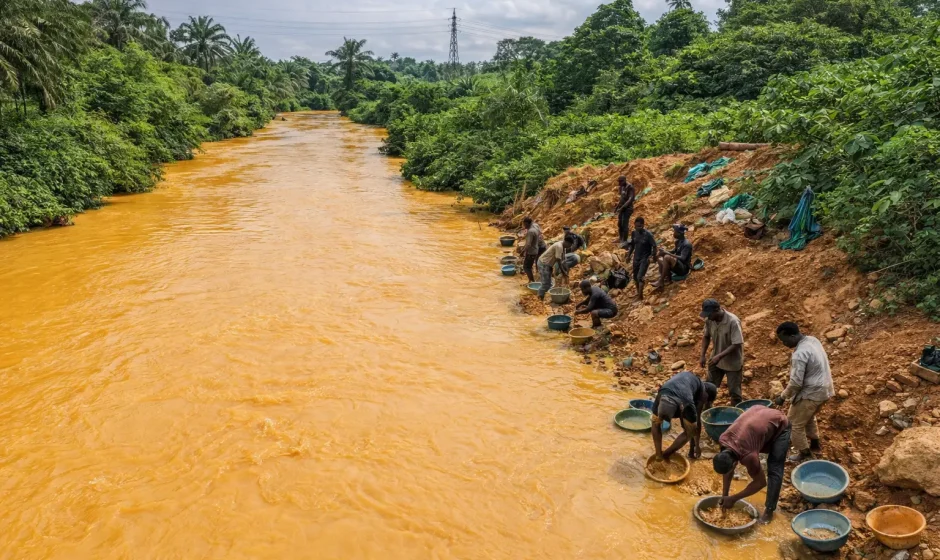
Galamsey in Ghana refers to unauthorized, small-scale gold mining that operates outside the country’s formal licensing system. Artisanal miners – often untrained and working with improvised equipment or, increasingly, industrial machinery – pan riverbeds, dig pits, and use toxic chemicals like mercury and cyanide to extract gold from ore. Those chemicals then flow into rivers and groundwater that communities rely on daily.
The scale of illegal operations is significant. A 2026 peer-reviewed study published in Elementa: Science of the Anthropocene (University of California Press) found that a large majority of Ghana’s small-scale mines operate illegally, with published estimates suggesting around 80% of small-scale operations lack valid permits. Gold dominates Ghana’s mineral export economy, with academic and industry sources indicating that it accounts for more than 90% of the country’s mineral exports, making the integrity of the sector central to the wider economy. (Springer Nature)
Foreign involvement has added complexity. The Wilson Center estimated in 2024 that thousands of Chinese nationals were linked to illegal mining networks in Ghana, with various reports over the preceding decade placing the range between 10,000 and 30,000 individuals living and operating in the country. These are historical estimates from a period of peak activity, not precise live counts, but they reflect a documented and persistent foreign presence that Ghanaian law explicitly prohibits – small-scale mining is reserved by law for Ghanaian citizens.
Legal Small-Scale Mining vs. Galamsey: An Important Distinction
Not all small-scale mining in Ghana is galamsey. This distinction matters and is often lost in media coverage. Ghana’s legal artisanal and small-scale mining (ASM) sector is a licensed, regulated industry. When properly managed, it generates livelihoods, contributes to export revenues, and operates within environmental guidelines. The Minerals Commission makes a formal distinction between licensed ASM operators and unlicensed illegal miners.
According to Ghana’s Ministry of Lands and Natural Resources, approximately 36% of gold exported in the first half of 2024 came from regulated small-scale mines – meaning legal operators working within the system. The Wilson Center also noted that Ghana’s ASM sector, including legal operators, was on track to contribute $10 billion to the country’s exports by the end of 2024.
The problem is not small-scale mining itself. The problem is the unlicensed, unregulated portion – miners operating without permits, in unauthorized zones, with no environmental controls and no accountability when damage occurs. That is what galamsey refers to. Conflating legal ASM with galamsey muddies the policy debate and does a disservice to compliant operators.
Legal Background and History of Galamsey in Ghana
Small-scale mining in Ghana has ancient roots, but its legal status has changed repeatedly. Under colonial rule, indigenous mining was largely prohibited. After independence, Ghana gradually moved toward recognizing artisanal miners. In 1989, the military government passed the Small-Scale Gold Mining Law (PNDC Law 218) – the first time Ghana formally recognized small-scale mining as a legal activity. That law was updated in 2006 by the Minerals and Mining Act (Act 703), which established licensing schemes for Ghanaian citizens in designated areas.
In theory, the framework was clear: only Ghanaian citizens could engage in artisanal mining with proper permits, in authorized zones. Article 257(6) of Ghana’s 1992 Constitution vests all minerals in the state, giving the government the legal authority to shut down unauthorized operations. In practice, licenses were difficult to obtain, enforcement was uneven, and most miners continued operating informally.
By the 2010s, rising gold prices and limited formal employment transformed galamsey from a marginal activity into a massive industry. Rivers like the Pra, Offin, Ankobra, and Birim ran visibly brown from mining waste. In April 2017, President Akufo-Addo imposed a ban on all small-scale mining and deployed a military task force – Operation Vanguard – to evict illegal miners from active sites. The ban bought time but did not solve the problem. When lifted, galamsey resumed at scale. A 2023 academic study confirmed that repeated crackdowns had not produced sustained reductions in environmental damage, with political corruption and inconsistent enforcement cited as the primary reasons.
A 2022 policy decision significantly worsened conditions. Legislative Instrument L.I. 2462 was widely criticized for creating a legal framework that, under approved conditions, permitted mining activity inside forest reserves – land previously treated as protected. Critics argued it opened critical habitats to operators using permits as cover for destructive extraction. In December 2025, the Mahama administration announced a prohibition on mining in forest reserves and moved to reverse the L.I. 2462 framework. Environmental groups welcomed the announcement; active implementation and monitoring remain ongoing.
Why Galamsey Persists Despite Crackdowns
The persistence of galamsey is not a mystery. It is the predictable result of specific economic conditions meeting weak enforcement structures.
Poverty and unemployment are the primary drivers. In rural mining regions of the Ashanti, Western, Western North, and Eastern regions, formal employment is scarce. In communities where illegal mining has become normalized, it functions as the primary household income source for many families – not because residents prefer it, but because alternatives are limited or nonexistent. Community-level reporting consistently shows that galamsey employment is widespread in affected areas, particularly among unskilled youth.
Gold prices dramatically amplified that calculation. Prices reached historic highs in 2024 and continued rising into 2025, with the Ghana Gold Board reporting that gold export earnings surged to approximately $20 billion in 2025 – nearly double the 2024 figure. Ghana’s mining sector regulator reported that small-scale mines produced 1.2 million ounces of gold in just the first seven months of 2024 – more than all of 2023’s small-scale output, according to Semafor. At those price levels, the profit motive is almost impossible to counter with enforcement warnings alone.
Bureaucratic obstacles also push miners informal. The permit process is complex and expensive, and designated small-scale mining zones are limited. For many rural operators, legal licensing is not a realistic option – not as a matter of defiance, but because the formal system was not designed to absorb them efficiently.
Enforcement has been uneven in ways that signal low risk. Foreign operators caught in crackdowns are typically deported rather than prosecuted. As a 2021 legal analysis stated directly: “Deportation alone cannot serve as a sufficient deterrent.” When the effective penalty for a foreign operator is a return flight home, re-entry and resumption are predictable outcomes.
Environmental and Health Impacts of Galamsey in Ghana
The environmental damage caused by galamsey in Ghana is extensive and well-documented. Ghana’s Water Resources Commission (WRC) has reported that approximately 60% of the country’s water bodies are polluted – a figure the WRC Executive Secretary stated publicly and which has been consistently cited by NBC News, Al Jazeera, and other outlets through 2024. Contamination is concentrated in south-western Ghana, where illegal mining is most active. Mercury and cyanide used to extract gold flow into rivers that hundreds of communities depend on for drinking and domestic use. Multiple water treatment plants along affected rivers have been forced to partially shut down because high turbidity from mining sediment damages machinery.
| Impact Category | Documented Scale | Source |
|---|---|---|
| Water body pollution | Approximately 60% of Ghana’s water bodies affected | Water Resources Commission / NBC News (October 2024) |
| Forest reserves impacted | 34 of 288 forest reserves affected by illegal mining | Ghana Forestry Commission head John Allotey, cited by Wilson Center (2024) |
| Cocoa farm destruction | More than 100,000 acres of cocoa farms destroyed | Wilson Center (2024) |
| Water stress risk | Ghana could face severe potable water stress by 2030 if current trends continue | WaterAid (2024) |
| Child health | Heavy metals linked to congenital malformations and cognitive deficits in exposed children | Pediatric Society of Ghana (2024) / CNN |
| Conflict deaths | More than 50 security personnel and 120 civilians killed in mining-related clashes, 2020-2023 | Human Rights Watch / Africa Defense Forum (June 2025) |
The health consequences are documented and serious. The Pediatric Society of Ghana has stated publicly that heavy metals from unlicensed mining are “significantly contributing” to child deaths and are suspected to cause congenital malformations in exposed communities. A 2024 WaterAid report warned that Ghana could face severe potable water stress by 2030 if current contamination trends are not reversed. That risk would fall hardest on mining-affected rural regions, but urban supply chains drawing from contaminated catchments would not be immune.
Deforestation compounds the water crisis. Ghana’s Forestry Commission head John Allotey confirmed that 34 of the country’s 288 forest reserves had been impacted by illegal mining, according to the Wilson Center. Forest loss removes the natural filtration systems that protect watersheds, accelerating both chemical contamination and soil erosion. Cocoa farms have been particularly hard hit – a serious concern given that cocoa remains one of Ghana’s most important export commodities. The Wilson Center estimated that over 100,000 acres of cocoa farms have been destroyed by galamsey operations. See our guide on Ghana’s cocoa farming industry for the broader agricultural context.
Abandoned mining pits breed mosquitoes, driving up malaria rates in affected communities. Mercury exposure causes kidney disease, vision loss, and developmental disorders. It does not flush out of river systems on its own – contamination from today’s activity will remain a health risk for years after mining stops.
Violence, Pit Collapses, and the Security Dimension
The dangers of galamsey extend beyond slow environmental degradation. The sector has developed a violent dimension that represents a direct physical threat to miners, security forces, and communities near active sites.
Between 2020 and 2023, clashes with armed galamsey groups killed more than 50 security personnel and over 120 civilians, according to Human Rights Watch data cited in a June 2025 Africa Defense Forum report. In 2022 alone, security forces confiscated approximately 1,500 illegal firearms – including submachine guns and grenades – from galamsey sites in the Ashanti and Western regions. The Africa Defense Forum reported that some operations now run from fortified camps with armed patrols, and that certain illegal mining networks have linked to transnational criminal organizations for equipment and weapons procurement.
On August 6, 2025, a Ghana Air Force helicopter carrying senior government officials crashed in the Adansi area of the Ashanti Region while en route to Obuasi for the launch of the Responsible Cooperative Mining and Skills Development Programme. All eight people on board were killed. Among the dead were Defence Minister Edward Omane Boamah and Environment Minister Ibrahim Murtala Muhammed. (Facebook/Asaase Radio)
Pit collapses are a separate and recurring hazard. Local reporting in 2025 documented multiple deadly pit collapses linked to illegal mining. In one October 2025 incident at Kasotie in the Ashanti Region, at least five people were killed and others injured after a mining pit collapsed. Separate local disaster officials also reported more than 20 drowning deaths in abandoned galamsey pits in 2025. These are not isolated accidents. They are a predictable consequence of mining with no engineering oversight, no safety standards, and no closure requirements. (Facebook/Asaase Radio)
What Galamsey in Ghana Means for Diaspora Members and Investors
For diaspora members with family land or inherited property in Ghana’s Western, Ashanti, or Eastern regions, galamsey is a direct financial and practical risk. Farms near active mining zones are being rendered unproductive by soil degradation and water contamination. Land that was productive a decade ago may now sit adjacent to an abandoned pit or a contaminated stream. Diaspora members who co-own or inherit land in affected areas should conduct due diligence on proximity to active and historical mining sites before making decisions about those properties. Our guide on land ownership in Ghana for foreigners covers the legal framework in detail.
For investors considering agriculture – cocoa, tomatoes, or other commodities – the galamsey picture is a material risk factor. Illegal mining has been reported across much of Ghana’s mineral-bearing regions. Anyone evaluating an agricultural investment in the Western, Ashanti, Eastern, or Western North regions should assess proximity to active and abandoned galamsey sites as part of standard due diligence. Our Ghana agriculture investment guide covers key regional considerations.
For people planning to relocate to Ghana, water quality is the most immediate practical concern. Contamination is concentrated in south-western and rural mining regions, with communities in the Western or Western North regions drawing from rivers like the Pra or Offin most directly affected. Residents of Accra using treated municipal water from Ghana Water Company face a less immediate risk, though treatment costs in mining-affected areas run significantly higher. Understanding current water quality conditions in Ghana is an important step before choosing where to settle.
On the opportunity side, Ghana’s broader economic trajectory recorded record gold export earnings of approximately $20 billion in 2025, driven by legal large-scale mining and a growing compliant ASM sector. The December 2025 forest reserve prohibition and the government’s active reclamation programme signal a shift in political will worth monitoring closely.
Government and Stakeholder Responses to Galamsey
Ghana’s response to galamsey has been cyclical: crackdowns followed by resumption, bans followed by reversal. Understanding that pattern matters more than any single policy announcement.
The most consequential recent development was the December 2025 decision by the Mahama administration to prohibit mining in forest reserves and reverse the L.I. 2462 framework. Environmental groups welcomed it as a long-overdue correction. Reuters reported that illegal mining activity was affecting 13 of Ghana’s 16 regions at the time of the ban, giving a sense of how widespread the problem had become before the prohibition took effect. Enforcement and monitoring are ongoing.
The government is also pursuing formalization. Community Mining Schemes legally recognize small groups of licensed miners in designated zones, creating a pathway for informal operators to enter the legal system. A World Bank-backed program – the Ghana Land Reclamation and Small-Scale Mining Project – is funding efforts to geotag ASM sites and improve oversight. In 2025, the government established the Ghana Gold Board (GoldBod), which now serves as the sole legal buyer, seller, assayer, and exporter of gold produced by licensed artisanal and small-scale miners. (AP News) GoldBod is designed to improve sector traceability and reduce gold smuggling, which the Wilson Center estimated costs Ghana more than $2.3 billion annually in lost revenue.
Community-level resistance has grown in parallel. In the Jema township of Western North Region, local chiefs enacted bylaws banning galamsey from their lands entirely – making it one of the few mining-free districts in Ghana. WaterAid Ghana has supported clean-up campaigns and alternative livelihood training in affected villages. In September and October 2024, large anti-galamsey protests organized by the Democracy Hub drew national attention, with demonstrators calling for direct presidential intervention to stop illegal mining in protected rivers including the Pra, Ankobra, and Birim. The Ghana Coalition Against Galamsey has separately called on President Mahama to declare a state of emergency on all affected water bodies.
Despite all of this, enforcement gaps remain real. Foreign operators caught in crackdowns are typically deported without prosecution. Consistent legal action – regardless of the operator’s nationality – is what most experts identify as the missing element in Ghana’s enforcement framework.
Reclamation: Early Signs of Progress
Amid the scale of the damage, credible evidence shows that reclamation is possible when properly resourced and politically sustained.
In February 2026, Ghana’s Ministry of Lands and Natural Resources confirmed the reclamation of an 800-acre galamsey site at Nyankumase in the Ashanti Region, carried out by RM Ecorestore Ghana Limited under the government’s Galamsey Rehabilitation Initiative. The site was replanted with selected tree species to restore vegetation and provide future economic value through sustainable forestry, according to Graphic Online. The minister described it as a “living symbol of recovery.”
In March 2025, the Minerals Commission formally handed over 63 hectares of reclaimed land in Twifo Atti Morkwa in the Central Region to chiefs and communities in Kotokyi, Gyeaware, and surrounding areas. The land had been revegetated with oil palm and economic tree species. The reclamation effort, spearheaded by the Ministry of Lands and Natural Resources through the Minerals Commission, began in 2021 and represents one of the earlier completed projects under what has since become a broader national programme.
Science is advancing the toolkit for future reclamation. A 2025 study published in Scientific African identified that simple tree planting is insufficient because galamsey soils contain persistent heavy metals including mercury, arsenic, cadmium, and chromium. Researchers recommended combining timber species with phytoremediation plants – fast-growing grasses and shrubs proven to absorb heavy metals from contaminated soil. Adding biochar from cocoa pods or rice husks was shown to reduce mercury and arsenic levels while improving soil fertility. Full ecological restoration of abandoned galamsey sites may take decades, but measurable improvements in soil quality and vegetation appear within the short to medium term when reclamation is carried out properly.
Ways Forward
Nearly every analyst who has studied galamsey in Ghana reaches the same conclusion: there is no single solution. The economic drivers, the enforcement gaps, and the accumulated environmental damage each require separate but coordinated responses. The approach that commands the most credibility combines firm legal enforcement with genuine economic alternatives for mining communities.
On enforcement: consistent prosecution is the missing element. Establishing dedicated environmental courts for swift case processing, applying the Mining Act uniformly across all operators regardless of nationality, and using satellite imagery to detect activity in protected zones before damage escalates are recommendations that appear repeatedly in academic and legal literature. The December 2025 forest reserve prohibition is only effective if actively monitored on the ground.
On economic alternatives: evidence from other countries with illegal mining problems suggests that communities respond to viable income substitutes. Government programmes that expand agricultural training, agro-processing facilities, or rural enterprise support in affected areas can reduce the pull of galamsey – but only if those programmes are adequately funded and actually reach the communities they are designed for.
On remediation: large-scale environmental cleanup is now unavoidable regardless of what enforcement measures follow. Mercury removal, sediment management, and pit reclamation using phytoremediation techniques all require sustained investment over years. World Bank programme support and UNEP partnerships can help fund this work, but domestic political will determines how effectively those resources are deployed.
Ghana is a signatory to the Minamata Convention on Mercury, which obligates the country to phase out mercury use in artisanal mining. Accelerating compliance by distributing mercury-free equipment and training miners in safer alternatives can reduce chemical damage even before licensing reform is complete.
The December 2025 forest reserve ban, the establishment of GoldBod, the government’s active reclamation programme, and growing community-level resistance all represent genuine progress relative to where Ghana stood two years ago. Whether that translates into sustained improvement or another cycle of crackdown and reversal is the defining environmental test of the next decade.
250 Things to Know Before Moving to Ghana
Sources
- Al Jazeera: “As Gold Prices Surge, Ghana Faces ‘Looming Crisis’ Over Illegal Mining” (January 2025)
- Al Jazeera: “Ghana’s Defence, Environment Ministers Among 8 Killed in Helicopter Crash” (August 2025)
- Wilson Center: “There’s Mining, Then There’s Galamsey” (2024)
- NBC News: “Illegal Mines, Pollution and a Thirsty Global Market: Anger Mounts Over Ghana’s Gold Problem” (October 2024)
- CNN: “Galamsey in Ghana: Illegal Mining Pollution Potentially Linked to Birth Defects” (2024)
- Reuters: “Ghana Bans Mining in Forest Reserves to Curb Environmental Damage” (December 2025)
- Elementa / University of California Press: “Assessing Shortcomings of Ghana’s Anti-Illegal Mining Reforms” (February 2026)
- Watson Farley and Williams: “INDABA 2025: How Can Ghana Combat Illegal Mining?” (February 2025)
- Semafor: “Ghana Galamsey Illegal Mining Hurts Economy as Election Looms” (November 2024)
- Africa Defense Forum: “Ghana’s Complex Illegal Mining Epidemic Grows More Dangerous” (June 2025)
- Adom Online: “Five Dead, Others Injured in Mining Pit Collapse at Kasotie in Ashanti Region” (October 2025)
- Graphic Online: “800-Acre Galamsey Site Reclaimed in Ashanti” (February 2026)
- Ghana Minerals Commission: “Reclaimed and Restored – Twifo Atti Morkwa Lands Handed Over to Communities” (March 2025)
- MyJoyOnline: “Reclaiming Galamsey Lands in Ghana: A Science-Based Way Forward” (October 2025)
- Ghana Gold Board (GoldBod): “Ghana Records US$20bn in Gold Export Earnings in 2025” (January 2026)
- Media Foundation for West Africa (MFWA): “The Ecological Damage of Illegal Mining in Water Bodies and Forest Management in Ghana” (2025)
- United Nations DESA: “Restoring Forests, Water Bodies, and Livelihoods in Ghana: Tackling Pollution from Galamsey”
- Springer Nature: “Mining sector expansion and sustainable economic growth in Ghana” (2026)
- AP News: “Ghana prohibits foreigners from trading gold in the country starting May 1” (2025)
- Facebook/Asaase Radio: “August 6 helicopter crash: eight civilians who aided rescue efforts gain security clearance” (2025)
- Facebook/Asaase Radio: “Five people confirmed dead after illegal gold mining pit collapse” (2025)