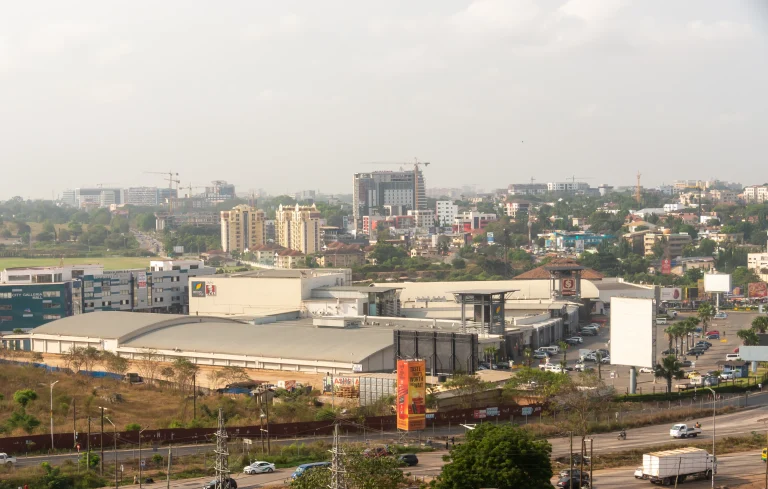

Accra International Airport (IATA: ACC, ICAO: DGAA) is the primary international airport of Ghana, serving the capital city of Accra and the surrounding Greater Accra Region. As the country's busiest aviation facility, it functions as the main gateway for passengers and cargo moving between Ghana and destinations across Africa, Europe, the Middle East, and the Americas. Operated by the Ghana Airports Company Limited (GACL), the airport connects the nation's political and commercial heart to the global air travel network.
The airport holds particular significance in Ghanaian civic life. For decades it was the country's sole international airport, and its evolution from a wartime military field into a modern passenger hub mirrors Ghana's own post-independence development. Its renaming on February 23, 2026, restored the original Accra International Airport designation, closing a long chapter in which the facility bore the name of a military officer associated with the overthrow of Ghana's first president.
Location
Names and History
The airport's official name is Accra International Airport, a designation restored on February 23, 2026. For more than five decades prior, the facility was known as Kotoka International Airport, named in honor of Lieutenant General Emmanuel Kwasi Kotoka (1926–1967), a member of the National Liberation Council that took power in Ghana in 1966.
The facility's origins trace to World War II, when it operated as a military airfield used by the British Royal Air Force. After the war, the site was handed over to civilian authorities. In 1956, Ghana's first president, Kwame Nkrumah, launched a development project to convert the military base into a civilian terminal building. That project was completed in 1958, creating an airport with an initial capacity of 500,000 passengers per year. At that time, the airport was named Accra International Airport.
The 1969 renaming to Kotoka International Airport has been a subject of public debate for years. Critics have argued that the airport was originally built under Nkrumah's government, which was overthrown in a coup led by Kotoka. Kotoka himself was killed in 1967 during an abortive coup attempt at a location that is now the airport's forecourt. The February 2026 decision to restore the Accra International Airport name settled a long-running civic discussion about the appropriateness of the Kotoka designation.
Until the Tamale and Kumasi airports were upgraded to international standards, Accra International Airport was, for an extended period, Ghana's only international airport. That historical role makes the airport central to the story of Ghanaian aviation and international connectivity.
Location and Codes
Accra International Airport is situated in Accra, the capital of Ghana, within the Greater Accra Region. The airport property lies within the La-Dade-Kotopon Municipal District and the Accra Metropolitan District, reflecting the urban expansion that has brought the city's commercial districts close to the airfield.
The airport operates under the IATA code ACC and the ICAO code DGAA. It sits at an elevation of 62 meters (205 feet) above mean sea level and falls within the Africa/Accra time zone (GMT+0).
The airport's position in the capital places it at the center of Ghana's administrative, commercial, and diplomatic life. Accra's role as the seat of government and a major West African business hub means the airport handles a significant share of the country's international arrivals and departures.
Terminals and Runways
Accra International Airport has two active passenger terminals: Terminal 2 and Terminal 3. Terminal 2 handles domestic flights exclusively, while Terminal 3 serves regional, international, and long-haul routes. The older Terminal 1 is no longer in passenger use; it is planned for redevelopment into a fixed-base operator (FBO) facility serving private and executive aviation.
Terminal 3 is the airport's flagship facility and its major piece of modern infrastructure. Construction began on March 1, 2016, with a sod-cutting ceremony attended by Ghanaian President John Dramani Mahama and Turkish President Recep Tayyip Erdogan. The project cost approximately $274 million. The terminal opened to passengers on September 15, 2018, and was officially inaugurated on October 2, 2018, by President Nana Akufo-Addo.
Terminal 3 was designed to handle 5 million passengers per year, with expansion potential to 6.5 million. It can process 1,250 passengers per hour and includes three business lounges, a large commercial and retail area, and six boarding bridges. The terminal's design accommodates large wide-body aircraft, including the Airbus A380.
The airport has a single runway, designated 03/21. It measures 3,403 meters (11,165 feet) in length and has an asphalt surface. This runway length is sufficient for the largest commercial aircraft operating on long-haul routes to and from West Africa.
Operations and Traffic
Accra International Airport is operated by the Ghana Airports Company Limited (GACL), a state-owned entity responsible for the management of Ghana's airport network. GACL maintains its corporate offices on the airport property.
Passenger traffic at the airport has grown substantially over the past decade and a half. In 2025, the airport served a record 3,624,087 passengers, according to statistics from the Ghana Civil Aviation Authority. That figure represents a full recovery from the sharp downturn caused by the COVID-19 pandemic, when passenger numbers fell to approximately 1.2 million in 2020.
The 2025 traffic total comprised 903,227 domestic passengers, 2,539,034 international passengers, and 181,826 transit passengers. The airport also recorded 47,262 aircraft movements and handled 46,372 tons of cargo during the year.
The growth trend predates the pandemic. Annual passenger totals rose from roughly 1.64 million in 2010 to more than 3 million by 2019. The opening of Terminal 3 in 2018 expanded capacity and improved the passenger experience, supporting the airport's ability to handle growing demand.
GACL reports that it serves an average of 7,780 passengers daily across its operations. The company has introduced self-check-in systems, improved parking facilities, enhanced security screening technology, and expanded retail and dining options as part of its efforts to modernize the passenger experience.
In recognition of its operational standards, the airport was named the "Best Airport in Africa" in the 2-5 million passengers per annum category by the Airports Council International for three consecutive years: 2019, 2020, and 2021.
Airlines and Connectivity
Accra International Airport serves as a hub for Africa World Airlines, a domestic and regional carrier, and as a base for Passion Air, a domestic operator. These two Ghanaian airlines anchor the airport's domestic network, which connects Accra to cities including Kumasi, Tamale, Takoradi, Sunyani, Wa, and Obuasi.
As of the latest researched schedules, the airport's international route network spans multiple continents. European carriers serving Accra include British Airways (London–Gatwick and London–Heathrow), Brussels Airlines (Brussels), KLM (Amsterdam), ITA Airways (Rome–Fiumicino), and Turkish Airlines (Istanbul).
Middle Eastern connections are provided by Emirates (Dubai–International, with service continuing to Abidjan), EgyptAir (Cairo), and Middle East Airlines (Beirut). Etihad Airways was scheduled to begin Abu Dhabi service on March 17, 2027.
North American service includes Delta Air Lines (New York–JFK, with seasonal Atlanta service).
African airlines form a substantial part of the airport's connectivity. Ethiopian Airlines serves Addis Ababa, Kenya Airways connects through Nairobi, and regional West African routes are operated by Air Burkina (Ouagadougou), Air Côte d'Ivoire (Abidjan), ASKY (Lomé and onward), Air Peace (Lagos, Monrovia, Freetown), and Air Tanzania (Dar es Salaam).
The airport also handles scheduled cargo traffic from carriers including Air Ghana, Cargolux, DHL Aviation, Emirates SkyCargo, Ethiopian Airlines Cargo, Qatar Airways Cargo, and Turkish Cargo. In 2016, Air Ghana opened the Ghana Airport Cargo Center, a 10,000-square-meter dedicated cargo warehouse facility supplemented by 9,000 square meters of office space, developed in partnership with GACL and Swissport.
Route networks change frequently in commercial aviation. Travelers should verify current schedules and destinations directly with airlines or the airport operator before planning travel.
Ground Transportation and Access
Accra International Airport is located within the city of Accra, making it readily accessible from the capital's major business and residential districts. The airport sits adjacent to the Airport City development, a commercial enclave that has grown up around the facility.
Ground transportation options include taxis, car rental services, and private shuttles. The airport's location on major city roads provides direct access to central Accra, the Accra Metropolitan District, and the broader Greater Accra Region. Passengers traveling to other parts of Ghana typically connect through domestic flights from Terminal 2 or continue by road.
Parking facilities at the airport have been improved in recent years as part of GACL's modernization efforts. The airport's position within the urban fabric of Accra means that hotels, restaurants, and business services are available within a short distance of the terminals.
Role in Ghana
Accra International Airport occupies a central place in Ghana's national infrastructure. As the country's primary international gateway, it handles the majority of Ghana's air passenger traffic and serves as the main entry point for business travelers, tourists, diplomats, and members of the Ghanaian diaspora visiting home.
The airport's economic importance extends beyond passenger travel. The facility supports employment across aviation, hospitality, retail, and logistics sectors. The adjacent Airport City development, promoted by GACL, reflects a broader strategy of treating airports as economic growth engines rather than mere transport terminals.
GACL describes its mission in terms of pursuing "smarter travel through Africa's gateway," emphasizing safety, security, and passenger comfort. The company has introduced new screening technology and expanded its security task force as part of its operational priorities.
The airport also has a military dimension. It shares its facilities with Air Force Base Accra, an installation of the Ghana Air Force. The base hosts a squadron of Airbus C295 transport aircraft and a helicopter squadron operating Harbin Z-9 and Mil Mi-17 utility helicopters.
For Ghanaian citizens abroad, the airport is often the first and last impression of home. Its terminals, services, and connections carry symbolic weight as the nation's front door to the world.
Related Places and Organizations
Several organizations and places are closely associated with Accra International Airport.
Ghana Airports Company Limited (GACL) is the state-owned operator of the airport and Ghana's broader airport network. GACL manages the airport's daily operations, infrastructure development, and commercial activities. The company's offices are located on the airport property.
Ghana Civil Aviation Authority (GCAA) is the regulatory body overseeing civil aviation in Ghana. It is responsible for safety oversight, air navigation services, and the collection of aviation statistics, including the passenger and cargo figures reported for Accra International Airport.
Airport City Accra is an urban development centered around the airport. Promoted by GACL, the development is built on the principle that airports have evolved beyond mere terminals into economic growth outlets that promote trade and generate employment. Developments within Airport City include retail outlets such as Marina Mall, hotels including Accra Marriott Hotel, ibis Styles Accra, and Holiday Inn Accra Airport, as well as corporate offices for companies such as Africa World Airlines and Vodafone Ghana. International airlines including Brussels Airlines and Turkish Airlines maintain ticketing and sales offices in the area. Projects underway include the five-star Pullman Accra Airport City by Accor and the Protea Hotel by Marriott Accra Airport.
Africa World Airlines and Passion Air are the Ghanaian carriers most closely tied to the airport's operations. Africa World Airlines uses the airport as its hub for domestic and regional services, while Passion Air operates domestic routes from the facility.
Air Force Base Accra shares the airport's facilities with civilian operations. This co-location of military and civilian aviation is a distinctive feature of the airport's operations.
Related Entries