
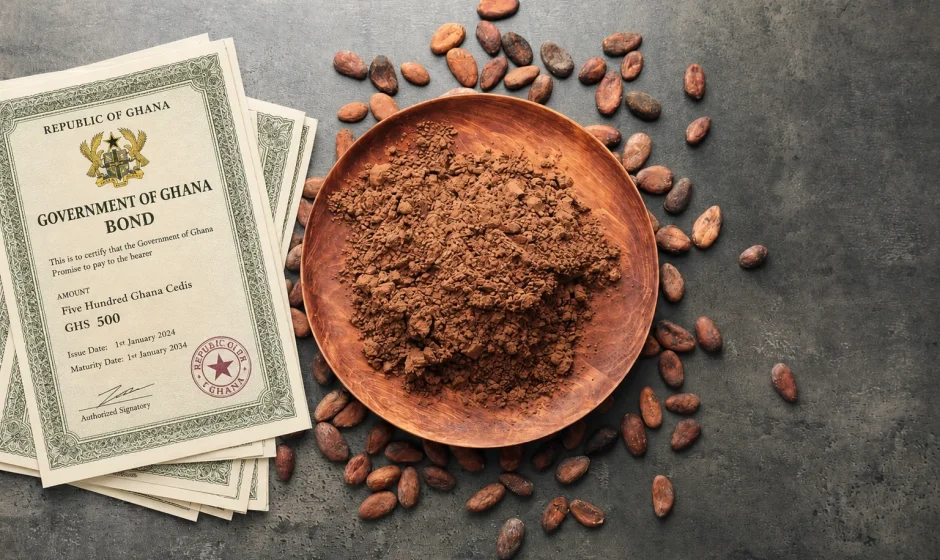

The Bank of Ghana (BoG) has announced that the government will raise $1 billion through the domestic bond market to finance cocoa purchases for the 2026/2027 crop season. Governor Dr Johnson Pandit Asiama made the announcement at the opening of the 130th Monetary Policy Committee (MPC) meeting in Accra on Monday, May 18, 2026.
If that sounds like routine government finance, here is the practical meaning: Ghana is moving away from the offshore syndicated loan model that funded cocoa purchases for more than three decades. Instead of borrowing in dollars from foreign lenders, the government will raise cedi‑denominated funds from local institutional investors to buy cocoa directly from farmers.
This shift matters because Ghana’s most strategic agricultural export—cocoa—generates about US$2 billion annually in foreign exchange and supports roughly 800,000 smallholder farming families. The new financing model aims to reduce currency risk, lower debt servicing costs, and give Ghana greater control over its cocoa value chain—including the ability to allocate beans to local processors rather than shipping them all abroad as collateral for foreign loans.
Table of Contents
- What Happened: Ghana Plans $1 Billion in Domestic Cocoa Bonds for 2026/2027 Season
- Why This Shift: Moving Away from Foreign Syndicated Loans
- How the New Cocoa Bond Financing Model Works
- A Critical Test for Investor Confidence
- Broader Reforms: Local Processing and Value Addition
- Economic Context: IMF Engagement and Global Risks
- Sources
What Happened: Ghana Plans $1 Billion in Domestic Cocoa Bonds for 2026/2027 Season
At the opening of the 130th Monetary Policy Committee (MPC) meeting at the Bank of Ghana headquarters on Monday, May 18, 2026, Governor Dr Johnson Pandit Asiama announced that cocoa purchases for the 2026/2027 crop season will be financed through $1 billion raised from the domestic bond market.
The initiative forms part of efforts to strengthen Ghana’s cocoa financing system and reduce dependence on foreign borrowing and external lenders. The proposed financing model comes as authorities seek to revive the cocoa sector following the reduction in farmgate cocoa prices earlier in 2026.
The arrangement is also expected to deepen the local capital market, encourage greater participation by institutional investors, and strengthen confidence in the domestic bond market after the successful resumption of treasury bond issuance earlier this year.
Under the new model, funding will be mobilized through financial instruments such as commercial paper and commercial notes while leveraging domestic liquidity sources.
Why This Shift: Moving Away from Foreign Syndicated Loans
For more than three decades, COCOBOD relied on annual syndicated pre-export facilities ranging between $1 billion and $1.5 billion to finance cocoa purchases from farmers. These loans, backed by cocoa receivables, were traditionally repaid within the crop season from export proceeds.
Borrowing conditions deteriorated sharply after Ghana’s sovereign debt crisis and the tightening of global financial conditions. By the 2023/2024 crop season, the cost of syndicated borrowing had climbed to about 8 percent in dollar terms, while the facility size dropped to $800 million as international lenders became increasingly cautious.
Production also weakened significantly. Output declined from a record peak of approximately 1.04 million metric tons in the 2020/2021 season to around 531,000 tons in 2023/2024 before recovering modestly to an estimated 600,000–700,000 tonnes in 2024/2025.
The crisis came to a head during the 2024–2025 season, when COCOBOD’s traditional syndicated loan model collapsed, leading to a buyer‑financed arrangement that left the organization heavily dependent on buyers’ willingness to pre‑finance cocoa purchases. When world market prices dropped from an average of roughly US$7,200 per ton to about US$4,100 per ton, COCOBOD was left vulnerable and unable to pay some farmers. Ghanaian cocoa had become uncompetitive and expensive, causing buyers to stop purchases altogether.
Compounding the problem, COCOBOD and the Licensed Buying Companies (LBCs) faced severe financial strain, with significant amounts owed to them leading to persistent payment delays to farmers. Addressing the situation, President John Dramani Mahama announced in February 2026 that the government would move away from foreign financing arrangements. “We’re going to stop foreign funding for the purchase of our cocoa. We’re going to raise domestic bonds to buy our own cocoa. We have enough cedis in Ghana to pay for our cocoa. We don’t need to collateralize the beans,” President Mahama said.
At the MPC meeting, Governor Asiama reinforced this message. “This is a significant shift to reduce reliance on dollar funding and foreign lenders,” the Governor stated.
How the New Cocoa Bond Financing Model Works
The new financing model, first unveiled by Finance Minister Dr Cassiel Ato Forson in February 2026, operates as a revolving fund. Under this arrangement, COCOBOD raises money from the domestic market, uses the funds to purchase cocoa from farmers, and repays the bonds from cocoa proceeds within each crop year.
“The new financing model will utilize domestic cocoa bonds to purchase cocoa and repay from cocoa proceeds within each crop year,” Dr Forson said.
The bonds will be denominated in Ghana cedis, which reduces exposure to exchange rate swings and frees up scarce foreign reserves. Authorities believe raising the funds locally could reduce exchange rate risks and lower the country’s dependence on dollar‑denominated borrowing.
The bond is expected to be issued before the new cocoa season begins around August. COCOBOD Chief Executive Dr Randy Abbey (full name Dr Ransford Anertey Abbey) said authorities were seeking to reduce dependence on foreign lenders and dollar‑denominated borrowing by leveraging improving domestic market conditions.
“We are looking at funding the entire crop. We believe that the interest rates in Ghana now are at the right place for us to go into the market,” Dr Abbey said, citing easing inflation and declining borrowing costs as creating favorable conditions for a large domestic issuance.
The government will issue local‑currency bonds specifically earmarked for COCOBOD to buy the upcoming crop at stable prices. Beyond purchasing beans directly from farmers, proceeds will also be used to maintain quality controls.
A Critical Test for Investor Confidence
The proposed issuance is emerging as a critical test of investor confidence in the country’s debt market recovery following the 2022/2023 Domestic Debt Exchange Programme (DDEP) and COCOBOD’s own restructuring challenges.
Market analysts say the success of the program will depend heavily on whether local investors are willing to absorb large‑scale, cocoa‑linked debt despite lingering concerns over COCOBOD’s approximately GH¢32.5 billion debt burden, past payment delays, and weakened production levels in recent years.
Corporate governance and banking consultant Dr Richmond Akwasi Atuahene said the proposed financing model represented a significant structural shift for the country’s cocoa industry but warned that rebuilding investor trust would be critical after recent debt restructuring and operational setbacks. “This is not just a financing adjustment. It represents a structural evolution in how Ghana funds one of its most strategic export commodities,” he said.
Concerns remain over investor appetite and the capacity of the domestic market to absorb an issuance potentially equivalent to GH¢11 billion to GH¢12 billion.
Market commentary and multiple Ghanaian financial media outlets have reported strong preliminary investor interest, though the true level of demand will only be known when the bond is formally priced.
Broader Reforms: Local Processing and Value Addition
The bond financing shift is part of a broader restructuring of Ghana’s cocoa sector aimed at increasing local value addition, strengthening domestic industries, and ensuring greater national control over the country’s key export commodities.
Cabinet has directed that from the 2026–2027 season, 50 percent of Ghana’s cocoa beans should be processed locally. The government has indicated it will revamp the State‑owned Cocoa Processing Company (CPC) to spearhead this domestic processing push.
President Mahama explained that using cocoa beans as collateral under foreign‑backed financing has limited Ghana’s ability to control its produce and support local processing industries. “We can buy them and add value by giving to our local processors. That’s what the Accra reset is all about,” he said.
Finance Minister Dr Cassiel Ato Forson has announced plans to introduce fresh legislative reforms for COCOBOD following government plans to restructure the cocoa sector, strengthen financial sustainability, and expand local value addition. The government intends to significantly increase local cocoa processing as part of its industrialization agenda.
At a separate event at the London Stock Exchange, CEO of COCOBOD Dr Ransford Abbey (also referred to as Dr Randy Abbey) argued that the new policy, beginning in the 2026/27 crop season, will make local processing profitable through improved bean quality, discounted light crop beans for local factories, and tax incentives under Ghana’s Free Zones framework.
Economic Context: IMF Engagement and Global Risks
Dr Asiama also provided an update on Ghana’s engagement with the International Monetary Fund (IMF), which continued following the completion of the sixth and final review under the Extended Credit Facility (ECF) program. The IMF acknowledged Ghana’s stabilization gains, including lower inflation, improved external reserves, stronger performance of the cedi, and enhanced debt sustainability.
Discussions are progressing toward a 36‑month non‑financing Policy Coordination Instrument (PCI) arrangement aimed at strengthening reforms, improving policy credibility, and reducing dependence on IMF financial support. The Governor explained that the PCI arrangement would help preserve the signaling benefits of IMF engagement while reinforcing domestic ownership of reforms and fiscal discipline.
However, Dr Asiama identified rising global energy prices and inflationary pressures as key risks likely to influence the committee’s policy decisions. According to him, the prolonged conflict in the Middle East has triggered sustained increases in global crude oil prices, putting renewed pressure on fuel costs, transportation, and consumer prices in Ghana. He warned that the combination of external commodity price shocks and domestic energy supply challenges could undermine inflation control efforts and affect recent macroeconomic gains.
The Governor noted that Ghana’s economic conditions had improved significantly since the previous MPC meeting held in March due to ongoing reform efforts. However, he cautioned that those gains were now being tested by worsening global conditions linked mainly to the Middle East conflict and its impact on energy and commodity prices, including the closure of the Strait of Hormuz intensifying pressure on global oil prices.
If you need personalized legal or business assistance with investing in Ghana’s cocoa sector or navigating Ghana’s business regulations, consider speaking with a qualified Ghanaian lawyer. Use the form below to get started:
Sources
- Citi Newsroom: “Gov’t to start selling $1bn bond to fund cocoa purchases – BoG” (May 29, 2026)
- GhanaWeb: “Government to raise $1 billion from domestic bonds to fund cocoa purchases – BoG” (May 29, 2026)
- Africa.com: “Ghana’s $1 Billion Cocoa Lifeline: Local Investors Step Up to Save the Golden Crop” (May 22, 2026)
- MyJoyOnline: “Gov’t to start selling $1bn bond to fund cocoa purchases – BoG” (May 29, 2026)
- GhanaWeb: “Cocoa financing overhaul to gauge market appetite” (May 20, 2026)
- Ghana News Agency: “Gov’t unveils domestic bond financing scheme for cocoa purchases” (February 12, 2026)
- Adomonline.com: “We’re going to raise domestic bonds to buy our own cocoa – Mahama” (February 14, 2026)
- IMF: “IMF Staff Completes the 2026 Article IV Consultation and Reaches Staff-Level Agreement on the Sixth Review of the ECF Arrangement and a 36-Month PCI Request” (May 15, 2026)
- USDA Foreign Agricultural Service: “Ghana Cocoa Sector Overview 2025” (2025)
- Reuters: “Ghana cuts farmgate cocoa price, introduces new financing model” (February 12, 2026)
- Reuters: “Ghana’s cocoa farmers are unpaid and investment in next harvest at risk” (January 20, 2026)
Compliance note: All bond and investment offerings must be conducted in accordance with regulations set by the Bank of Ghana and the Securities and Exchange Commission of Ghana..