

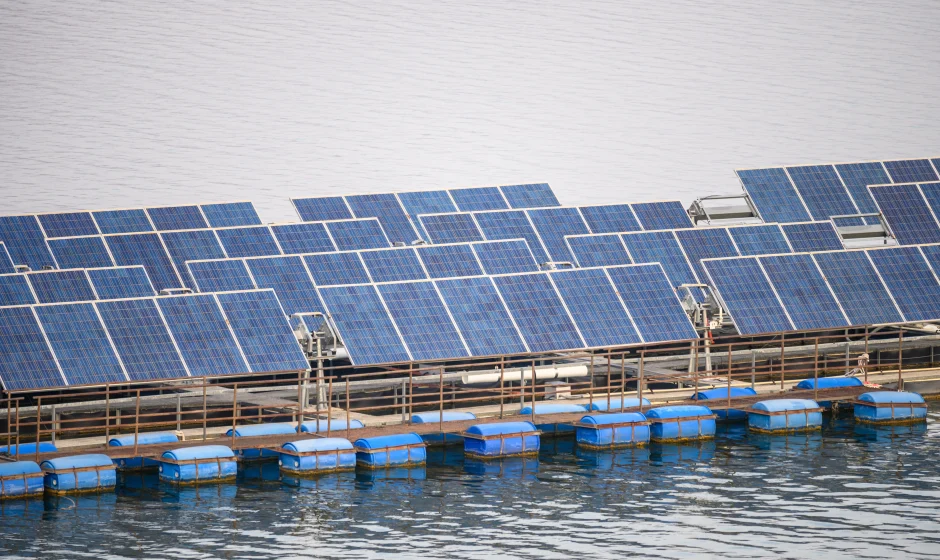

The government has announced plans to build a 1.5-gigawatt solar-hydropower project with battery storage at Buipe in the Savannah Region, aimed squarely at cutting the cost of electricity for factories and other industries expected to run under Ghana’s 24-Hour Economy program.
In plain terms, this is an attempt to solve a problem that has quietly undermined Ghana’s industrial ambitions for years: power is too expensive for manufacturers to compete. The project promises to bring industrial electricity tariffs down from roughly 18 to 23 US cents per kilowatt-hour to between 7 and 9 cents, a gap that officials say matters more to Ghanaian industry than almost any other single policy lever.
That matters to readers well beyond the energy sector. Cheaper, more reliable power touches manufacturing jobs, the price of locally made goods, and the country’s ability to attract the kind of large-scale investment that a genuine 24-hour production economy requires.
What Was Announced
The announcement came from Augustus Goosie Tanoh, Presidential Advisor on the 24-Hour Economy, at the opening of the seventh Ghana Investment and Trade Week (GITW 2026) in Accra. Speaking under the event’s theme of powering Ghana’s 24-hour economy for investment and trade competitiveness, Tanoh described the Buipe project as a central piece of government’s plan to make Ghanaian industry more competitive through cheaper power.
The government has already signed a Joint Development Agreement for the project, dated April 10, 2026, and is now working to bring in financing partners. The first phase, a 100-megawatt solar plant paired with battery storage, is scheduled to begin construction next year. Later phases would add hydropower capacity and expand storage until the site reaches its full 1.5-gigawatt target.
Buipe sits in the Savannah Region, along the Volta Economic Corridor that government has flagged for wider industrial development, including electric mobility, agro-industrial parks, and affordable housing.
Why Electricity Costs Matter So Much
For Ghanaian manufacturers, electricity is often one of the largest line items on the balance sheet. The Association of Ghana Industries has repeatedly flagged high utility costs as a drag on competitiveness, one that eventually shows up in the price tag on locally made goods. When power is cheaper to produce elsewhere, it becomes harder for Ghanaian factories to compete, both at home and across the region.
Tanoh has argued that narrowing this specific cost gap would do more for Ghanaian industrial competitiveness than any other single policy government could offer. The math behind that claim is straightforward. Industrial tariffs currently sit between 18 and 23 US cents per kilowatt-hour. The Buipe project is projected to bring that down to between 7 and 9 cents, a reduction of more than half.
Government’s own target tied to this shift is ambitious: raising manufacturing’s share of Ghana’s Gross Domestic Product from roughly 10 percent today to 20 percent over time. Whether that goal is realistic depends on more than electricity prices alone, but cheaper power removes one of the most commonly cited obstacles standing in the way.
How the Buipe Project Is Meant to Work
The project combines three elements that are increasingly paired together in modern grid planning: solar generation, hydropower, and battery energy storage. Solar panels generate electricity during daylight hours, hydropower adds a steadier baseline supply, and batteries store surplus power for use at night or during periods of high demand.
This matters for a 24-hour industrial economy specifically because factories, agro-processing plants, and logistics hubs cannot simply shut down when the sun goes in or demand spikes. Battery storage is the piece that is supposed to smooth out those gaps, storing daytime solar output for release when generation dips.
Unlike earlier conversations about the 24-Hour Economy program, which focused mostly on extending business hours, this proposal treats stable, affordable electricity as the actual foundation the policy needs to function. Without it, a 24-hour production push has little to stand on.
Financing and Investment Plans
Government says it is seeking financing from local and international investors, development finance institutions, and pension funds to build out the project. To reduce the commercial risk that typically scares off large energy investors, officials are aggregating electricity demand from industrial parks, inland ports, and logistics hubs to offer guaranteed power off-take arrangements. In practice, that means investors would have committed buyers for the electricity before construction is even finished.
If the project moves forward as planned, it would rank among Ghana’s largest renewable energy investments to date. That scale is part of the pitch to investors: a single, coordinated project tied directly to a national industrial strategy, rather than a smaller standalone solar farm.
How This Fits Ghana’s Wider Energy Strategy
The Buipe announcement did not happen in isolation. Ghana has been positioning its energy transition as one that expands renewables without abandoning conventional power sources outright. At the International Energy Agency’s Global Conference on Energy Efficiency in Montreal, Deputy Minister for Energy and Green Transition Richard Gyan-Mensah reaffirmed that government’s approach pairs renewable growth with improvements to natural gas use, energy efficiency, and grid performance.
A similar message came through at the Beyond Oil and Gas Alliance-European Commission Ministerial Dialogue, where Gyan-Mensah described Africa’s energy transition as one that has to remain grounded in the development realities of emerging economies rather than following a template built for wealthier nations. Read alongside that, the Buipe project looks less like a one-off announcement and more like a test case for how Ghana intends to build out renewable capacity going forward: paired with industrial demand, financed through blended public and private capital, and justified on cost grounds rather than climate messaging alone.
What Readers Should Watch Next
The project is still at an early stage. A Joint Development Agreement is not the same as secured financing, and the 100-megawatt first phase has not yet broken ground. A few things worth tracking:
- Whether financing commitments from pension funds and development finance institutions materialize on the timeline government has set out.
- Progress on the first 100-megawatt solar and battery storage phase, expected to begin construction in 2027.
- Whether the projected drop in tariffs, from 18 to 23 cents down to 7 to 9 cents per kilowatt-hour, holds up once actual construction and financing costs are known.
- How the project connects to other 24-Hour Economy components already underway, including industrial parks and the broader Volta Economic Corridor plan.
For business owners and prospective investors, the practical takeaway is that Ghana’s industrial electricity costs are a live policy issue, not a settled one. Manufacturers weighing expansion or relocation decisions should factor in both the current tariff environment and the pace at which projects like Buipe actually get built.
Sources
- BusinessGhana (Graphic Online): “Govt unveils renewable energy plan – To power 24-Hour Economy” (July 8, 2026)
- The Vaultz News: “Gov’t Targets Cheaper Industrial Power with 1.5GW Renewable Energy Project for 24-Hour Economy” (July 8, 2026)