

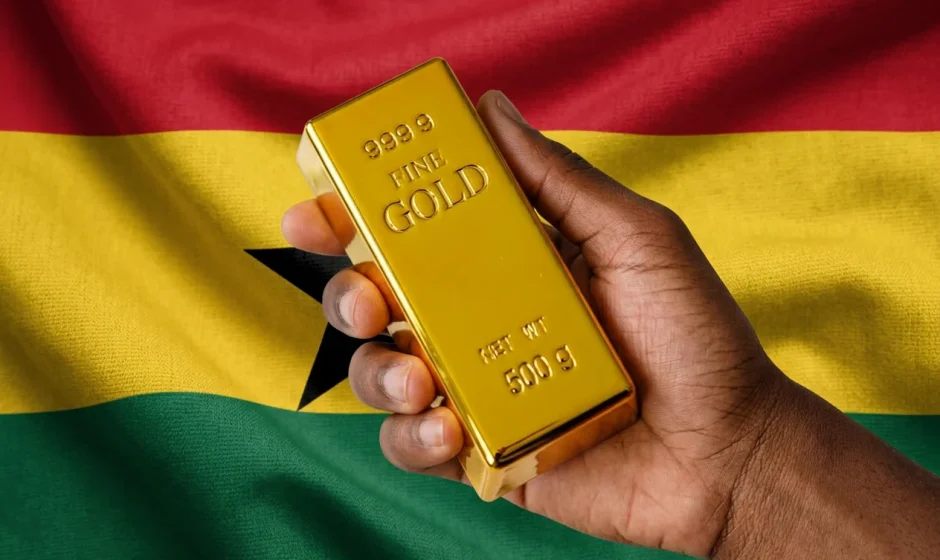

Ghana has asked large-scale gold miners to sell 30% of their annual output to the Bank of Ghana, up from the existing 20% requirement, as the government accelerates its national reserve-building drive. Paul Bleboo, head of the central bank’s Gold Management Programme, confirmed the new target to Reuters on May 18, 2026, adding that all 30% must be delivered in unrefined doré form rather than refined gold bars.
The immediate effect, if miners agree, would be a significant increase in gold flowing directly into state hands at below-market terms. At current production levels of roughly 100 metric tons per year from large-scale industrial miners, a 30% quota would represent about 30 metric tons annually destined for the central bank alone.
The catch is that miners have not agreed yet. Ghana Chamber of Mines CEO Kenneth Ashigbey said discussions on pricing, discounts, and structure are “not straightforward” and that no deal has been reached. The proposal is the central bank’s opening position in what appears to be a contested renegotiation, not a signed commitment.
Background: Ghana’s Gold Reserve Program
Ghana’s central bank announced the Domestic Gold Purchase Programme (DGPP) in 2021, when gold reserves stood at roughly 8.77 metric tons, according to Bank of Ghana data cited by Reuters. The first formal supply agreement with large-scale miners, including Gold Fields, Newmont, AngloGold Ashanti, and Asanko Mining, was signed in 2022. The goal was straightforward: use Ghana’s status as Africa’s largest gold producer to rebuild the country’s own reserves rather than watching nearly all production leave the country as exports.
The program was later formalized as a 20% supply agreement negotiated through the Ghana Chamber of Mines. By February 2026, gold reserves stood at 19.2 metric tons after the Bank of Ghana rebalanced part of its gold holdings into other reserve assets following a late-2025 peak above 38 metric tons, a move the central bank described as reducing concentration risk rather than liquidating its gold position.
In February 2026, the government revamped the initiative under the Ghana Accelerated National Reserve Accumulation Policy (GANRAP), presented to Parliament by Finance Minister Cassiel Ato Forson. The framework targets 157 metric tons of gold by 2028, equivalent to 15 months of import cover, with intermediate milestones of 8.6 months of import cover by end of 2026 and 11.8 months by end of 2027. The 30% quota proposal is the main lever for reaching those targets.
What the 30% Quota Actually Means
At declared industrial production of about 100 metric tons per year, a 30% quota would mean roughly 30 metric tons flowing to Ghana Gold Board (GoldBod) annually. Under Act 1140 of 2025, GoldBod holds the statutory purchase monopoly over artisanal and small-scale mining gold, with pre-emption rights over large-scale output. Its role as gatekeeper for large-scale miners under GANRAP operates through voluntary offtake agreements, not a statutory purchase mandate — a distinction that matters for enforcement when miners are not complying. That compares to the 20% commitment under the previous framework.
The financial implications are real. The Bank of Ghana posted an operating loss of approximately GH₵15.6 billion (around USD 1.37 billion) in 2025, driven largely by the cost of monetary tightening and reserve build-up, with a portion of the loss tied specifically to the gold purchase program. Scaling up to 30% of output would increase the reserve build-up component of those costs unless commercial terms are renegotiated favorably.
Bleboo described the offtake discount as “necessary,” framing it as a cost of building reserves rather than a deduction from miner revenues. The central bank treats the spread between purchase price and international price as equivalent to what other countries pay to acquire reserve assets through foreign exchange markets.
The Doré Requirement and Local Refining
A significant shift in the new proposal is that all 30% must be delivered in doré form. Doré is a semi-refined gold alloy that usually contains gold, silver, and other trace metals, and must be processed further at a refinery before it can be sold as investment-grade bullion.
Existing agreements, including the April 2025 nine-miner deal under GoldBod, already require doré delivery. The new proposal appears to lock in the doré requirement uniformly across the full 30% target and all participating large-scale miners, removing any flexibility that earlier contracts may have allowed. By routing all 30% as doré, the government gains two things: better traceability over volumes across the export chain, and the ability to direct more business toward domestic refineries, which feeds Ghana’s broader goal of capturing more value from its mineral wealth locally rather than exporting raw or semi-processed metals.
For miners, the shift to uniform doré delivery across all 30% adds logistical complexity, particularly for operations that have operated under different terms. Rerouting a larger share as unrefined doré means adjusting internal processes and accepting different pricing terms, since doré is valued at a discount to refined gold to account for further processing costs.
The Compliance Problem
One of the more striking disclosures in Bleboo’s Reuters interview was the current compliance rate. Industrial miners delivered roughly 10 metric tons of gold to the central bank in 2025 against declared production of about 100 metric tons, an effective rate of 10% against a 20% commitment. The government is therefore trying to double the quota rate while simultaneously trying to enforce the existing one.
This compliance gap is part of why GoldBod’s routing role matters under the revamped programme. By requiring that large-scale gold exports clear through GoldBod, the government gains more visibility over whether the quota is actually being met, rather than relying on voluntary compliance.
The gap also raises a practical question: if miners are delivering half of the 20% they are already required to supply, what changes in enforcement or commercial terms would make a 30% commitment workable? That question sits at the center of the ongoing negotiations.
Why Miners Are Pushing Back
The Ghana Chamber of Mines and its members have not rejected the principle of supplying gold to the central bank. Their objections are commercial and structural. According to industry sources cited by Reuters, the main sticking points include:
Volume-based discounts. The proposed under-1% discount on industrial gold purchases is opposed by miners who argue it functions effectively as a tax on production at scale. Bleboo maintains the discount reflects refining, freight, and purity costs, and is reasonable given what the central bank is being asked to absorb.
By-product valuation. Doré bars contain silver alongside gold. Miners want silver content valued in the purchase price. The current proposal as described by industry sources gives zero valuation to by-products, which miners say is not commercially acceptable.
Implementation timeline. Mining companies built their production and financial plans around a 20% offtake level. Jumping to 30% immediately disrupts those plans. Miners have proposed a phased approach, increasing the share gradually rather than applying the new quota to existing operations from the start.
These are not unusual objections in large-scale government offtake negotiations, and they do not necessarily signal that a deal cannot be reached. But they indicate that the timeline for finalizing a 30% agreement is open-ended.
What Happens Next
The GANRAP framework sets a hard reserve target of 157 metric tons by 2028 with specific intermediate milestones. That timetable creates genuine pressure on negotiators. If miners continue delivering at the current 10% rate, the 2026 import cover milestone of 8.6 months becomes much harder to reach.
The most likely outcome is a phased agreement that bridges the gap between the government’s 30% target and the miners’ preference for gradual implementation, with commercial terms on doré discounts and by-product valuations adjusted to reach a workable middle ground. A full impasse would leave the government short of its reserve targets while forcing miners to navigate a confrontation with a government that controls their export licenses through GoldBod.
For investors, operators, and businesses with exposure to Ghana’s mining sector or currency, this negotiation is worth watching closely. The outcome will affect how much foreign exchange Ghana captures from gold exports, how the cedi performs against reserve currency pressure, and whether Ghana’s push for local mineral processing gains traction beyond policy announcements. For more on how Ghana’s currency has responded to reserve-building efforts, see the Ghana cedi forecast for 2026 and recent coverage of the Damang mine gold sale.
Sources
- Reuters: “Ghana seeks to buy 30% of gold from miners to boost reserves, central bank” (May 18, 2026)
- Bloomberg: “Ghana Proposes 30% Gold Output Sale to Central Bank for Local Refining” (May 18, 2026)
- Reuters via CNBC Africa: “Ghana secures deal with nine more gold miners to buy 20% of their output” (April 30, 2025)
- Ghana Gold Board (GoldBod): “GoldBod secures agreement with 9 large-scale mining companies” (April 30, 2025)
- Bank of Ghana: Governor’s Remarks at the Launch of the Domestic Gold Purchase Programme (2021)
- NewsGhana: “Ghana Raises Gold Purchase Demand from Miners to 30%” (May 2026)
- Mining.com: “Ghana seeks to buy 30% of gold from miners to boost reserves, central bank” (May 2026)
- Bank of Ghana: Official gold reserves data