


Quick links (related guides):
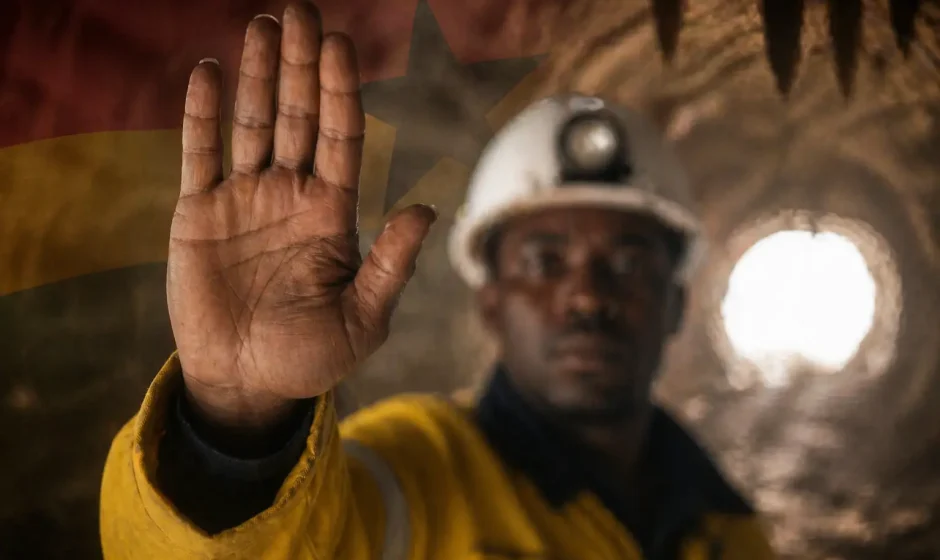
Ghana’s Minerals Commission has ordered Newmont, AngloGold Ashanti, and Zijin Mining to shift certain mining operations to local contractors by December 2026 or face sanctions, according to Reuters. A separate Reuters report said the Ghana Mineworkers’ Union warns the policy could reduce wages and weaken job security if not revised.
If that sounds like a straightforward “buy local” policy, here is what it actually means on the ground: the Ghana Mineworkers’ Union (GMWU) says the regulation, intended to build Ghanaian ownership of the mining sector, is instead being used by multinationals to replace permanent, unionized jobs with precarious contract work at sharply lower wages.
That tension, between a government pursuing resource sovereignty and workers watching their pay packets shrink, is at the center of one of the most consequential policy debates in Ghana’s mining sector today. It matters because gold mining accounts for a significant share of Ghana’s export revenue, and the question of who controls the pickaxe, and on what terms, will shape the industry for years to come.
Ghana’s Local Content Rules Explained
The rules at issue were introduced in January 2025 under Ghana’s Minerals and Mining (Local Content and Local Participation) Regulations, 2020 (L.I. 2431), revised and enforced with new urgency under the Minerals Commission. They require all mining operations in Ghana to shift from company-operated mining to contract mining run by locally owned firms.
The ownership thresholds are specific. Surface mining must be handled entirely by Ghanaian-owned companies. Underground mining must be carried out by contractors with at least 50% Ghanaian ownership. The Commission’s Chief Executive Isaac Tandoh has framed it clearly: “Employment is not the same as ownership. Labour is not the same as control.”
By early 2026, most large miners operating in Ghana had already made the transition. Newmont, AngloGold Ashanti’s Iduapriem gold mine, and Zijin Mining are the last holdouts still operating with their own staff. In February 2026, the Minerals Commission announced the revocation of more than 300 small-scale mining licences as part of the same push for greater local control.
The December 2026 Deadline: Newmont, AngloGold, Zijin
The Commission sent separate compliance letters to the three companies in October 2025 and January 2026, seen by Reuters. Each company requested an extension. The Commission rejected all three requests, though it gave them until December 2026 to comply rather than enforcing an immediate switchover.
Newmont, which operates the Ahafo North and South gold mines in Ghana, pushed hardest for more time. Its global CEO, Natascha Viljoen, met with the Minerals Commission in Accra this month seeking an extension to 2027. The company cited additional regulatory and governance requirements it must satisfy as a publicly listed company. The Commission turned it down, pointing out that other listed miners, including Gold Fields, had already complied without issue.
AngloGold Ashanti’s position is slightly different. The company already operates contract mining at its Iduapriem mine through a 50/50 joint venture, and says it began the transition before the January 2025 rules were even introduced as a business decision. It told Reuters it expects to complete the shift to a fully local contractor by year end.
Zijin’s Ghana unit said it has been engaging with the Commission since November 2025, preparing tender documents and technical frameworks while rolling out new technologies that require initial benchmarking before a full handover can proceed.
The consequences for non-compliance are graduated but severe. Government officials told Reuters: a major fine first, then, if that fails to move the company, the right to shut down the mine entirely.
The Workers’ Warning: Lower Pay, Riskier Jobs
The Ghana Mineworkers’ Union (GMWU) does not oppose local content in principle. Its opposition is to what it says is happening in practice.
GMWU General Secretary Abdul-Moomin Gbana has been raising the alarm consistently since August 2025, when the union’s National Executive Council met in Tarkwa. At a subsequent meeting in Accra in December 2025, he put a number on the problem: the union says more than 90% of workers in Ghana’s mining sector are now engaged in non-standard forms of employment, meaning temporary, casual, or fixed-term contracts. His description of the trend was unambiguous: “retrogressive.”
The mechanics are straightforward. When a multinational transfers a contract to a local firm, it typically awards that contract at rates Gbana describes as “cut-throat,” pricing designed to maximise the multinational’s margin, not to sustain a viable local business. The local contractor, capital-constrained and operating in a country where credit is expensive, cannot afford to match the wages, pension contributions, or safety standards the multinational previously maintained. Workers end up with less money, weaker protections, and a higher risk of accidents. Union sources indicated some contractor workers earn around 50% less than direct employees of mine operators.
The irony the union highlights is stark: gold prices have been at historic highs throughout this period. Prices surpassed USD 3,000 per ounce during 2025. In GHS terms, at a Bank of Ghana reference rate of approximately GHS 11.07 per dollar, a single ounce of gold represents significant export value. Ghana’s annual gold output is projected to rise from 4.8 million ounces to 5.1 million ounces. The money flowing into the industry has rarely been larger. The workers extracting that gold are not seeing the same trajectory in their pay.
| Issue Raised by GMWU | What It Means in Practice |
|---|---|
| Contracts awarded at “cut-throat” rates | Local contractors may struggle to cover decent wages, pensions, or safety costs |
| Union says over 90% on non-standard contracts | Many mineworkers may have limited job security or weaker employment protections |
| Wage delays and unpaid pensions | Some workers may be owed money by contractors under financial strain |
| Higher workplace accident risk | The union warns that safety obligations may suffer under cost-squeezed contracts |
| 19,000+ workers’ savings locked | Funds remain frozen in institutions affected by Ghana’s 2017-2019 financial sector clean-up |
There is one positive signal the union pointed to: Heath Goldfields, the new operator of the Bogoso-Prestea Mine, paid GH₵80 million in outstanding wages owed by the previous leaseholder and committed to restarting operations. The union cited this as evidence that responsible handovers are possible when companies prioritise workers in the transition.
The Government’s Position
The Minerals Commission’s position is that local capacity exists and is growing. Government officials pointed specifically to Ghanaian mining service companies Rocksure and Engineers & Planners as proof that the country has firms capable of taking on expanded contract mining roles. The Commission said it would provide guidance and support to local contractors as they scale up.
The underlying philosophy of the policy is straightforward: Ghana has been Africa’s top gold producer and has watched billions of dollars in mining revenue leave the country for decades. Ownership, the Commission argues, is how Ghana captures more of that value rather than simply supplying labour. That argument has broad political support across party lines.
What the government has not yet done is establish enforceable minimum wage or safety standards for contract mining under the local content framework. The GMWU has called on the Minerals Commission and the Ministry of Lands and Natural Resources to require sustainability in contract pricing, not just compliance with the ownership threshold. “Regulators must ensure sustainability, not just compliance,” Gbana said in August 2025.
Ghana’s Labour Act, 2003 (Act 651) provides baseline worker protections. A proposed Draft Labour Bill 2024 is still under review and would introduce paternity leave and extended maternity rights, but it does not specifically address the casualisation trend in mining. The GIPC Act, 2013 (Act 865), governs foreign investment broadly but leaves sector-specific arrangements to the Minerals Commission.
What This Means for Investors and Ghana’s Economy
For foreign companies already operating in Ghana’s mining sector, the message from the Minerals Commission is clear: the transition to contract mining is not optional and extensions will not be granted on demand. The December 2026 deadline is firm.
For investors looking at Ghana’s mining services sector, the policy creates a direct opportunity. Demand for Ghanaian-owned mining contractors, particularly firms with underground mining capability, is structurally growing as the Commission enforces these rules. The Commission has indicated it will actively support qualified Ghanaian firms to meet the demand. Capital access remains the constraint: Ghana’s credit market is expensive, and firms taking on contracts at compressed margins face real financial risk.
For the broader diaspora and expat investor community, the policy also has implications for how the Mahama government is positioning Ghana’s extractive sector. Ghana has followed a regional trend of tightening mining rules to retain more in-country value, a path also taken recently in Mali and other African gold producers. Foreign investment is still welcome, but the terms are narrowing. Anyone starting a business in Ghana in the mining services or supply chain space should factor in local ownership requirements from the outset.
The Ghana Chamber of Mines, which represents large miners, told Reuters it was engaging with the Commission but did not comment publicly. One industry source acknowledged the policy rationale while expressing concern about commercial logic: “If I can be more efficient mining myself, why shouldn’t I?”
What Happens Next
The clock is running for Newmont, AngloGold Ashanti, and Zijin. Each has roughly eight months to complete a transition that involves tendering operations to qualified local contractors, negotiating contract terms, and satisfying the Commission that ownership thresholds are met. For Newmont in particular, with two large mines and a listed-company compliance framework, this is a significant operational undertaking.
For the GMWU, the fight shifts to the terms of those contracts. The union has said it will intensify engagement with mines, regulators, and ministries to push for contract rates that allow local firms to pay fair wages and meet safety standards. Whether the Commission adds enforceable wage floors to the local content regulations, beyond the national daily minimum wage of GHS 21.77 (approximately USD 1.97, GBP 1.45, RMB 14.25) set by the National Tripartite Committee for January 2026, remains the central unresolved question.
Ghana’s gold sector is generating record revenue. The policy debate it has triggered is about whether the workers who produce that gold share in the result, or whether “local content” becomes a mechanism that changes who owns the contract without changing what the worker takes home at the end of the month.
Get your copy of 543 Business Ideas to Start in Ghana here.
Sources
- Reuters: “Ghana directs Newmont, AngloGold, Zijin to shift mining ops to local firms by December, sources say” (April 22, 2026)
- Reuters: “Ghana mineworkers warn local outsourcing rule will cut wages, jobs” (April 24, 2026)
- MyJoyOnline: “Ghana Mineworkers’ Union raises red flag over casualisation in mining sector” (August 14, 2025)
- Adom Online: “Job insecurity and locked savings: Mineworkers call for urgent sector reforms” (December 3, 2025)
- Bank of Ghana: Daily Interbank FX Rates (April 2026)