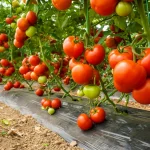



The tomato industry Ghana presents a contradiction that is difficult to ignore. Ghana produces tomatoes across multiple regions, yet the country continues to import large volumes of fresh tomatoes and processed paste every year.
If that sounds inefficient, here is what it actually means. The issue is not a lack of farming. The problem sits deeper in the system. Storage, processing, logistics, and coordination failures prevent locally grown tomatoes from reaching markets in usable form.
That gap has turned tomatoes into one of the clearest examples of a failing agricultural value chain in Ghana. It has also created a measurable foreign exchange drain, deepened import dependency, and produced one of the most accessible investment opportunities in the country today.
Market Size and Economic Impact
The scale of Ghana’s tomato problem is not small. According to the Chamber of Agribusiness Ghana (CAG), the country’s main agribusiness industry body, Ghana spends between GH¢650 million and GH¢760 million every year on imported tomato products.
The broader economic loss, according to CAG, is even larger. When post-harvest waste, missed industrial output, and import dependency are combined, the CAG estimates the total impact at approximately GH¢5.7 billion annually, equivalent to around 1.2 percent of Ghana’s GDP. These are CAG’s own estimates, not official government statistics, and should be read as industry figures reflecting the Chamber’s research and modelling.
According to CAG’s February 2026 statement, Ghana has become the world’s second-largest importer of tomato paste, behind only Germany. CAG CEO Anthony Morrison described the distinction as an indictment of decades of neglected agricultural investment.
CAG also estimates that underdevelopment of the sector has stalled the creation of approximately 250,000 direct and indirect jobs that could exist within a properly functioning domestic tomato value chain.
This is not just an agricultural issue. It is a macroeconomic leak that affects jobs, foreign exchange, and national productivity.
Production vs Demand Gap
Ghana produces substantial volumes of tomatoes each year. However, demand consistently exceeds usable supply.
National demand is estimated at around 800,000 metric tonnes annually, while production currently stands at roughly 370,000 to 375,000 metric tonnes, cultivated across approximately 47,000 hectares. These figures are broadly consistent with MoFA estimates and FAO production ranges for recent years.
Headline production figures, however, overstate the supply actually available to consumers and processors. According to a MoFA-IFPRI market brief, post-harvest losses reduce effective local supply to roughly 230,000 metric tonnes after accounting for spoilage in transport, storage, and handling. Combined with formal and informal imports, total domestic supply has been estimated at around 340,000 metric tonnes, still well short of aggregate consumption.
The import composition reflects this gap. Ghana imports up to 100,000 metric tonnes of fresh tomatoes each year, primarily from Burkina Faso, alongside a similar volume of processed paste sourced from Europe and Asia.
The seasonal dimension matters for understanding the dependency on Burkina Faso specifically. According to the MoFA-IFPRI brief, Burkinabe tomatoes supply the Ghanaian market particularly during the first half of the calendar year, when domestic irrigated production in the northern regions has ended and rainfed supply from the forest zone has not yet entered the market. That six-month window of structural dependence is now directly exposed by the Burkina Faso security crisis and the March 2026 export ban described below.
The productivity gap is equally telling. According to the MoFA-IFPRI market brief, MoFA estimates tomato yield potential in Ghana at 20 metric tonnes per hectare with improved seeds and good agricultural practices, roughly two-and-a-half times the current average of around 7.5 metric tonnes per hectare under combined irrigated and rainfed conditions. Even Burkina Faso, whose tomatoes have historically supplied Ghana’s off-season market, achieves around 10 metric tonnes per hectare. The gap is not just about land or investment; it is about agronomic practice and input access.
The Real System Failure
From a systems perspective, Ghana does not have a tomato production problem. It has a value chain failure.
Between 30 percent and 45 percent of tomatoes are lost after harvest due to poor storage, weak transport networks, and a near-complete absence of cold chain infrastructure. The CAG estimates this post-harvest waste costs Ghana between GH¢175 million and GH¢250 million every year in produce that rots before it can be sold.
At the same time, processing capacity is extremely limited. Tomatoes that could be preserved as paste or stored products instead spoil in fields or markets.
This creates a cycle. Surplus becomes waste, and shortages lead to imports. The system never stabilizes.
One data point from CAG’s February 2026 statement captures the depth of the failure more sharply than any other: according to the Chamber, only 7 percent of the tomatoes currently processed in Ghana use locally grown fruit. The remaining 93 percent is imported bulk paste, repackaged domestically under Ghanaian brand names. Ghana has a processing industry in name; in practice, it is largely a repackaging operation for foreign-produced paste.
The Burkina Faso Security Crisis
Ghana’s dependence on fresh tomato imports from Burkina Faso is no longer just an economic problem. It has become a security and supply chain problem with no short-term resolution.
On February 14, 2026, JNIM militants attacked the town of Titao in Burkina Faso’s Loroum Province. Among those caught in the attack were members of the Ghana National Tomatoes Traders and Transporters Association who had crossed the border to purchase tomatoes. Ghana’s Ministry of Foreign Affairs confirmed on February 17 that eight Ghanaian nationals were killed in total: seven died in the initial attack and an eighth victim succumbed to injuries while receiving treatment. Market leaders in Techiman described the risk of crossing the border as now unbearable.
Then, on March 16, 2026, Burkina Faso’s Trades and Agriculture ministers signed a communique placing an indefinite ban on fresh tomato exports. The stated reason was to redirect domestic supply toward Burkina Faso’s own processing plants. Holders of existing export permits were given just two weeks to complete outstanding shipments. Any goods seized after the deadline would be redirected to Burkinabe processing facilities.
The practical effect on Ghana’s markets began to emerge quickly. Bloomberg reported that tomato prices had already risen following the February attack on traders in Titao. MyJoyOnline reported that vendors at Kumasi’s Racecourse Market were expressing frustration over the export ban within days of its announcement, warning of further price increases ahead. Northern Ghana, the main corridor for Burkina Faso produce flows, is expected to feel the shortage most acutely during the coming lean season months. Traders are calling on the government to accelerate investment in domestic irrigation and processing infrastructure, calls that have gone largely unmet for years.
Together, the February attack and the March ban make the same structural point: Ghana’s fresh tomato supply chain has been running through a region experiencing an active insurgency, and that arrangement has now broken down. The CAG has cited both the security dimension and the export ban in pressing the case that domestic processing capacity must be built urgently.
Why Processing Factories Fail
A common assumption is that Ghana simply needs more tomato factories. However, past attempts show the problem is more complex.
The Pwalugu Tomato Factory (now the Northern Star Tomato Company) is the most documented example. Multiple causes contributed to its collapse, including inadequate machinery, financial unprofitability, and the deterioration of the Vea and Tono irrigation facilities that once fed the factory with raw material. A supply failure was also directly documented: when the factory operated under a Memorandum of Understanding with local farmers, the Managing Director told the Daily Graphic that farmers reneged on the agreements and sold their tomatoes to market traders from Accra instead, because the open market price was considerably higher than what the factory could offer. Research by IFPRI confirmed the same dynamic more broadly: fresh market prices for farmers in some regions were more than double what processors offered per tonne, making contract compliance economically irrational for many smallholders.
Processing plants also face high energy costs, unreliable electricity, and difficult logistics from production zones to factory gates. Without coordination between farmers, aggregators, logistics providers, and processors, factories cannot achieve the throughput needed to be commercially viable.
This explains why building factories alone does not solve the problem. The entire system feeding those factories must function properly first.
Hidden Gaps Most People Miss
Several critical issues are rarely discussed but play a major role in Ghana’s tomato industry challenges.
Informal Trade Distortion
A large portion of tomato imports enters Ghana through informal cross-border trade. These volumes are not always captured in official data, which makes it difficult to accurately measure supply and demand. The Burkina Faso import channel in particular has operated largely outside formal tracking systems.
Crop Variety Mismatch
Many farmers grow tomato varieties suited for fresh consumption rather than industrial processing. Processing requires specific varieties with higher dry-matter and solid content, which are not widely cultivated in Ghana. This mismatch reduces the usable raw material available to processors even when overall production volumes appear adequate.
Farmer Incentive Misalignment
Farmers prioritize immediate cash sales to open market traders, while processors require stable long-term supply agreements at contracted prices. This misalignment prevents consistent industrial production and is a key reason past factory investments have underperformed.
Energy and Infrastructure Constraints
Processing plants require reliable electricity and water supply. High energy costs and infrastructure gaps increase operating risk for investors and raise the cost of production relative to imported paste.
Price Volatility
Tomato prices fluctuate sharply between harvest and shortage periods. This volatility creates uncertainty for both farmers and processors and discourages long-term investment commitments from both sides of the supply chain.
The CAG Proposed Industry Strategy
In February 2026, the Chamber of Agribusiness Ghana published a proposed National Tomato Production Strategy for 2026 to 2030. According to CAG’s own February 16 statement, the coalition intended to present the strategy to the President and Cabinet, meaning it was not yet a formal state programme at time of publication. It should be read as an industry roadmap and investment case rather than an adopted government plan.
The strategy calls for GH¢3.2 billion in investment to build what it describes as a resilient seed-to-shelf ecosystem. Its stated objectives include reducing the annual import bill by at least GH¢600 million, generating GH¢220 million in new tax revenues, establishing value-addition processing hubs, and shifting the primary fresh tomato supply base back onto Ghanaian soil.
The proposal is explicitly framed around private sector participation. The government’s role is positioned as policy alignment and infrastructure facilitation, with investors expected to fund the processing, storage, and aggregation capacity the strategy requires.
For investors assessing entry timing, the proposal is a useful signal even without formal government adoption. It shows that industry stakeholders have mapped the gaps, quantified the losses, and built a structured case for intervention. The Burkina Faso export ban has since added additional urgency to that case.
Where the Real Opportunities Are
Despite these challenges, the gaps in Ghana’s tomato industry point directly to investment opportunities.
The most valuable areas include:
- Tomato processing plants that convert surplus into shelf-stable paste and puree products
- Cold storage systems that reduce post-harvest losses currently costing GH¢175-250 million annually
- Aggregation hubs that connect farmers to processors under formal supply agreements
- Logistics networks that improve farm-to-factory and farm-to-market efficiency
- Irrigation systems that stabilize year-round production and reduce seasonal gluts
- Certified seed production for processing-grade tomato varieties
These are not theoretical opportunities. They address measurable inefficiencies that currently cost Ghana billions each year. The demand already exists. The CAG’s proposed strategy provides an industry framework. The Burkina Faso export ban has made the urgency immediate. The system simply has not been built to support what the market already needs.
For investors and members of the diaspora, the question is less whether the opportunity is real and more which part of the value chain to enter first.
Sources
- MyJoyOnline: Ghana’s tomato crisis and the GH¢5.7bn economic drain CAG statement (February 2026)
- MyJoyOnline: Burkina Faso bans tomato exports traders warn of looming shortage (March 2026)
- MyJoyOnline: Agribusiness Chamber 12-month plan to end tomato import dependence (March 2026)
- African Eye Report: Ghana’s tomato sector loses GHS 5.7 billion annually CAG full statement (February 2026)
- Ghana News Agency: Government confirms eight Ghanaian deaths in Burkina Faso attack (February 2026)
- MoFA-IFPRI Market Brief No. 3: Ghana’s Tomato Market production, yields, seasonal trade, post-harvest losses
- IFPRI/GSSP Working Paper: The Case of Tomato in Ghana Processing, contract farming, and farmer incentive dynamics
- GhanaCitizenship.com: Burkina Faso tomato ban explained
Related Ghana guides: