

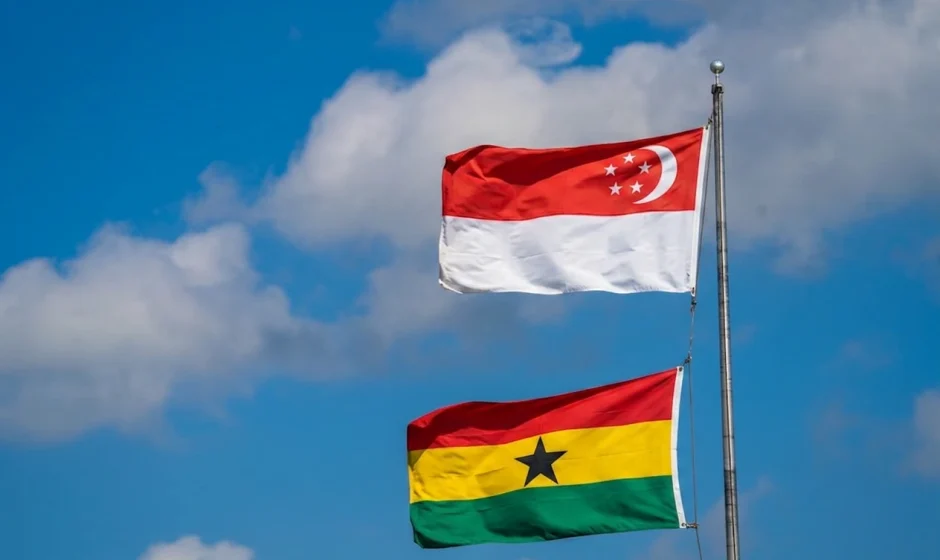

In April 2026, Ghana’s Deputy Minister for Foreign Affairs, Hon. James Gyakye Quayson, led a high-level consultative visit to Singapore from April 10 to 15 and formally announced Ghana’s intention to establish a resident diplomatic mission there. For a relationship that once operated through an Honorary Consulate General and a non-resident High Commissioner, that announcement marks a genuine turning point. What looks like a bureaucratic step is actually the institutional culmination of decades of investment, diplomacy, and an emerging South-South partnership that few people outside government circles have paid close attention to.
The relationship between Ghana and Singapore has transformed from occasional high-level visits into a multi-sector strategic partnership spanning trade, carbon finance, agribusiness, digital technology, and capacity building. With over 69 Singaporean companies registered in Ghana and cumulative investments reportedly exceeding US$2 billion, there is now enough substance on the ground to justify a permanent diplomatic infrastructure.
This guide covers the full scope of that relationship: its historical roots, the landmark 2025 state visit, the five pillars guiding the partnership, and what it means for Ghana’s economy and diaspora.
Table of Contents
- Historical Roots and Diplomatic Foundations
- The 2025 State Visit: A Watershed Moment
- The Five Pillars of Partnership
- Economic Ties: Trade and Investment
- The Carbon Credit Agreement
- Digital Economy and Technology
- People-to-People Ties and Capacity Building
- Outlook: Challenges and Opportunities
- Sources
Historical Roots and Diplomatic Foundations
Both Ghana and Singapore are former British colonies that inherited English common law, parliamentary governance traditions, and economies built on trade. Ghana achieved independence in 1957 as sub-Saharan Africa’s first independent state. Singapore followed in 1965 after a short-lived merger with Malaysia. They shared a colonial starting point but quickly diverged in approach: Singapore adopted an export-oriented industrialization model and invested heavily in human capital; Ghana under Nkrumah pursued a more state-led development path until the 1966 coup. The divergence set very different economic trajectories, but it also created the complementarity that underpins their modern partnership.
Singapore’s founding Prime Minister Lee Kuan Yew reportedly visited Accra in the 1960s and met President Kwame Nkrumah. Formal diplomatic ties were established in the early-to-mid 1990s. The first confirmed high-level visit came in December 1995 when then-President Jerry John Rawlings made a working visit to Singapore. From there, interactions deepened: Singapore’s Senior Minister of State for Foreign Affairs Zainul Abiding Rasheed visited Ghana in 2008, and Senior Minister Tharman Shanmugaratnam (now Singapore’s President) visited Accra in 2019, meeting then-President Akufo-Addo to discuss technical and vocational training, tax administration, and investment promotion.
A structural milestone came in 2013 when Enterprise Singapore opened its Accra Overseas Centre, one of its first trade offices on the African continent. In March 2017, both countries signed a Double Taxation Agreement (DTA), which entered into force on 12 April 2019, according to Singapore’s Ministry of Finance, lowering barriers to cross-border investment.
The 2026 Push for a Permanent Mission
For most of the relationship’s history, neither country maintained a resident diplomatic mission in the other’s capital. Ghana’s April 2026 consultative visit, led by Deputy Minister Quayson, changed that formally. During discussions with Singapore’s Minister of State for Foreign Affairs and Social and Family Development, Hon. Zhulkarmain Abdul Rahim, Ghana communicated its intention to open a resident mission as part of a broader strategy to expand its diplomatic footprint in Asia.
The rationale goes beyond consular services. With 69 Singaporean companies now registered in Ghana, a permanent mission is as much about protecting and promoting Ghana’s economic interests as it is about diplomatic representation. Singapore, for its part, views Ghana as a stable, reform-minded gateway into the African Continental Free Trade Area (AfCFTA) market, which covers 1.4 billion people and a combined GDP of approximately US$3.4 trillion.
The 2025 State Visit: A Watershed Moment
No event has done more to redefine the Ghana-Singapore relationship than President John Dramani Mahama’s three-day state visit to Singapore from August 26 to 28, 2025. This was the first-ever state visit by a Ghanaian president to Singapore, at the invitation of President Tharman Shanmugaratnam. The visit included a ceremonial welcome, meetings with Prime Minister Lawrence Wong, a state banquet, a keynote address at the 8th Africa-Singapore Business Forum, and a tour of the Singapore Institute of Technology.
Two Memoranda of Understanding were signed in the presence of President Mahama and Prime Minister Wong: one on bilateral consultations between the two foreign ministries, and a second on capacity building in investment promotion. Beyond the formal agreements, Mahama announced plans for a Ghana-Singapore deal team co-led by the Ghana Investment Promotion Centre (GIPC) and Enterprise Singapore, tasked with generating new investment pipeline commitments in the months ahead.
Investment Commitments Secured
The visit produced over US$1 billion in investment pledges across multiple sectors, confirmed by Foreign Minister Samuel Okudzeto Ablakwa following the President’s return.
| Investor / Sector | Commitment | Details |
|---|---|---|
| Olam International (Agribusiness) | US$200 million | 43,000-metric-ton pasta processing plant plus feed processing for poultry and aquaculture; ~4,000 jobs expected |
| Shangri-La (Hospitality) | US$300 million | Green five-star hotel, shopping mall, and convention centre in Accra |
| University of Ghana Hostel | Undisclosed | 10,000-bed student hostel through Rock Africa and Robin Village Development |
| Other agreements | Remainder of US$1B+ | Airport security systems, Tema Port expansion, road construction testing, central bank payment platform |
Notably, President Tharman praised Mahama’s approach directly, describing him as “a man on a mission” determined to see his country and its young population succeed. Both leaders also advanced negotiations on a Bilateral Investment Treaty (BIT) that would give investors from both sides legally binding protections.
The Five Pillars of Partnership
In his keynote address to the 8th Africa-Singapore Business Forum, President Mahama outlined five priority areas that now structure the bilateral relationship.
1. Efficient and Green Supply Chains
Singapore’s port management expertise and global logistics standards are central to this pillar. Mahama invited Singaporean investors to partner in modernizing Ghana’s ports, inland waterways, and cold chain infrastructure to reduce Africa’s trade costs and support the AfCFTA.
2. Agribusiness and Food Systems
Ghana has over 2 million hectares of arable land along the Volta River available for agro-processing parks. Singapore’s expertise in irrigation technology, food processing, and packaging makes it a natural partner for transforming Ghana’s agricultural output into globally competitive exports. Olam’s US$200 million commitment is the clearest expression of this pillar in action. For more on where agricultural investment is heading, see the Ghana Agriculture Investment Guide.
3. Clean Energy and Carbon Markets
Ghana and Singapore signed an Article 6 Implementation Agreement on carbon credits in May 2024, making Ghana the first country in Sub-Saharan Africa to sign such an agreement with Singapore, and Singapore the first Asian country to do so with Ghana. This creates a legally binding framework for generating and internationally transferring carbon credits, channeling financing into low-carbon projects including renewable energy, regenerative agriculture, and forestry in Ghana.
4. Digital Economy and Services
This pillar covers e-payments, cybersecurity, digital identification, and smart governance. The Trident Digital Tech-Aliska joint venture announced in April 2026 (see below) is the most recent and concrete example of this pillar taking shape.
5. Advanced Manufacturing and Critical Minerals
Ghana holds significant deposits of lithium, manganese, graphite, gold, and rare earth minerals. The fifth pillar focuses on value addition at home rather than raw mineral exports, with Singapore’s advanced manufacturing expertise positioned to support processing and refining capacity.
Economic Ties: Trade and Investment
According to figures cited by President Mahama and reported by Ghanaian media (attributed to Ghanaian government sources), bilateral trade between Ghana and Singapore reached over US$215 million in 2024, with West Africa accounting for a significant share of the nearly US$14 billion in total Africa-Singapore trade. That figure is modest relative to the size of both economies, and President Mahama has set an explicit target of pushing it into the billion-dollar range.
| Trade Flow | Category | Approximate Value (2023) |
|---|---|---|
| Singapore exports to Ghana | Refined petroleum products | US$54.4 million |
| Ghana exports to Singapore | Cocoa beans | US$30.1 million |
| Ghana exports to Singapore | Cocoa paste | US$11.1 million |
The pattern reveals a classic asymmetry: Singapore exports processed industrial goods while Ghana sends agricultural commodities. Reversing this will require deliberate value-addition investment, which is precisely why the agribusiness and manufacturing pillars exist in the first place. A more detailed picture of Ghana’s current economic position is available in the Ghana Economy 2026 overview.
On the investment side, Singaporean companies operate across sectors from agribusiness (Olam, Wilmar) to urban planning and infrastructure (Surbana Jurong) to shipping and logistics (PIL). Enterprise Singapore’s Accra office, open since 2013, continues to support Singaporean companies expanding into the West African market.
The Carbon Credit Agreement
The May 2024 Article 6 Implementation Agreement is arguably the most innovative element of the Ghana-Singapore relationship. It creates a legally binding bilateral framework for generating and internationally transferring carbon credits aligned with the Paris Agreement. Singapore’s Ministry of Foreign Affairs noted that Ghana was the first country in Sub-Saharan Africa to conclude a Carbon Credits Implementation Agreement with Singapore; Singapore was Ghana’s first Asian partner for this type of agreement.
Under the framework, carbon credit projects developed in Ghana in areas like sustainable agriculture, waste-to-compost, and land restoration can generate credits that Singaporean companies purchase to offset carbon tax liabilities. Singapore has committed to channeling the value of 5% of proceeds from authorized credits toward climate adaptation measures in Ghana, including heat resilience and coastal protection.
In July 2024, Singapore’s Minister of State for Trade and Industry, Alvin Tan, led a delegation of 22 Singapore-based companies to Accra to meet Ghana’s environment officials and cultivate a pipeline of Article 6 projects under the agreement. By September 2025, Singapore contracted approximately 2.175 million tonnes worth of nature-based carbon credits from projects in Ghana, Peru, and Paraguay, including a 40-year land restoration project in Ghana’s Kwahu region targeting 51,000 hectares of degraded land.
Digital Economy and Technology
The digital pillar produced its clearest private-sector outcome on April 13, 2026, when Singapore-headquartered Trident Digital Tech Holdings Ltd. (Nasdaq: TDTH) signed a 50/50 joint venture agreement with Ghana-based Aliska Business Advisory and Research Limited. The resulting entity, Trident Aliska Digital Tech Ghana Ltd., targets projected combined revenue of up to US$800 million over the first five years, covering e-government identity verification, financial services infrastructure, and public sector data management.
That figure is a projected ceiling, not a guarantee. It depends on securing government approvals and project funding in Ghana. What it signals is that Singapore’s technology companies see Ghana’s Digital Ghana Agenda as a live commercial opportunity, not a future aspiration.
For context on Ghana’s digital transformation ambitions, see the Ghana National AI Strategy.
People-to-People Ties and Capacity Building
Travel between the two countries is visa-free but on different terms. Singaporeans can enter Ghana without a visa for up to 90 days, confirmed by Singapore’s Ministry of Foreign Affairs. Ghanaian passport holders can enter Singapore visa-free for short stays of up to 30 days. Travelers should verify current entry conditions before departure, as policies can change. Singapore’s capacity-building contribution through the Singapore Cooperation Programme has trained over 500 Ghanaian participants in areas including tax and customs administration, environmental protection, information technology, and aviation emergency management.
During the 2025 state visit, both sides agreed to expand cooperation in technical and vocational education and training. The first cohort of 18 Chief Directors from Ghana’s ministries traveled to Singapore in September 2025 for a leadership boot camp. A partnership was also announced to establish a model Accra Institute of Technology drawing on Singapore Institute of Technology’s approach to applied, industry-relevant higher education.
Outlook: Challenges and Opportunities
The relationship has real potential and real gaps. On the opportunity side, the AfCFTA market gives Singaporean investors a compelling reason to use Ghana as a continental gateway. The carbon credit framework could channel significant financing into Ghana’s renewables and forestry sectors while helping Singapore meet its 2030 climate targets. And the digital economy is still in early stages, with mobile money adoption already among the highest on the continent.
The challenges are equally real. Ghana’s exports to Singapore declined from around US$138 million in 2018 to approximately US$45 million in 2023. Reversing that trend requires moving beyond raw cocoa exports toward processed goods, which takes sustained investment and infrastructure. Ghana’s macroeconomic position, while improving in 2025-2026, still represents a risk consideration for potential investors watching inflation and currency stability. And the physical distance between West Africa and Southeast Asia remains a logistical constraint on trade and people flows until direct flights become viable.
The establishment of Ghana’s diplomatic mission in Singapore, expected during 2026, addresses some of these structural gaps. A permanent on-the-ground presence enables proactive investment promotion, investor support, and trade facilitation rather than reactive diplomatic management. Its success will depend on adequate resourcing and focus.
Bottom Line
The Ghana-Singapore relationship is built on mutual economic interest, not aid dependency. Both sides are pragmatic about what they want from it: Ghana wants technology transfer, institutional expertise, and investment; Singapore wants a stable, reform-minded gateway into a 1.4 billion-person African market. That alignment of interests, combined with genuine historical goodwill and deepening institutional frameworks, puts this partnership in a stronger position than most Africa-Asia bilateral relationships. For investors watching where the next wave of Singapore capital flows in West Africa, Ghana is the clearest answer right now.
Get your copy of 543 Business Ideas to Start in Ghana
Sources
- Ghana Ministry of Foreign Affairs: “Ghana Moves to Establish Diplomatic Mission in Singapore” (April 2026) (backup: Pulse Ghana report)
- Singapore Ministry of Finance: “Tax Agreement With Ghana Enters Into Force” (April 2019)
- Singapore Ministry of Foreign Affairs: State Visit of President John Dramani Mahama (August 2025)
- Citi Newsroom: “Mahama Secures US$1bn Investment in Singapore – Ablakwa” (August 2025)
- Singapore Ministry of Sustainability and the Environment: Article 6 Implementation Agreement with Ghana (May 2024)
- Singapore Ministry of Trade and Industry: MOS Alvin Tan Business Mission to Ghana (July 2024)
- Singapore National Climate Change Secretariat: Nature-Based Carbon Credit Projects (September 2025)
- GlobeNewswire: Trident Digital Tech Holdings Establishes Joint Venture in Ghana (April 2026)
- Ghana Business News: “Ghana Signs $1B Investment Deals in Singapore” (August 2025)