

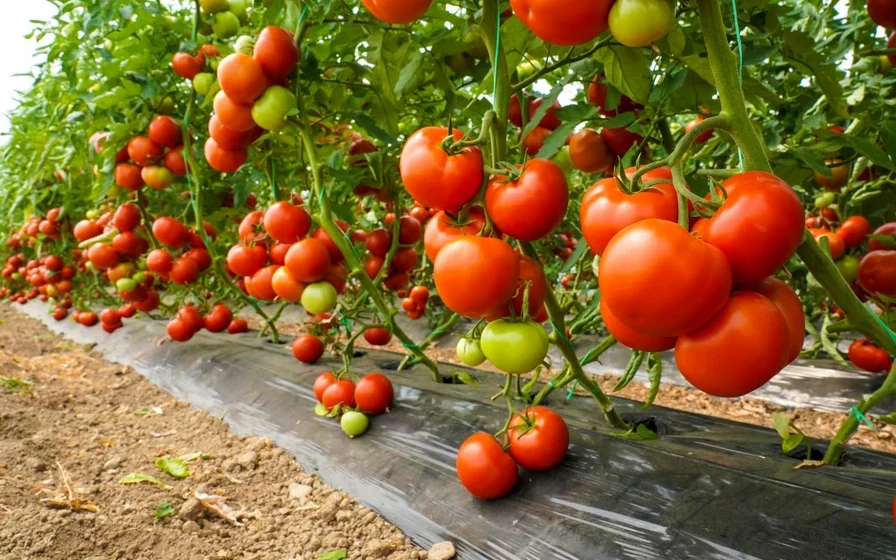

Understanding why Ghana imports tomatoes starts with a simple contradiction. Ghana produces substantial volumes of tomatoes across multiple regions, yet it still imports large quantities of fresh tomatoes and tomato paste every year.
The scale of this problem is striking. The Chamber of Agribusiness Ghana reports that the country has become the world’s second-largest importer of tomato paste after Germany. The country spends between GH₵650 million and GH₵760 million annually on foreign tomato products, and the total economic cost of import dependency, inefficient production, and lack of processing infrastructure amounts to approximately GH₵5.7 billion per year – equivalent to 1.2% of GDP, according to the Chamber.
If that sounds counterintuitive for a country with significant agricultural land, here is the real explanation: the issue is not production alone. Ghana’s tomato problem is a system failure involving storage, processing, and distribution. What looks like a farming issue is actually an infrastructure and coordination problem.
That matters because it affects food prices, national spending, and long-term investment opportunities in Ghana’s agricultural sector.
The Tomato Paradox in Ghana
Ghana produces substantial volumes of tomatoes, particularly in regions such as the Upper East, Upper West, and parts of the Northern Region. During peak harvest seasons, farmers often face oversupply, leading to falling prices and wasted produce.
However, during off-season periods, tomato shortages become common. Markets in Accra and across Ghana rely heavily on imports, including roughly 75,000 to 100,000 metric tonnes of fresh tomatoes annually. At the same time, Ghana imports about 95,000 to 110,000 metric tonnes of processed tomato paste annually – products that could be manufactured domestically from the very tomatoes that rot in the fields every harvest season.
This creates a cycle where tomatoes are wasted locally while the country continues to spend money importing similar products. According to Chamber of Agribusiness Ghana estimates, only about 7% of tomatoes used in processed products are currently sourced domestically, with the vast majority arriving as concentrated paste and repackaged for sale.
Why Ghana Imports Tomatoes
The reasons behind this system are layered. It is not one single issue, but a combination of structural weaknesses.
Seasonal Production Gaps
Tomato farming in Ghana is largely seasonal. Production rises during certain months and drops sharply during others. Without irrigation systems to support year-round farming, supply becomes inconsistent and markets depend on imports to fill the gap.
Post-Harvest Losses
A significant portion of tomatoes is lost after harvest. Between 30% and 45% of domestically grown tomatoes spoil before reaching the market due to poor storage and transportation infrastructure.
Lack of Processing Capacity
Ghana has very limited large-scale tomato processing facilities. According to Chamber of Agribusiness Ghana estimates, only about 7% of tomatoes used in processed products are sourced domestically. The Chamber describes the failure to build local processing infrastructure as a national emergency, as nearly all paste consumed in Ghana is imported and simply repackaged locally.
Weak Supply Chain Infrastructure
Transportation networks, cold storage systems, and distribution channels are underdeveloped. Farmers often struggle to move produce quickly enough to prevent spoilage, and without cold storage, even marketable tomatoes deteriorate in transit.
Cheaper Imports
Imported tomato paste is often cheaper due to large-scale production and subsidies in exporting countries. This makes it difficult for local producers to compete on price, reinforcing the cycle of import dependency.
The Real System Failure
From a systems perspective, Ghana does not have a tomato production problem. It has a coordination problem.
Production, storage, transportation, and processing operate independently rather than as a unified system. When one part fails, the entire chain breaks down.
For example, farmers may produce excess tomatoes, but without storage or processing facilities, that surplus becomes waste. Later, when supply drops, imports become necessary.
The broader economic damage extends well beyond the import bill itself. According to the Chamber of Agribusiness Ghana, the country loses an estimated GH₵4.5 billion in potential wages annually because domestic production and processing remain underdeveloped – with those jobs and that value creation going to foreign suppliers instead. The Chamber also estimates foregone tax revenue tied to non-existent jobs and businesses in the domestic value chain at a further GH₵180 million to GH₵220 million per year.
This disconnect explains why Ghana can simultaneously produce tomatoes and depend heavily on imports.
What Burkina Faso Did Differently
Burkina Faso has restricted exports of fresh tomatoes, limiting the volumes available to Ghanaian markets. As explained in our related analysis on the Burkina Faso tomato ban, the policy is intended to keep raw tomatoes available for domestic processing.
However, the situation is more complex than a straightforward industrial policy success. Deadly attacks on Ghanaian tomato traders in northern Burkina Faso have exposed the human cost of relying on supply chains that pass through volatile areas.
The broader lesson is not that Burkina Faso has found a replicable model, but that Ghana’s reliance on a single cross-border supply source for a staple food creates both economic and physical vulnerability. Countries that process their agricultural products locally retain more economic value and reduce their exposure to external disruptions.
How Ghana Can Fix It
Solving this problem requires coordinated investment across multiple areas. The Chamber of Agribusiness Ghana has formally proposed a National Tomato Production Strategy (2026–2030) backed by a GH₵3.2 billion investment target, with the goals of slashing the annual import bill by at least GH₵600 million and generating GH₵220 million in new tax revenues. The strategy represents the most comprehensive public roadmap to date for addressing the crisis.
Expand Irrigation Systems
Irrigation would allow farmers to grow tomatoes year-round, reducing seasonal shortages and stabilizing supply. A specific opportunity exists in the Pwalugu Multi-Purpose Dam project in the Upper East Region. The nearly $1 billion infrastructure project has faced long delays but the government announced a phased rollout in February 2026, and if completed it could support large-scale irrigation and enable consistent tomato cultivation in one of Ghana’s primary growing areas.
Build Processing Factories
Processing plants can convert surplus tomatoes into paste and other products, reducing waste and creating new revenue streams. Given that Chamber of Agribusiness Ghana estimates put domestic sourcing at only about 7% of processed tomato products, even modest investment in processing capacity would meaningfully reduce import dependency.
Develop Cold Storage Infrastructure
Cold storage facilities can extend shelf life and reduce post-harvest losses, which currently destroy 30% to 45% of the domestic harvest before it reaches the market.
Improve Transportation Networks
Better roads and logistics systems can help farmers get produce to markets and processors more efficiently, reducing the time pressure that currently forces much of the harvest to spoil.
Strengthen Agricultural Policy Coordination
Government agencies, private investors, and farmers must operate within a coordinated framework rather than isolated efforts. The CAG’s 2026–2030 strategy is an attempt to establish that framework, but implementation will require active policy commitment from the Ministry of Food and Agriculture alongside private sector participation.
The Opportunity for Investors and the Diaspora
This challenge presents a clear opportunity. Ghana’s agricultural sector does not lack demand. It lacks infrastructure and coordination.
The scale of the gap is measurable. The Chamber of Agribusiness Ghana estimates that around 250,000 direct and indirect jobs remain uncreated because the domestic tomato value chain is underdeveloped. The GH₵4.5 billion in potential wages the Chamber says is currently lost to foreign processors represents the ceiling of what a functioning domestic industry could generate.
Opportunities exist in:
- Tomato processing businesses
- Cold storage solutions
- Agricultural logistics companies
- Irrigation technology
For investors and members of the diaspora, this represents a chance to enter a market with strong, proven demand, clear structural gaps, and an active government strategy seeking private sector partners.
Sources
- The High Street Journal: Ghana’s import-dependent tomato market
- MyJoyOnline: Ghana’s tomato crisis and the Chamber of Agribusiness 2030 rescue plan
- 543 Ghana business ideas for Entrepreneurs
Related Ghana guides:
All money transfer services must be licensed by the Bank of Ghana.