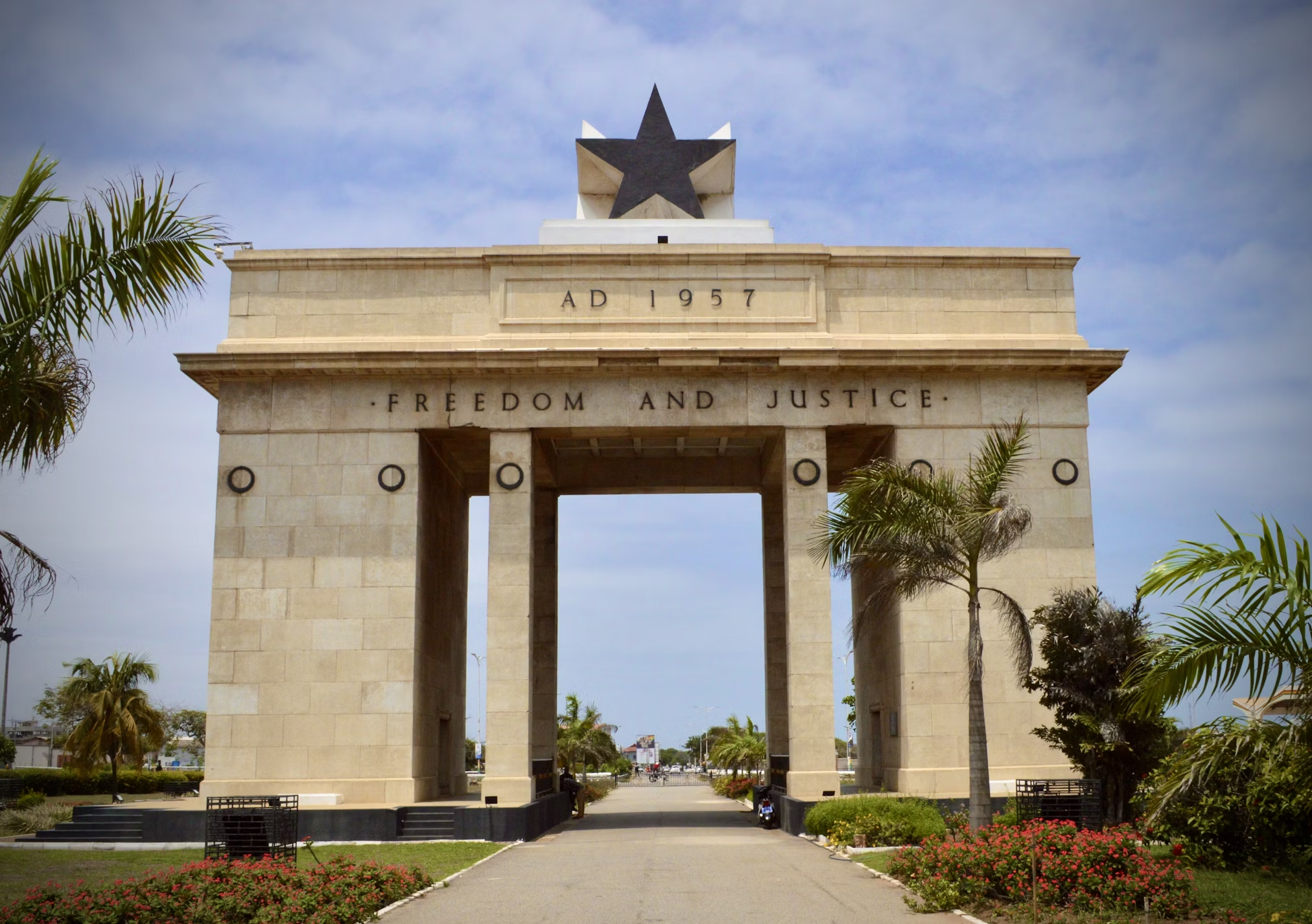



U.S. citizens can potentially become Ghanaian citizens through naturalization after establishing substantial lawful residence in Ghana and satisfying Ghana’s language, character, contribution, assimilation, and permanent-residence requirements.
However, there is no mandatory legal sequence of:
Visa → temporary residence → Indefinite Residence → citizenship.
A person can potentially qualify for ordinary naturalization while still holding a valid temporary residence permit. Indefinite Residence and Right of Abode are separate immigration statuses, not mandatory preliminary stages of Ghanaian citizenship.
Before Starting: Determine Which Ghanaian Route Actually Applies
A U.S. citizen considering long-term residence in Ghana can fall into several very different categories.
| Your Situation | Potential Route | Important Point |
|---|---|---|
| You already qualify through a Ghanaian parent or qualifying grandparent | Citizenship by birth / documentation of existing citizenship | You may already be Ghanaian. Naturalization is generally unnecessary. |
| You are married to a Ghanaian citizen | Citizenship by registration | This is a separate citizenship route from ordinary naturalization. |
| You were formerly Ghanaian and lost citizenship under Ghana’s former anti-dual-nationality rules | Citizenship reinstatement may apply | Reinstatement can be more appropriate than Right of Abode or naturalization. |
| You are a qualifying person of African descent in the diaspora | Right of Abode may eventually be available | Right of Abode is permanent immigration status, not citizenship, and diaspora applicants face a substantial prior-residence requirement. |
| You have no existing Ghanaian citizenship claim or special registration route | Ordinary naturalization | Long-term lawful residence plus the Section 14 requirements applies. |
Initial Entry and Establishing Legal Residence
Step 1: Enter Ghana Lawfully
A U.S. citizen must first enter Ghana under the entry rules applicable at the time of travel.
Ghana launched its national e-Visa platform on May 25, 2026. Travelers should use Ghana’s official entry portal to confirm their current visa requirements:
https://evisa.immigration.gov.gh/
Receiving permission to enter Ghana is not the same thing as receiving permission to live or work in Ghana indefinitely.
Step 2: Obtain the Residence Status Appropriate to Your Purpose
Section 13 of the Immigration Act, 2000 (Act 573) allows a person lawfully admitted into Ghana to apply for a residence permit.
The correct residence category depends on why you are in Ghana.
Examples include:
- Employment.
- Self-employment or qualifying business activity.
- Study.
- Marriage or dependency.
- Religious or NGO activity.
- Other recognized immigration categories.
For a company-sponsored foreign employee, Ghana Immigration Service currently lists documents including:
- Application or employer support documentation.
- Company registration records.
- Tax-clearance documentation.
- Audited accounts where applicable.
- Medical report from the Ghana Immigration Clinic.
- Police report from the applicant’s home country.
- Passport bio-data page.
- Curriculum vitae.
- Educational and professional certificates.
- Employment contract or appointment letter.
- Non-Citizen Ghana Card.
The exact checklist depends on the permit category.
How Long Does the First Residence Permit Take?
The old version of this guide gave a four-to-six-week estimate.
GIS currently states that there are no clearly defined universal processing times for residence permits and that processing may generally take approximately eight to ten weeks, depending on the permit.
That is an estimate rather than a legal guarantee.
How Long Is the Residence Permit Valid?
Do not assume that every first permit will automatically be issued for exactly one year.
Section 13 of Act 573 allows residence permits for periods determined by the immigration authority, subject to statutory limits. The Act allows a residence permit of up to eight years overall and no more than four years in the first instance.
Actual validity depends on the immigration category and approval.
If your permit requires renewal, renew it before expiration and keep copies of every old permit.
Non-Citizen Ghana Card
The Non-Citizen Ghana Card is not automatically handed to you by GIS when a residence permit is approved.
It is administered separately through the National Identification Authority’s Foreigner Identification Management System (FIMS).
NIA currently says a foreign national who has been cumulatively resident in Ghana for at least 90 days can apply, subject to specified exemptions.
Current FIMS fees are:
- First issuance: Cedi equivalent of US$120.
- Annual renewal: Cedi equivalent of US$78.
NIA currently requires documents including a valid passport, residence permit, and qualifying civil-status documentation.
Years 1-5: Build a Clean Lawful Residence Record
If citizenship is your long-term goal, the most important task during the first several years is maintaining evidence of actual lawful residence.
Keep records such as:
- Current and expired passports.
- All Ghanaian residence permits.
- Entry and exit stamps or travel records.
- Non-Citizen Ghana Card records.
- Employment contracts.
- Tax-clearance records.
- SSNIT records where applicable.
- Residential leases.
- Business records where applicable.
- School or professional records.
- Evidence of community involvement.
Travel outside Ghana can matter because both naturalization and Indefinite Residence contain specific residence tests.
Indefinite Residence: Usually Around Year 6, Not Year 5
General Indefinite Residence is Ghana’s permanent-residence-style immigration status.
Section 15 of the Immigration Act establishes its ordinary eligibility conditions.
A person generally must:
- Have resided in Ghana throughout the 12 months immediately before applying.
- Have resided in Ghana for at least five years in total during the seven years immediately preceding those 12 months.
- Be of good character, supported by two qualifying Ghanaian attestors.
- Not have been sentenced to imprisonment for 12 months or more.
- Have made, or be capable of making, a substantial contribution to Ghana’s development.
- Intend to reside permanently in Ghana.
- Possess a valid residence permit when applying.
What Does That Mean on a Continuous Timeline?
If a U.S. citizen moves to Ghana and remains continuously resident from the beginning, the ordinary residence formula is generally first satisfied at roughly:
Year 6.
At that point:
- The immediately preceding year satisfies the 12-month requirement.
- The first five years can satisfy the required five years during the earlier seven-year window.
Do You Need Indefinite Residence Before Citizenship?
No.
This is one of the most important corrections to the old timeline.
The Ministry of the Interior’s current naturalization checklist expressly accepts either:
- A current residence permit, or
- An Indefinite Residence Permit.
Therefore, Indefinite Residence is not a legally required intermediate step before ordinary naturalization.
A person who satisfies the citizenship requirements while still holding a valid temporary residence permit can potentially proceed directly to naturalization.
What Does Indefinite Residence Give You?
Section 18 of the Immigration Act gives both Indefinite Residence holders and Right of Abode holders the right to:
- Remain indefinitely in Ghana.
- Enter Ghana without a visa.
- Work as an employee without a work permit.
- Work as a self-employed person without a work permit.
Indefinite Residence is still not citizenship.
Section 15 also provides that a general Indefinite Residence holder automatically loses that status after being absent from Ghana for more than 12 consecutive months, although a fresh application for reinstatement may be possible.
Indefinite Residence Processing Time
The previous article stated that GIS aimed to process Indefinite Residence in approximately four weeks.
That should not be published as an official current standard.
GIS’s general residence-permit FAQ states that processing times are not clearly defined and permits may generally take approximately eight to ten weeks.
Indefinite Residence can require substantial verification, so applicants should not plan travel or immigration deadlines around a guaranteed four-week approval.
Right of Abode: A Separate Route
Right of Abode is another permanent immigration status under Sections 17 and 18 of the Immigration Act.
It is available to two statutory categories:
- A person who was Ghanaian by birth, adoption, registration, or naturalization and lost Ghanaian citizenship because of acquiring another nationality.
- A qualifying person of African descent in the diaspora.
It should not be confused with citizenship by descent.
Can a Black American Apply for Right of Abode Immediately After Moving to Ghana?
No, not under the ordinary diaspora verification rule.
Immigration Regulations, 2001 (L.I. 1691) require a person of African descent in the diaspora to have resided in Ghana:
- Throughout the 24 months immediately preceding the application, and
- For at least five years in total during the seven years immediately preceding those 24 months.
For someone beginning with no previous Ghana residence, continuous residence would generally reach that mathematical threshold at approximately:
Year 7.
The Regulations also require the application to be submitted in person.
Other Diaspora Right of Abode Requirements
The applicant must also satisfy requirements concerning:
- Age of at least 18.
- Good character.
- Two qualifying Ghanaian attestors.
- Those attestors having personally known the applicant for at least five years.
- No disqualifying criminal sentence.
- Independent financial means.
- Capacity to make a substantial contribution to Ghana’s development.
How Long Does Right of Abode Take?
The Ministry of the Interior currently publishes a timeframe of:
Six months after Ghana Immigration Service has submitted its due-diligence report.
That is not the same as six months from the date you first apply.
The total process includes the GIS investigation before the Ministry’s six-month published timeframe begins.
Former Ghanaian Citizens Should Check Reinstatement First
A former Ghanaian who lost citizenship because Ghana’s old law prohibited dual citizenship should investigate citizenship reinstatement under Section 16(5) of the Citizenship Act before choosing Right of Abode.
Restoring Ghanaian citizenship produces citizenship rights, while Right of Abode leaves the person legally classified as a non-citizen.
Ordinary Naturalization: Approximately Year 6 on a Continuous Residence Timeline
Ordinary naturalization is governed by Sections 13 and 14 of the Citizenship Act, 2000 (Act 591).
The Minister for the Interior may, with the approval of the President, grant a Certificate of Naturalization to an applicant who satisfies the statutory requirements.
Residence Requirement
The ordinary residence test is:
- Residence in Ghana throughout the 12 months immediately before applying, and
- At least five years of residence during the seven years immediately preceding those 12 months.
For a person continuously resident from the date of relocation, the earliest ordinary mathematical threshold is therefore approximately six years.
Other Naturalization Requirements
The applicant must also satisfy the Minister that the applicant:
- Is of good character, attested in writing by two Ghanaian notaries public, lawyers, or senior public officers.
- Has not been sentenced to any period of imprisonment in Ghana or elsewhere for an offense recognized by Ghanaian law.
- Can speak and understand an indigenous Ghanaian language.
- Has made, or is capable of making, a substantial contribution to Ghana’s progress or advancement.
- Has assimilated, or can easily assimilate, into the Ghanaian way of life.
- Intends to reside permanently in Ghana if citizenship is granted.
- Possesses a valid residence permit on the date of application.
The imprisonment standard for naturalization is stricter than the ordinary Indefinite Residence rule. Naturalization refers to any period of imprisonment for a qualifying offense, while general Indefinite Residence refers to imprisonment of 12 months or more.
Special Circumstances
Section 14 gives the Minister limited flexibility, with presidential approval, in special circumstances.
The Act allows adjustments to certain residence calculations and, in other special circumstances, permits qualifications to be modified, varied, or waived.
However, the indigenous Ghanaian language requirement cannot be waived under Section 14(3).
These powers are discretionary and should not be treated as an entitlement or a shortcut available merely because an applicant is American, wealthy, retired, or an investor.
Naturalization Application: Current 2026 Checklist
The Ministry of the Interior currently requires:
- Naturalization Form 5.
- Sponsor Form 14.
- An application letter addressed to the Minister for the Interior.
- Copy of the current residence permit or Indefinite Residence Permit.
- Passport bio-data page.
- Four passport-sized photographs with white background.
- Business, tax, SSNIT, audited-account, property, or other supporting records listed by the Ministry where applicable to the applicant’s circumstances.
The Ministry’s public checklist continues to use some older corporate terminology, including “Certificate to Commence Business” and “Company Code.” Ghana’s corporate and investment framework has since changed, so business applicants should confirm with the Ministry which current ORC and investment-authority documents are accepted as substitutes.
Do You Need a Ghana Police Report?
The Ministry’s current public naturalization checklist does not list a Ghana Police clearance as a universal document that every Form 5 applicant must submit.
The applicant is still subject to character and criminal-history requirements, and government vetting can involve checks or requests for additional evidence.
Do not purchase police reports or foreign background checks merely because an unofficial checklist says they are always mandatory. Follow the current Ministry instructions for your particular application.
Naturalization Fees in 2026
The Ministry currently publishes two relevant sets of charges.
Its Naturalization service page lists:
- Form 5: GH₵7,758.
The Ministry’s separate statutory fee schedule under L.I. 2512 lists Naturalization charges of:
- ECOWAS citizens: GH₵15,000.
- Africans / Diaspora: GH₵25,000.
- Non-Africans: Cedi equivalent of US$25,000.
How Long Does Naturalization Take?
The Ministry currently publishes a processing timeframe of:
Six months upon receipt of duly completed forms.
This should be treated as the Ministry’s published service timeframe, not a guaranteed citizenship date.
Delays can occur if:
- Documents are incomplete.
- Residence history needs verification.
- Additional evidence is requested.
- Character or background issues require investigation.
- The applicant has not established the statutory language, assimilation, contribution, or permanent-residence criteria.
The statute also requires presidential approval for the grant of a Certificate of Naturalization.
The Oath of Allegiance: When Do You Actually Become Ghanaian?
The original version of this article had the certificate and oath sequence backwards.
Section 13 of Act 591 provides that the Minister, with presidential approval, may grant a Certificate of Naturalization to a qualifying applicant.
The recipient must then take the Oath of Allegiance.
The law is explicit:
You become a Ghanaian citizen by naturalization on the date you take the Oath of Allegiance.
Approval alone does not make you a citizen before the oath.
After Naturalization
Once citizenship is effective, the new citizen can pursue Ghanaian citizen documentation such as:
- Ghana Card registration as a Ghanaian citizen.
- Ghanaian passport.
- Voter registration if the person separately meets Ghana’s electoral requirements.
Naturalization does not automatically qualify a person for every public office.
Some positions have separate constitutional requirements, including requirements for citizenship by birth or restrictions relating to allegiance to another country.
Ghanaian law permits dual citizenship, so Ghana does not generally require a qualifying U.S. citizen to renounce U.S. citizenship merely because Ghanaian citizenship is acquired.
Illustrative Timeline for an Ordinary U.S. Applicant
| Approximate Point | What May Happen | Important Qualification |
|---|---|---|
| Entry | Enter Ghana lawfully and establish the residence status appropriate to your purpose. | Entry permission alone does not authorize indefinite residence or employment. |
| First several months | Obtain the applicable residence/work authorization and Non-Citizen Ghana Card where required. | GIS says permit processing can generally take 8-10 weeks, but there is no universal guaranteed timeframe. |
| Years 1-5 | Maintain lawful residence and renew permits as required. | Keep evidence of actual residence and travel. |
| Around Year 6 | The ordinary residence formula for both naturalization and general Indefinite Residence may first be satisfied after continuous residence. | Neither status is automatic. All additional requirements still apply. |
| Around Year 6+ | Potentially submit Form 5 for naturalization if every Section 14 condition is satisfied. | You do not need to obtain Indefinite Residence first. |
| After complete naturalization filing | Ministry publishes a six-month service timeframe. | Actual timing can vary and presidential approval is required. |
| After grant | Take the Oath of Allegiance. | Citizenship begins on the date of the oath. |
| Approximately Year 7 or later for a new diaspora resident | A qualifying African-diaspora applicant may first satisfy the ordinary Right of Abode residence-verification calculation. | RA is completely separate from naturalization and is not necessary before citizenship. |
Right of Abode vs. Indefinite Residence vs. Naturalization
| Status | Citizenship? | Can Remain Indefinitely? | Visa-Free Ghana Entry? | Work Without Work Permit? | Main Purpose |
|---|---|---|---|---|---|
| Temporary Residence Permit | No | No | During valid permit, re-entry rules apply | Only where authorized by the permit/status | Temporary lawful residence for an approved purpose |
| Indefinite Residence | No | Yes | Yes | Yes | Permanent immigration status for qualifying long-term residents |
| Right of Abode | No | Yes | Yes | Yes | Special permanent status for statutory former-Ghanaian and diaspora categories |
| Naturalization | Yes | Citizen | Citizen | Citizen | Acquisition of Ghanaian citizenship |
Key Takeaways for U.S. Citizens
- Check whether you are already Ghanaian before naturalizing.
- Do not assume Right of Abode can be obtained immediately after arrival. African-diaspora applicants face a substantial statutory residence-verification requirement.
- Indefinite Residence is not automatically available at Year 5. The ordinary residence formula points closer to Year 6 for someone continuously resident from scratch.
- Indefinite Residence is not required before naturalization.
- Ordinary naturalization can potentially become available around Year 6 of continuous residence, assuming every other statutory requirement is satisfied.
- A valid residence permit is required on the date of the ordinary naturalization application.
- Naturalization requires an indigenous Ghanaian language.
- Naturalization requires substantial contribution and assimilation, not residence time alone.
- The Ministry currently publishes a six-month naturalization timeframe after receipt of duly completed forms.
- Citizenship becomes effective when the Oath of Allegiance is taken.
Sources
- Parliament of Ghana: Citizenship Act, 2000 (Act 591), Sections 13-15
- Ministry of the Interior: Naturalization as Ghanaian Citizen – Requirements, Form 5 and Six-Month Timeframe
- Ministry of the Interior: Current Citizenship and Migration Fees under L.I. 2512
- Parliament of Ghana: Immigration Act, 2000 (Act 573), Sections 13-18
- Ghana Immigration Service: Indefinite Residence Status Generally
- Ghana Immigration Service: Right of Abode
- Ghana Immigration Service: Immigration Regulations, 2001 (L.I. 1691), including Form H and Right of Abode verification
- Ghana Immigration Service: Legal Handbook containing Act 573 and L.I. 1691
- Ministry of the Interior: Right of Abode Processing Timeframe
- Ghana Immigration Service: Work and Residence Permit for Company-Sponsored Foreign Workers
- Ghana Immigration Service: Residence Permit FAQ and General Processing-Time Guidance
- National Identification Authority: Non-Citizen Ghana Card / FIMS
- Government of Ghana: Official e-Visa and Entry Eligibility Portal
- Ministry of the Interior: Ghana e-Visa Launch, May 25, 2026