
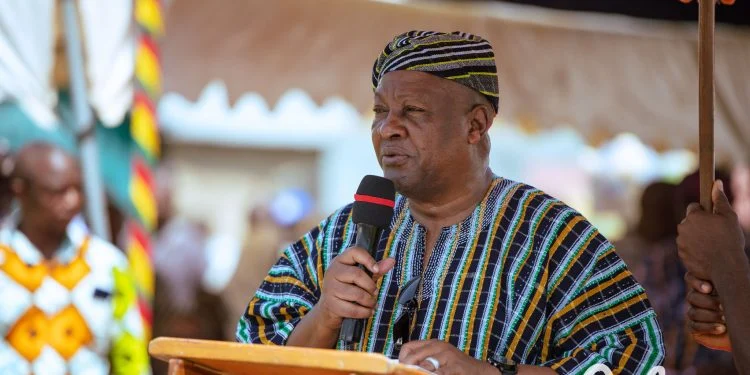

President John Dramani Mahama has unveiled a package of development projects targeting Zongo communities across Ghana. The announcement came during the National Eid al-Adha celebrations at Black Star Square in Accra on May 27, 2026.
In plain terms: the government plans to build roads, construct new STEM schools, and provide small business loans specifically for Zongo communities.
This matters because Zongo communities—historically underserved urban settlements—have long faced infrastructure deficits. The announcement signals that addressing these gaps has moved from political promises to an actionable government agenda. For residents, business owners, and families in these areas, the coming months could bring visible changes to roads, schools, and economic opportunities.
Key Announcements at a Glance
| Initiative | Details |
|---|---|
| Road Construction | New roads and rehabilitation projects, reportedly starting in Koforidua Zongo before expanding nationwide. |
| STEM Schools | Modern Community Day STEM secondary schools in densely populated Zongo and urban areas. |
| Business Support | Operationalising the Zongo Development Fund and Soya Fund to provide small credits to traders and informal sector workers. |
| Arabic Teacher Recruitment | 6,000 Arabic teachers recruited through the Youth Employment Agency, fully paid with expansion planned. |
The announcements cover four main areas: physical infrastructure, education, economic empowerment, and employment. Each is explored in detail below.
Road Construction and Rehabilitation
President Mahama stated that road construction and rehabilitation projects will soon begin in several Zongo communities nationwide. According to multiple news reports, the initiative will start in the Koforidua Zongo area before expanding to other Zongo communities across the country.
“Very soon, construction and rehabilitation of roads and other infrastructure projects will begin in several Zongo communities across the country,” he said. “We are starting with the Koforidua Zongo area; the road network and similar projects will be replicated in other Zongo communities.”
The projects are designed to enhance accessibility within Zongo communities and support socio-economic activities by improving transport links for residents and businesses. The announcement builds on earlier commitments, including a plan to construct five kilometres of roads in each district, with communities able to prioritize key areas such as Zongo roads within that allocation.
Community Day STEM Schools
On education infrastructure, President Mahama announced the construction of modern Community Day STEM (Science, Technology, Engineering, and Mathematics) secondary schools in densely populated Zongo and urban communities.
The schools will be sited within communities to reduce travel distances for students, a longstanding challenge for many Zongo families whose children are often posted to schools far from home. “So where we have dense Zongo communities or dense urban populations, we’ll put a modern Community Day E-block STEM secondary school in the community so that the children don’t have to travel far away… They’ll go to school right there within their communities,” he explained.
President Mahama expressed appreciation to the Council of Zongo Chiefs for providing land for some of the projects, describing their support as key to implementation.
Economic Empowerment: Zongo and Soya Funds
President Mahama announced that the government is operationalising the Zongo Development Fund and the Soya Fund (also referred to as the Soyeya Fund) to support small-scale businesses, traders and informal sector workers in Zongo communities.
The Soya Fund, in particular, is designed to provide small credits to traders, food vendors and small business owners across Zongo communities. “The Zongo Fund coordinator and other relevant officials are actively working on getting the Soyeya Fund off the ground,” the President said. “Once operational, the fund will be accessible to anyone in a Zongo community running a small business.”
This move comes after the Zongo Development Fund faced significant financial challenges. In March 2026, the fund’s CEO disclosed that the previous administration had left the fund with a balance of just GH¢221—an amount described as shockingly inadequate for supporting over 4,000 Zongo communities. The current government is now pursuing a restructuring programme aimed at enhancing the fund’s capacity to deliver on its mandate.
The operationalisation of both funds signals a push to move beyond infrastructure and create direct economic opportunities for residents, many of whom operate in the informal sector.
Arabic Teacher Recruitment
On employment, President Mahama disclosed that the Youth Employment Agency has recruited 6,000 Arabic teachers to support Islamic education while simultaneously creating jobs for young people.
He noted that the programme is expected to grow in the coming years, providing additional employment opportunities and strengthening access to Arabic and Islamic studies in schools. The President also confirmed that all recruited teachers have been fully paid with no arrears outstanding.
What This Means for Zongo Residents
For residents of Zongo communities, the announcement translates into three near-term expectations:
Visible infrastructure work. Road construction is expected to begin in Koforidua Zongo first, according to reports, with other communities to follow. Improved roads should reduce travel times, lower vehicle maintenance costs, and make it easier for businesses to transport goods.
New schools closer to home. The planned Community Day STEM schools mean that secondary school students may no longer need to travel long distances for quality education. For families, this reduces transportation costs and safety concerns associated with long commutes.
Access to small business credit. Once operational, the Zongo and Soya Funds are expected to provide small loans to traders, food vendors, and informal sector workers—groups that often struggle to access traditional bank financing.
However, residents should note that these projects are at the announcement stage. Timelines for road construction, school completion, and fund disbursement have not been specified. The operationalisation of the Zongo Development Fund, in particular, follows years of financial instability, and its effectiveness will depend on successful restructuring.
Sources
- MyJoyOnline: “President Mahama announces road construction projects in Zongo communities” (May 27, 2026)
- Citi Newsroom: “Mahama unveils Zongo development projects, targets roads, schools” (May 27, 2026)
- GhanaWeb: “President Mahama unveils new development plans for Zongo communities” (May 27, 2026)
- Information Services Department: “Government Moves to Operationalise Soyeya Fund for Zongo Small Businesses” (May 27, 2026)
- Kessben Online: “Gov’t to build modern STEM community day SHSs in Zongo areas-Mahama” (May 27, 2026)
- GhanaWeb: “NPP left Zongo Development Fund with just GH¢221 – CEO alleges” (March 12, 2026)