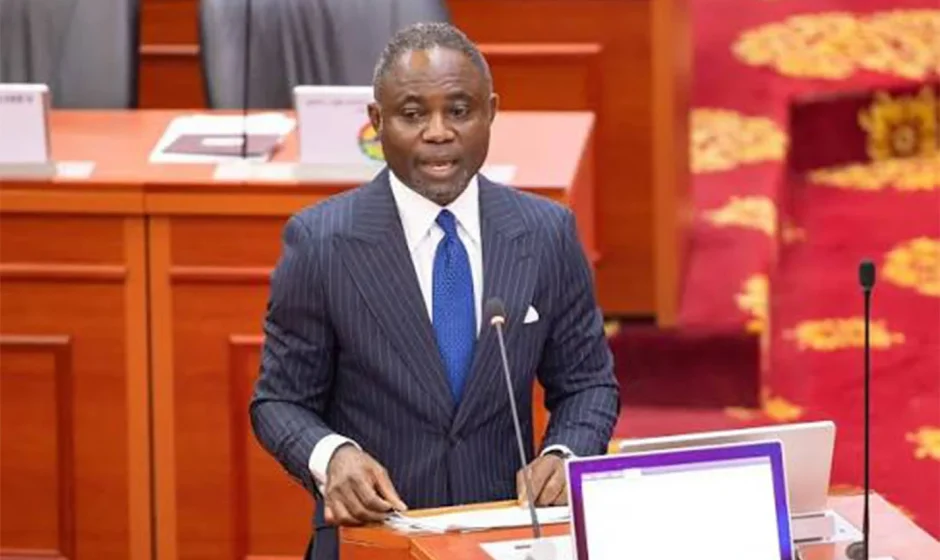

Health Minister Kwabena Mintah Akandoh has announced that Cabinet has decided to discontinue the majority of the Agenda 111 hospital projects, prioritising the completion of only 35 facilities across Ghana instead.
If that sounds like a major shift in healthcare policy, here is the reality: the government is abandoning the previous administration’s ambitious plan to build hospitals in every district without a hospital, and is instead focusing resources on a smaller number of projects deemed most viable and necessary.
That decision matters because Agenda 111 was one of the flagship healthcare initiatives of the Nana Akufo-Addo administration, designed to bridge Ghana’s healthcare infrastructure gap. Scaling it back to 35 projects signals a significant change in how the current government approaches public health investment. Multiple independent Ghanaian news outlets, including Citi Newsroom, Modern Ghana, MyJoyOnline, and GBC Ghana Online, have confirmed the announcement and the government’s stated rationale.
Quick links (related guides):
What Is Agenda 111?
Agenda 111 was launched by the previous Nana Addo Dankwa Akufo-Addo administration as an ambitious healthcare infrastructure program. The initiative was designed to bridge Ghana’s healthcare infrastructure gap by constructing hospitals in districts without such facilities, as well as regional and specialised hospitals.
The program aimed to ensure that every district in Ghana had access to a hospital, addressing long-standing disparities in healthcare access between urban and rural areas. At its peak, it was one of the most significant public health infrastructure investments in Ghana’s history.
Why the Scale-Back?
According to Akandoh, the decision to scale back the program follows a review by Cabinet, which resolved to adopt a phased approach that focuses on completing a smaller number of projects based on priority and available resources.
The minister explained that the move forms part of the government’s efforts to ensure prudent use of public resources and avoid what it describes as unproductive spending.
Speaking in Parliament on Wednesday, July 8, 2026, Akandoh stated: *”I am happy to inform this House that there has been a Cabinet decision on Agenda 111 and we are supposed to phase them out and so Cabinet has taken the decision to invest in the first 35 districts or facilities.”*
The shift suggests that the government has concluded that completing all 111 projects is not financially feasible under current economic conditions, and that a more targeted approach is necessary. This announcement has been corroborated by multiple outlets, including GBC Ghana Online, which had previously reported in June 2026 that the government had prioritised 35 projects under the first phase due to limited financial resources.
How the 35 Projects Will Be Selected
Akandoh outlined three key criteria the government will use to determine which 35 facilities will receive priority funding:
- Level of completion: Projects that are already significantly advanced will be prioritised to avoid wasting resources already invested.
- Need of the people in the area: Facilities in districts with the most urgent healthcare needs will be given preference.
- Regional distribution: The government aims to ensure that at least one facility is completed in every region of Ghana.
This regional distribution requirement is particularly significant, as it guarantees that no region is entirely left out of the program, even as the overall scope is reduced.
Collaboration With CHAG
Beyond the 35 projects, Akandoh indicated that the government intends to deepen collaboration with the Christian Health Association of Ghana (CHAG), a longstanding partner in healthcare delivery.
CHAG operates a network of health facilities across the country and has been a critical player in Ghana’s healthcare system, particularly in underserved areas. The government’s plan to strengthen this partnership suggests that it sees CHAG as a key vehicle for maintaining healthcare access in districts that may no longer receive a new hospital under the scaled-back Agenda 111.
What This Means for Healthcare in Ghana
The decision to scale back Agenda 111 represents a significant policy pivot with several implications:
- Reduced infrastructure spending: The government will spend considerably less on new hospital construction than originally planned.
- Focus on completion: Rather than spreading resources thinly across 111 projects, the government will concentrate on finishing 35 facilities, potentially ensuring they are fully operational rather than left incomplete.
- Greater reliance on CHAG: The partnership with CHAG may become more important for healthcare delivery in districts that do not receive a new hospital.
- Regional equity: The requirement for at least one facility per region ensures some level of geographic balance.
For ordinary Ghanaians, the practical impact will vary by location. Districts with projects selected for completion will see new hospitals delivered. Districts whose projects are not selected may have to rely on existing facilities, CHAG-run clinics, or other healthcare providers. The government’s phased approach, first signaled by President Mahama in May 2026, now appears to be formal policy following Cabinet approval.
Sources