
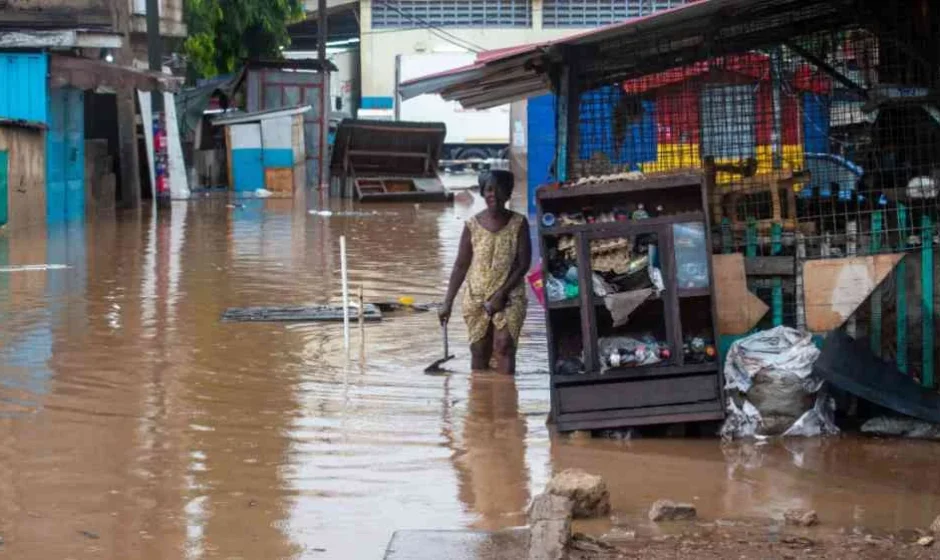

Heavy rains on the morning of June 29, 2026, caused severe flooding across multiple communities in Accra, stranding residents, cutting power, and triggering a simultaneous fire at a rubber factory in the Circle-Odawna area of Accra. Emergency services scrambled to respond, but flooding slowed firefighters trying to reach the blaze. Within hours, the Ministry of the Interior had issued a formal public safety advisory and deployed police, fire, military, and disaster management personnel across the capital.
What happened in Accra on June 29 was not unusual in isolation. Accra floods every rainy season. What was unusual was the scale: entire neighborhoods submerged, the Weija Dam spillway threatening additional downstream communities, a rubber factory burning while fire trucks could not get through, and the Ministry of Health issuing a cholera warning the same day. The situation drew international attention, with Al Jazeera covering the scenes of residents left stranded.
The event also ignited a political dispute. The main opposition New Patriotic Party (NPP) issued a formal statement criticizing the government’s flood response, calling it disorganized and blaming split ministerial responsibility for a confused chain of command. That political dimension, combined with the public health warning and the ongoing fire, makes this more than a routine weather event for residents and diaspora families tracking conditions in Ghana.
Quick links (related guides):
What Happened on June 29
Heavy rainfall hit Accra in the morning hours of June 29, 2026, producing flooding across a wide band of communities that stretch from the northern suburbs down to the coast. Affected areas named in official statements and news reports include the N1 Highway, Apenkwa, Achimota, Kaneshie, Weija, Spintex, Darkuman Junction, and the Kwame Nkrumah Interchange.
Al Jazeera reported that entire neighborhoods were submerged, leaving residents stranded and facing power cuts. The scenes of flooded streets and a fire burning simultaneously drew comparisons to earlier flooding disasters that have struck Accra repeatedly over the past decade. Motorists attempting to drive through flooded roads became trapped, and pedestrian movement across the city was severely disrupted.
The flooding was significant enough that the Ministry of the Interior issued a formal public safety advisory signed by Interior Minister Muntaka Mohammed-Mubarak, urging people to stay where they were and avoid any unnecessary movement until conditions improved.
The Circle-Odawna Fire and Delayed Response
While the floods were developing, a fire broke out at a rubber factory in the Circle-Odawna area of Accra. Al Jazeera described it as a massive fire that was compounded by the flooding: floodwaters slowed firefighters trying to reach the scene, delaying the response and allowing the blaze to spread.
The Ghana National Fire Service (GNFS) confirmed that flooding was a direct factor in its delayed response to the Circle-Odawna fire. Fire officers were unable to navigate routes that were underwater, which is a recurring logistical problem in Accra when heavy rain and emergency incidents occur simultaneously. The GNFS also used the event to publicly call for better-equipped rescue boats, a request that reflects a known gap in Ghana’s flood emergency infrastructure.
The combination of fire and flood hitting the same part of the city at the same time is the kind of compound emergency that strains any urban response system. For Accra, where drainage infrastructure has not kept pace with population growth, compound emergencies of this type are a known seasonal risk.
If you want to understand which parts of Accra are most exposed to this kind of flooding, the flood risk guide for Ghana covers neighborhood-level exposure in more detail.
Government Response: Advisory and Deployment
The Ministry of the Interior’s public advisory, issued June 29, 2026, and signed by Interior Minister Muntaka Mohammed-Mubarak, directed citizens to remain wherever they were until conditions improved. It specifically warned motorists and pedestrians not to attempt crossing flooded roads, bridges, or waterways, noting that floodwaters can rise rapidly and pose serious danger.
The advisory confirmed deployment of the Ghana Police Service, the Ghana National Fire Service, the Ghana Armed Forces, and the National Disaster Management Organisation (NADMO) across the capital to assist affected persons, manage traffic, and conduct rescue operations. Emergency contact numbers listed in the advisory were:
| Agency | Contact Number |
|---|---|
| Ghana Police Service | 18555 or 112 |
| Ghana National Fire Service (GNFS) | 192 |
| National Disaster Management Organisation (NADMO) | 112 |
NADMO separately directed evacuations along the Weija Dam spillway zone, signaling that dam management was an additional concern on top of the surface flooding already hitting urban communities.
The Ministry of Works and Housing also issued a statement urging public cooperation with ongoing flood response efforts, though the specific measures announced were not detailed in reports available at the time of publication.
NPP Criticism: Confusion and Fragmented Authority
The New Patriotic Party (NPP), Ghana’s main opposition, issued a formal statement on June 29 signed by General Secretary Justin Kodua Frimpong that took direct aim at what it described as a disorganized government flood response.
The NPP’s core argument was structural. It claimed that flood management responsibilities had been divided between the Ministry of Local Government and the Ministry of Works, Housing and Water Resources, and that this split created confusion about who was in charge. The party also questioned the role of a Deputy Chief of Staff in coordinating the response, arguing that such an arrangement blurs lines of authority in a crisis situation.
The statement further alleged that some announced flood mitigation measures had not been implemented or had been poorly executed, and that funding constraints were slowing down key interventions. These are claims the opposition has not yet substantiated with documentation, and the government has not formally responded to the specific structural criticisms raised.
The NPP also pushed back on comments attributed to President John Mahama during a town hall meeting abroad, where he reportedly suggested that human behavior contributed to flooding. The party described this framing as unfair to affected citizens, arguing that government bears primary responsibility for designing and managing flood systems, not residents.
The party called for flood management to be consolidated under a single ministry, a clearly designated lead authority to be appointed, and a full public account of the flood task force’s activities and expenditure. It also called for closer coordination with local assemblies and technical experts on land use, sanitation, and drainage.
Whether this political pressure accelerates actual structural reform remains to be seen. Ghana has had debates over flood management accountability for years, and the recurring nature of Accra flooding suggests that institutional arrangements have not yet produced lasting solutions.
Ministry of Health Cholera Warning
The Ministry of Health issued a cholera warning on June 29, cautioning that flooding creates high-risk conditions for waterborne disease transmission. Spokesperson Tony Goodman, speaking on the Citi Breakfast Show, said health authorities had already begun public education campaigns before the rains started, specifically anticipating that flooding would elevate cholera risk.
Goodman identified waste disposal into water bodies as a particular concern, noting that flooding events often prompt residents to treat floodwaters as a disposal channel, which accelerates disease spread. The Ghana Health Service has been sending alerts to districts to monitor for early cholera symptoms as part of its seasonal emergency preparedness protocols.
The Ministry’s position was direct: Ghana is endemic for cholera, and rainy season preparedness routinely includes cholera surveillance and response planning. What the June 29 flooding does is compress the timeline for that risk to materialize, given the scale of the inundation across so many communities simultaneously.
For diaspora families and expats in Accra right now, the practical implication is that water safety and food hygiene need heightened attention in the days following the flooding, particularly in areas where municipal water infrastructure may have been compromised by floodwater intrusion. The top health threats guide for Ghana covers waterborne disease risk in more detail.
Weija Dam and Downstream Risk
NADMO’s directive to evacuate communities along the Weija Dam spillway is a notable development that sits alongside but separate from the urban flooding already affecting Accra. The Weija Dam, which supplies water to parts of Accra, becomes a downstream flood risk when heavy rainfall pushes reservoir levels high enough to require spillway releases.
Communities located along the spillway channel have faced displacement in previous years when dam management decisions were made during heavy rain seasons. The June 29 evacuation directive suggests that dam levels on that day reached a threshold that required precautionary action.
No information was available at the time of publication on the specific extent of the spillway release or how many households were affected by the evacuation directive. Residents near the Weija Dam corridor should follow updates from NADMO and local district assembly communications directly.
What Residents and Diaspora Should Watch
For people currently in Accra, the Ministry of the Interior’s guidance remains in effect: avoid unnecessary movement, do not drive through floodwaters, and use official channels for emergency information. The GMet weather service issued a fresh rain warning on June 29, indicating that conditions may not improve immediately.
For diaspora families trying to reach relatives in affected neighborhoods, phone connectivity may be disrupted in areas that lost power. The communities with the highest reported flooding on June 29 include N1 Highway, Apenkwa, Achimota, Kaneshie, Weija, Spintex, Darkuman Junction, and the Kwame Nkrumah Interchange zone.
On the health side, the cholera warning from the Ministry of Health means that post-flood hygiene practices matter in the days and weeks ahead. Boiling or using treated water for drinking, washing hands before food preparation, and avoiding food sold near floodwater-contaminated areas are the baseline precautions recommended in any cholera-risk environment.
The political question of whether Ghana’s flood management structure will be reformed is a longer-term issue. The NPP’s call for consolidated ministerial authority and a named lead coordinator reflects a governance debate that has resurfaced after each major flood event in recent years. Whether the Mahama administration responds with structural changes or incremental adjustments will determine whether the next heavy rainy season produces a different outcome.
The Ghana rainy season guide provides broader context on what to expect across the June-to-September period, including how flood patterns typically develop in Accra and other regions.
Sources
- CitiNewsroom: “NPP: Govt’s flood response marked by confusion and failure” (June 29, 2026)
- Ministry of the Interior, Republic of Ghana: “Public Safety Advisory on Flooding” (June 29, 2026)
- CitiNewsroom: “MoH warns of possible cholera outbreak after flooding across Accra” (June 29, 2026)
- Al Jazeera: “Fire and floods hit Ghana’s capital as residents are left stranded” (June 29, 2026)