

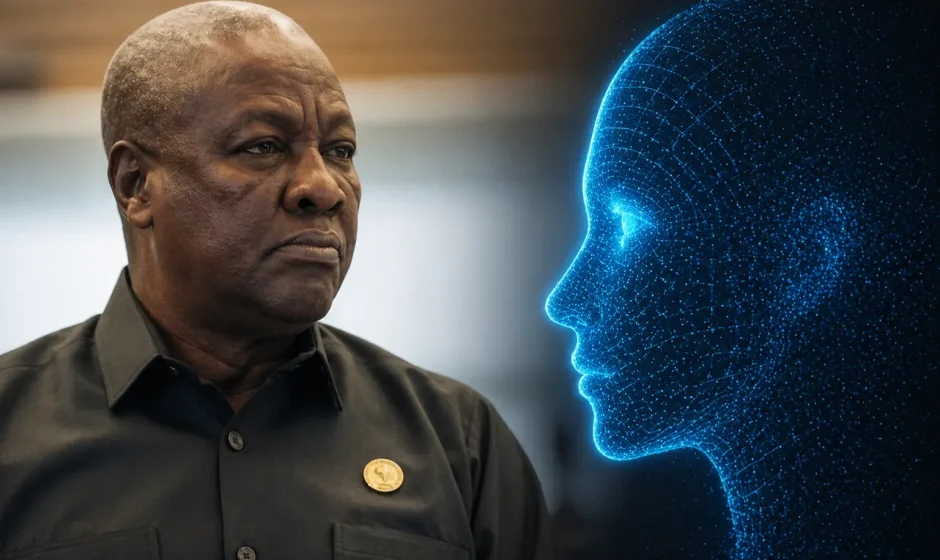

President John Dramani Mahama has formally launched Ghana’s National Artificial Intelligence Strategy, positioning the country to harness AI for inclusive growth while ensuring technology reflects local values and culture. The official launch took place on Friday, April 24, 2026, at the Labadi Beach Hotel in Accra. The strategy covers the period 2023 to 2033 and was originally developed under the previous administration with support from Smart Africa, the German development agency GIZ FAIR Forward, and The Future Society. After receiving Cabinet approval from the Mahama administration, it was formally adopted and launched on April 24. The plan focuses on job creation, startup growth, public-sector modernization, education reform, digital inclusion, and local innovation, with the goal of making Ghana an active builder of AI systems rather than a consumer of technology developed elsewhere.
To underscore the significance of the moment, an AI-powered robot walked across the stage at the event and handed the strategy document to President Mahama before he officially declared the launch. The government backed the adoption with a $270 million financial commitment: $250 million earmarked for a world-class AI Computing Centre, and a further $20 million directed at short-to-medium-term implementation of the strategy.
This is one of the most significant technology policy announcements in Ghana in recent years. If implemented effectively, it could reshape how students learn, how businesses operate, how government services are delivered, and how Ghana competes in the global digital economy.
Quick links (related guides):
Table of Contents
What Mahama Announced
Ghana’s National AI Strategy (2023-2033) is the country’s formal, Cabinet-approved blueprint for artificial intelligence development. The document was originally developed under the previous Akufo-Addo administration in partnership with Smart Africa, GIZ FAIR Forward, and The Future Society. After the Mahama administration took office in January 2025, the strategy was reviewed, received Cabinet approval, and was officially launched on April 24, 2026, at the Labadi Beach Hotel in Accra. The event brought together government officials – including Interior Minister Hon. Muntaka Mohammed-Mubarak and the ministers for Foreign Affairs, Education, and Fisheries – as well as industry leaders, academics, and development partners.
President Mahama described the strategy as a national roadmap with measurable targets and indicators across multiple pillars. A key institutional feature is the creation of a Responsible Artificial Intelligence Office to coordinate stakeholders across government, academia, and the private sector, and to oversee implementation throughout the 10-year period.
The strategy is structured around eight pillars: AI education and skills development, youth employment pathways, digital infrastructure, data governance, ecosystem coordination, sector-wide AI adoption, applied research, and public sector AI deployment. Seven priority sectors are identified for implementation: healthcare, agriculture, financial services, transportation, energy, environment and land management.
Mahama framed the strategy not just as a technology policy but as a national call to action. “Ghana must build, own, and govern AI that understands the local languages, respects Ghanaian culture, and solves their problems,” he said, stressing that the country should not remain a consumer of foreign AI systems alone.
The $270 Million Investment
The most concrete financial announcement from the launch was a combined commitment of $270 million. The larger portion – $250 million – is earmarked for the construction of a world-class national AI Computing Centre. President Mahama described this facility as the backbone of Ghana’s AI development, intended to serve as a hub for research, innovation, and enterprise that will allow Ghanaian experts to develop solutions for both the local market and the wider African continent.
The remaining $20 million is directed at the short-to-medium-term implementation of the strategy itself, covering capacity building, institutional setup, and programme rollout in the near term.
| Investment Component | Amount | Purpose |
|---|---|---|
| National AI Computing Centre | $250 million | Research, innovation, and enterprise hub for AI development |
| Strategy Implementation Fund | $20 million | Short-to-medium-term delivery of the National AI Strategy priorities |
| Total Commitment | $270 million | Full scope of government investment announced at launch |
Mahama acknowledged that government cannot achieve its AI goals in isolation. He called for strong partnerships between the state, academia, industry, civil society, and development partners to complement the public investment. Ghana currently ranks 72nd globally and 6th in Africa on the Global AI Index 2025, behind Egypt, Mauritius, South Africa, and Tunisia. The $270 million commitment is a serious capital deployment by any African government standard and signals intent to move that ranking.
Governance and Accountability
A notable feature of the Mahama administration’s approach to the strategy rollout is an early emphasis on governance literacy within the government itself. Reporting from the launch indicated that senior officials undertook AI orientation and capacity-building sessions ahead of the formal launch – an effort to ensure that decision-makers understand what they are overseeing before implementation begins. This kind of pre-launch preparation is uncommon for national AI strategies in the region.
Beyond that preparation, the government has introduced key performance indicators across all ministries, departments, and agencies to track measurable AI adoption. The Responsible Artificial Intelligence Office will use these indicators to monitor implementation and hold institutions accountable against the strategy’s targets through 2033.
Why This Matters for Ghana
Many countries are racing to integrate AI into their economies. Nations that build local talent, computing capacity, and strong policy frameworks early may secure long-term advantages in digital industries. For Ghana, this strategy signals an intent to move up the value chain – from raw resource exports and service outsourcing into higher-value digital production.
In practical terms, AI built with local context can help Ghana address problems that generic foreign tools often miss. Potential applications include healthcare diagnostics in under-served communities, fraud detection in mobile money and banking, crop forecasting and pest alerts for farmers, traffic management in urban centers like Accra and Kumasi, translation and voice tools for local languages, faster processing of government records and citizen services, and personalized education tools adapted to Ghanaian school contexts.
The strategy explicitly targets sectors where AI adoption could have the most immediate development impact, rather than positioning Ghana as a general-purpose tech destination. That focus is one reason some observers view this strategy as more grounded than previous digital economy announcements in the region.
Education and Workforce Development
One of the strategy’s clearest commitments is early education reform. Mahama announced that AI, coding, robotics, and electronics will be introduced at the basic school level. The Ministry of Education’s Curriculum Review Committee has been tasked to complete its work by the end of June 2026, after which the new subjects can be rolled out. That means students could be exposed to future-focused skills significantly earlier than previous generations.
At the tertiary level, universities are expected to lead in frontier research, with innovation hubs encouraged to grow beyond Accra into other regions. The government’s vision is a pipeline running from basic school coding literacy through to university-level AI research and startup formation.
Closely linked to this is the One Million Coders Programme, which is already underway as a parallel workforce development initiative. At the April 24 launch, Mahama confirmed that 300,000 Ghanaians are expected to receive training this year under the programme, with more than 100,000 applications already processed. The nationwide rollout officially began on April 10, 2026, with 130 training centres activated across all 16 regions, each equipped with customised laptops for coding instruction. Twelve universities – including the University of Ghana, Kwame Nkrumah University of Science and Technology, and the University of Cape Coast – are participating in the first phase.
Private sector partners are contributing meaningfully. MTN Ghana committed resources valued at approximately $2 million to support laptop procurement for university participants, and Telecel Ghana announced it would provide free training to 100,000 young Ghanaians at no cost to participants – a contribution valued at around $5 million.
The programme has not been without criticism. Early reporting raised concerns about laptop procurement costs and whether a clear post-training employment pathway exists. Communications Minister Samuel Nartey George has acknowledged these concerns and stated that the government’s goal is not just training volume, but ensuring graduates obtain internationally recognised certifications and secure real employment – including in remote digital jobs. Whether the programme delivers on that full chain will be one of the key near-term tests of the broader AI strategy’s credibility.
AI adoption without workforce training can widen inequality. But if training reaches ordinary citizens – especially outside major cities – it can create upward mobility at scale.
What It Could Mean for Startups and Business
The strategy repeatedly emphasizes entrepreneurship and startup growth. Ghana already has a growing ecosystem of fintech, logistics, e-commerce, education technology, and health technology founders. AI could give these companies new tools to compete regionally and globally.
Near-term applications for Ghanaian businesses include customer service automation for small and medium enterprises, predictive analytics for retail demand planning, credit scoring for consumers who lack formal credit histories, fraud monitoring for fintech platforms, supply-chain optimization across agriculture and trade, local-language voice assistants, and marketing automation tools for exporters.
The Communications Minister linked Ghana’s AI ambitions directly to the African Continental Free Trade Area (AfCFTA) Secretariat – headquartered in Accra – arguing that AI will be central to driving digital trade and inclusive growth across the continent. He set a benchmark of scaling AI solutions from 20,000 users locally to 20 million across Africa. For investors and businesses planning to operate in Ghana, that continental positioning is a meaningful signal.
Partners Behind the Strategy
The National AI Strategy was developed with input from multiple institutions over several years. The original framework was produced by the Ministry of Communications and Digitalisation working with Smart Africa, GIZ FAIR Forward, and The Future Society, based on more than 40 stakeholder consultations and an extensive SWOT analysis of Ghana’s AI ecosystem.
At the April 24 launch, Mahama publicly acknowledged the contributions of the Ministry of Communications, Digital Technology and Innovation, the UK High Commission in Ghana, GIZ, the United Nations group, and the Responsible AI Lab at Kwame Nkrumah University of Science and Technology. The UNESCO-led AI Readiness Assessment Methodology process – funded by the European Union – also shaped the final form of the strategy as adopted by the Mahama Cabinet.
The involvement of KNUST’s Responsible AI Lab is particularly significant. It places a Ghanaian academic institution at the center of AI ethics and governance work, rather than relying entirely on external consultants or foreign frameworks.
The Real Challenges Ahead
A strategy document is only the beginning. Execution is where many countries fall short. Ghana will face several structural hurdles that the strategy itself acknowledges, even if the launch event kept the focus on ambition rather than obstacles.
| Challenge | Why It Matters |
|---|---|
| Electricity reliability | AI systems and data centres require stable, uninterrupted power – a persistent pressure point in Ghana. |
| Internet access | Meaningful AI adoption in rural regions depends on affordable, reliable broadband coverage. |
| Funding continuity | The $270 million commitment must survive budget cycles, potential donor dependency, and political transitions. |
| Brain drain | Skilled Ghanaian AI talent faces significant international demand. Retention requires competitive conditions at home. |
| Data governance | Privacy protections and data sovereignty rules must be established before sensitive AI systems scale. |
| Employment pipeline | Training programmes must connect to real jobs, not produce graduates without viable career pathways. |
| Implementation discipline | Announced targets must translate into measurable results, year by year, through 2033. |
The KPIs introduced across all government agencies and the AI capacity-building sessions held ahead of the launch suggest some awareness that accountability mechanisms must be built in from the start. The strongest AI economies in the world are built through consistent annual execution – not launch events.
The Bigger Picture for Africa
Ghana is not alone in this race. Kenya, Nigeria, Rwanda, and South Africa have all moved to formalize AI policy in recent years. The question is not whether African governments will develop AI strategies, but which will build the institutional capacity to follow through on them.
Ghana’s emphasis on indigenous language technologies is one of the more distinctive elements of its approach. The majority of global AI systems are built around English and a small number of dominant world languages. If Ghana develops strong tools for Twi, Dagbani, Ewe, Ga, and other local languages, it could produce solutions with demand far beyond its own borders – including across the West African region.
A concrete benchmark was articulated at the launch: by 2030, a farmer in the Northern Region should be able to use an AI tool in Dagbani, and Ghanaian engineers should be building the underlying models rather than simply deploying foreign ones. That is a testable standard the country can be held to.
Bottom Line
Ghana’s National AI Strategy (2023-2033), formally adopted and launched under President Mahama on April 24, 2026, is more than a technology headline. Backed by a $270 million government commitment and anchored by an institutional accountability structure – including the Responsible Artificial Intelligence Office and KPIs across all ministries – it is a serious attempt to position Ghana as West Africa’s leading AI economy by 2033.
The opportunity is real. The difficulty is equally real. Whether this becomes a transformational national project will depend on infrastructure investment, political continuity, talent retention, the success of workforce programmes, and sustained year-on-year execution across the full period.
For diaspora members, investors, and professionals watching Ghana’s development trajectory, this strategy is worth tracking closely. The decisions made in the next three to five years will determine whether the 2033 vision becomes a reference point for African digital development – or a cautionary tale about the gap between ambition and delivery.
Planning to do business in Ghana or relocate? Our e-book covers everything you need to know about living, working, and investing in Ghana as a foreigner. Get your copy here.
Sources
- Ministry of the Interior, Republic of Ghana: “President Mahama Launches Ghana’s National AI Strategy, Calls for AI That Reflects Ghanaian Values” (April 24, 2026)
- Ghana Broadcasting Corporation: “Government invest $250m to establish national AI computing centre – President Mahama” (April 24, 2026)
- Ghana Broadcasting Corporation: “AI will be embedded across our education system to prepare our children for the digital age – President Mahama” (April 24, 2026)
- MyJoyOnline: “Mahama unveils plan to train 300,000 in Coding and AI this year” (April 24, 2026)
- Adom Online: “Mahama unveils 10-year AI strategy, outlines vision for Ghana’s digital future” (April 24, 2026)
- Ghana Chamber of Telecommunications: “Ghana to Launch National AI Strategy on April 24 as Mahama Sets Continental Vision” (April 2026)
- Africa AI News: “Ghana approves $250M AI Hub and National AI Strategy” (April 2026)
- Xinhua: “Ghana vows to accelerate AI development” (April 25, 2026)
- TechAfrica News: “Ghana Launches Nationwide One Million Coders Programme with Laptop Distribution” (April 13, 2026)
- Digital Watch Observatory: “Ghana’s National Artificial Intelligence Strategy (2023-2033)”