



Ghana flies home xenophobia victim Emmanuel Asamoah after a viral video showing the Ghanaian legal resident being confronted by a vigilante group in KwaZulu-Natal, South Africa triggered a swift diplomatic response. Foreign Affairs Minister Samuel Okudzeto Ablakwa personally confirmed the government will cover the full cost of Asamoah’s relocation. The incident has since expanded into a much larger debate, drawing in the Economic Community of West African States, the African Union, South Africa’s courts, and Ghana’s historical role in the anti-apartheid struggle. What began as one video has become a regional test of whether African governments can protect their citizens across borders.
Quick links (related guides):
Table of Contents
- What happened: the KwaZulu-Natal confrontation
- Ghana’s diplomatic response
- Officials say statements are not enough
- Why past measures are being questioned
- Operation Dudula: the movement behind the violence
- Ghana’s anti-apartheid history and the betrayal argument
- Why some blame poverty and inequality
- What happens next
- Sources
What happened: the KwaZulu-Natal confrontation
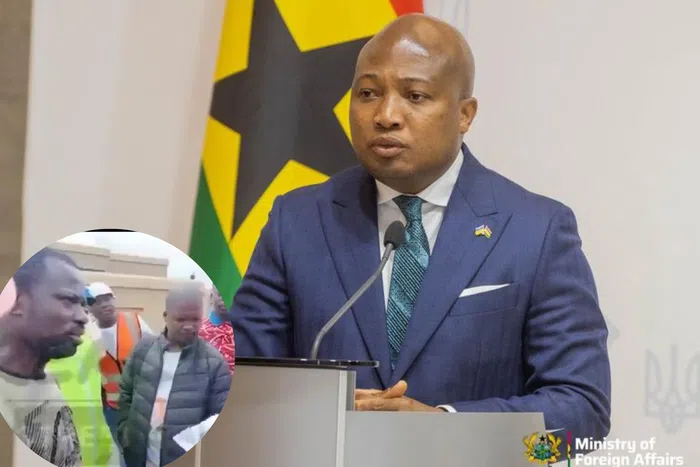
Emmanuel Asamoah is a Ghanaian national legally residing in South Africa. A video showing him being surrounded by a group of approximately 15 people in KwaZulu-Natal province circulated widely on social media and triggered the diplomatic dispute. In the footage, the group demanded he produce his passport. Asamoah presented a certified copy, explaining he had left the original at home due to rain, and showed documentation confirming his legal entry to South Africa in April 2026. The group dismissed his explanation, accused him of obtaining the document from a corrupt official, and told him to leave the country.
Foreign Affairs Minister Samuel Okudzeto Ablakwa confirmed that Asamoah holds the appropriate documentation to reside in South Africa and had not broken any law. After meeting Ghana’s High Commissioner to South Africa, Benjamin Quashie, Asamoah told Ghanaians he was doing well. Speaking on TV3, Ablakwa said the government would cover all relocation costs. The minister described the decision to move Asamoah partly as a response to safety concerns arising from the public exposure of his identity.
Separately, protests in Mthatha demanding that job opportunities be given to South Africans ahead of foreigners led the local Ghanaian community chairman, Dr Yirenyi Gyekye Darko, to advise Ghanaian traders in the area to delay opening their businesses until midday and to exercise caution. That guidance reflects the broader anxiety among Ghana’s diaspora community in South Africa about the current climate.
Ghana’s diplomatic response
Ghana’s response was immediate and escalated quickly through official channels. On Thursday April 23, Ablakwa summoned South Africa’s Acting High Commissioner to Ghana, Thando Dalamba, and formally demanded protection for Ghanaian nationals. He also held a direct telephone call with South Africa’s Minister for International Relations and Cooperation, Ronald Lamola, who reportedly committed to full-scale investigations into the incidents.
At the signing of a memorandum of understanding between Ghana and Sierra Leone on the same day, Ablakwa described the attacks as a betrayal of the African solidarity Ghana demonstrated during South Africa’s anti-apartheid struggle, noting that targeting fellow Africans undermines the spirit of continental unity. He urged Ghanaians in South Africa to remain calm and avoid any retaliatory action, stressing that the government’s response would remain diplomatic. Ablakwa also warned publicly against retaliatory attacks against South African nationals inside Ghana.
South Africa’s acting police minister, Firoz Cachalia, responded publicly on Friday April 25, describing xenophobic acts as unlawful, a violation of the country’s constitutional values, and stating that those found participating in, inciting, or supporting such conduct would be identified, apprehended, and prosecuted. South Africa’s Ministry of Police also confirmed that the South African Police Service had been instructed to act decisively and without hesitation.
Officials say statements are not enough
Former Ghana High Commissioner to South Africa Charles Owiredu, who also previously served as Ghana’s deputy foreign minister, has criticized the official response on both sides, arguing that ministry statements and joint condemnations have never produced a lasting solution. Speaking on JoyNews’ Newsfile on Saturday April 25, he said that although key South African figures have consistently condemned such acts, the violence continues to recur, often on an annual basis.
Owiredu made a specific call that goes beyond what previous diplomatic cycles have attempted: the current High Commissioner should involve ECOWAS Ambassadors and engage the African Union, because the attacks are not directed at Ghanaians alone but at foreign nationals from across the continent. A coordinated, multi-country response, he argued, is more likely to produce a durable outcome than bilateral statements between Accra and Pretoria.
That argument carries weight. Several other voices across the region, including an Abirem Member of Parliament, have echoed the call for a unified African response to what is now a continental pattern of anti-migrant violence rather than an isolated bilateral dispute.
Why past measures are being questioned
South Africa has a National Action Plan to Combat Racism, Racial Discrimination, Xenophobia and Related Intolerance, originally adopted in 2019. In November 2025, the Johannesburg High Court found that the government had failed to adequately implement it, ordering the state to take concrete steps to operationalise the plan. The court also confirmed that all persons in South Africa, regardless of nationality, are entitled to dignity, equality, and protection under the Constitution, and that reasonable suspicion is required before anyone can be stopped and asked to produce identification in a public space.
That ruling followed a legal case brought by civil society groups against Operation Dudula, in which applicants sought orders prohibiting the group from threatening, intimidating, or harassing people based on nationality, and compelling the government to fulfill its constitutional obligations to foreign nationals. The International Commission of Jurists separately intervened in the case as a friend of the court, urging the High Court to apply international law protecting migrants and refugees from discrimination and xenophobic violence.
The pattern critics identify is consistent: statements are issued, courts rule, plans are adopted, and the violence still returns. Owiredu’s argument is that without a fundamentally different enforcement model and genuine political accountability, the current cycle will repeat after this episode fades from the news.
Operation Dudula: the movement behind the violence
Operation Dudula is the vigilante movement most closely associated with recent anti-foreigner actions in South Africa. The word “dudula” means “push out” or “force out” in isiZulu. The movement was established in Soweto, a township of Johannesburg, and has since spread to other parts of the country. It has since evolved into a political party while retaining its street-level presence.
The group presents its campaign as a push against undocumented migration and criminality. In practice, it has become widely associated with targeting foreign nationals at clinics, schools, and businesses, often demanding identity documents and accusing migrants of draining public services and taking jobs that belong to South Africans. A Johannesburg High Court ruling confirmed that Operation Dudula’s clinic blockades were unlawful, and that migrants retain full constitutional rights to health care, regardless of immigration status.
South Africa’s Ministry of Police has specifically linked vigilante groups such as Operation Dudula to recent xenophobic violence and confirmed that the South African Police Service has been instructed to act against those found participating in or inciting such conduct. Rights organizations including Human Rights Watch have warned that anti-immigrant groups in South Africa have systematically blocked migrants from health care and education despite constitutional protections, and that the pattern extends well beyond street-level intimidation.
Ghana’s anti-apartheid history and the betrayal argument
A significant part of Ghana’s diplomatic response to this incident rests on a historical argument. When South African anti-apartheid activists were being persecuted by the apartheid state, Ghana under Kwame Nkrumah opened its doors. Accra became a base for liberation movement leaders, including figures affiliated with the African National Congress. The 1958 All-African Peoples Conference, held in Accra, was used by Nkrumah to push the global community toward isolating apartheid South Africa years before it became an internationally coordinated effort. Ghana provided support, shelter, and in some documented cases, travel documents to stateless individuals fleeing the regime.
Ablakwa invoked this history directly when summoning South Africa’s Acting High Commissioner, arguing that attacks on law-abiding foreign nationals represent a betrayal of the African unity and solidarity that Ghana’s support for the liberation struggle was meant to build. That framing gives the current diplomatic protest a moral weight that goes beyond the immediate consular case.
The argument has resonance but also complexity. Critics note that South Africa is a sovereign state facing real domestic pressures, and that the current government does not bear direct institutional responsibility for its predecessors’ choices. The more practical question, which Owiredu and others are pressing, is whether South Africa’s current leadership is willing to enforce its own constitution and court orders against vigilante groups that operate in open defiance of both.
Why some blame poverty and inequality
Owiredu also addressed the underlying socioeconomic drivers of xenophobia directly. South Africa carries an unemployment rate of over 30 percent, and more than three million foreigners live in the country, representing approximately 5.1 percent of the population. When jobs are scarce and public frustration is high, organized groups have pointed to foreign nationals as a convenient explanation for problems that are far more structural in origin.
The argument runs: migrants are running businesses, taking informal employment, or accessing public services that some South Africans believe should be reserved for citizens. Operation Dudula has explicitly campaigned for small businesses to employ only South Africans and for foreign shopkeepers to close and leave. The Johannesburg High Court has ruled that such actions violate constitutional rights, but the rulings have not stopped the campaigns.
Analysts note that xenophobia in South Africa is not simply a product of poverty, but of poverty combined with weak state accountability, organized political mobilization of grievance, and a long history of scapegoating migrants that predates the current economic crisis. The first major wave of xenophobic violence in South Africa occurred in May 2008, when attacks spread nationwide, killing approximately 62 people. The pattern of recurring violence since then suggests the problem is structural, not episodic.
None of this justifies what was done to Emmanuel Asamoah or to others like him. But understanding the drivers matters for designing responses that go beyond statements and court orders, and actually interrupt the cycle.
What happens next
| Stakeholder | Likely Next Step | Key Challenge |
|---|---|---|
| Ghana Government | Complete Asamoah’s relocation, maintain diplomatic pressure on Pretoria, and monitor conditions for other Ghanaians in South Africa. | Keeping sustained attention on the issue beyond the news cycle. |
| South African Authorities | Demonstrate enforcement against Operation Dudula and other groups under the pledges made by Cachalia and Lamola. | Converting public condemnations into prosecutions and actual protection on the ground. |
| ECOWAS and African Union | Consider a coordinated regional response as called for by Owiredu and multiple commentators. | Turning diplomatic solidarity into a mechanism with enforceable outcomes. |
| Ghanaian Diaspora in South Africa | Follow safety guidance, delay trading in high-tension areas, and maintain communication through community networks. | Balancing daily economic survival against physical safety in a volatile environment. |
| South African Courts | Monitor compliance with the November 2025 High Court ruling requiring the government to implement the National Action Plan against xenophobia. | Enforcement of orders against a government that has so far failed to fully operationalise the plan. |
This story is about one man, but the question it raises is a continental one: whether African governments can protect their citizens across borders, hold vigilante groups accountable, and build the kind of regional trust that pan-African solidarity has always promised but rarely delivered in practice.
Sources
- News Ghana: “Ghana to Fly Home Xenophobia Victim Emmanuel Asamoah From South Africa” (April 25, 2026)
- News Ghana: “Ghana Evacuates Citizen as South Africa Pledges Xenophobia Crackdown” (April 25, 2026)
- MyJoyOnline: “Xenophobia Attacks: S.A Police Ministry’s Statement Is Not Enough – Charles Owiredu” (April 26, 2026)
- MyJoyOnline: “Xenophobia: Former Ghana High Commissioner to South Africa Urges a Shift From Ineffective Past Measures” (April 26, 2026)
- MyJoyOnline: “Some South Africans See Xenophobia as a Solution to Poverty and Inequality – Charles Owiredu” (April 26, 2026)
- CAJ News Africa: “South Africa Condemns Xenophobic Violence” (April 24, 2026)
- The Africa Report: “Ghana Drags South Africa’s Xenophobia Into the Diplomatic Light” (April 2026)
- Power Law Africa: “Kopanang Against Xenophobia and Others v Operation Dudula and Others” (November 4, 2025)
- International Commission of Jurists: “South Africa: ICJ Urges High Court to Apply International Law Protecting Migrants” (July 2025)
250 Things to Know Before Moving to Ghana