
The Northern Region is one of the sixteen administrative regions of Ghana, located in the northern part of the country. It is the second largest region in Ghana by land area, with an area of 26,524 km², according to the 2021 census. The Savannah Region is the largest. The region serves as a vital cultural and economic hub for the northern territories. The region is defined by its capital, Tamale, its predominantly rural population, and its deep-rooted traditions, including the historic Dagbon kingdom. Understanding the Northern Region of Ghana is essential to grasping the country's diverse ethnic landscape, agricultural economy, and the administrative changes that reshaped the nation's political map in 2018.
Location
Capital and Administration
The capital of the Northern Region is Tamale, which also serves as the region's largest settlement and administrative center. The region's political and administrative structure is anchored by the Northern Regional Coordinating Council (RCC), which is headquartered in Tamale. The RCC's role is to coordinate, harmonize, monitor, and evaluate the activities of District Assemblies as well as government ministries, departments, and agencies operating within the region. The political head of the region is the Regional Minister, who is appointed by the central government.
The Northern Region operates under Ghana's local government system. The region is divided into 16 Metropolitan, Municipal, and District Assemblies (MMDAs). This structure includes 1 Metropolitan, 6 Municipal, and 9 District Assemblies. Each assembly is administered by a Chief Executive who represents the central government, while a presiding member, elected from among the assembly members, heads the legislative functions of the assembly.
The 16 MMDAs of the Northern Region, as documented by the Local Government Service, are:
- Tamale Metropolitan (capital: Tamale)
- Gushegu Municipal (capital: Gushegu)
- Sagnarigu Municipal (capital: Sagnarigu)
- Savelugu Municipal (capital: Savelugu)
- Yendi Municipal (capital: Yendi)
- Nanumba North Municipal (capital: Bimbilla)
- Kumbungu District (capital: Kumbungu)
- Tolon District (capital: Tolon)
- Mion District (capital: Sang)
- Nanton District (capital: Nanton)
- Karaga District (capital: Karaga)
- Kpandai District (capital: Kpandai)
- Nanumba South District (capital: Wulensi)
- Saboba District (capital: Saboba)
- Tatale Sanguli District (capital: Tatale)
- Zabzugu District (capital: Zabzugu)
This administrative framework reflects the region's importance in Ghana's decentralized governance model. The official website for the Northern Regional Coordinating Council is northernrcc.gov.gh.
Population and Geography
According to the 2021 Population and Housing Census conducted by the Ghana Statistical Service, the Northern Region recorded a population of 2,310,939. This figure represents a significant increase from the region's population in the 2010 census. The 2021 census noted that the current Northern Region observed the largest change in population among all sixteen regions, with an almost 50% increase over its 2010 population. This growth is partly attributed to the creation of two new regions, North East and Savannah, which were carved out of the former Northern Region in 2018. The remaining territory, now the Northern Region, continued to experience substantial demographic growth.
The Northern Region is the second largest administrative region in Ghana by land area, with an area of 26,524 km², according to the 2021 census. The Savannah Region is the largest. Its geography is characterized by the Guinea Savannah ecological zone, which features short, fire-resistant trees interspersed with grasses. Common tree species in this zone include the baobab, kapok, parkia, and the economically valuable sheanut tree. The region experiences two marked seasons: a wet season brought by South-Western Monsoon winds from the Atlantic Ocean, typically from May to September, and a long dry season brought by North-Eastern Trade winds from the Sahara Desert, typically from October to April. Temperatures can reach as high as 41°C in March and April, just before the onset of the rainy season.
The region's population density is lower than the national average, reflecting its predominantly rural character. Settlement patterns vary across the region, with some communities dispersed and others nucleated. The distribution of settlements poses challenges for the provision of basic services such as water and healthcare, particularly in rural areas.
Major Towns
Tamale is the undisputed capital and largest settlement of the Northern Region. As the regional capital, it hosts the Regional Coordinating Council and serves as the primary commercial and administrative center. Tamale's status as a Metropolitan Assembly underscores its urban importance within the region.
Beyond Tamale, several other towns serve as administrative capitals for the region's municipalities and districts. Yendi, the capital of Yendi Municipal, holds particular historical and cultural significance as the seat of the Dagbon traditional kingdom. Bimbilla, the capital of Nanumba North Municipal, is another important traditional and administrative center. Savelugu, Gushegu, and Sagnarigu are additional municipal capitals that contribute to the region's urban network.
Other notable district capitals include Karaga, Kpandai, Kumbungu, Sang (Mion District), Nanton, Wulensi (Nanumba South), Saboba, Tatale, Tolon, and Zabzugu. These towns, while smaller than Tamale, serve as crucial service centers for their surrounding rural populations. They host district assemblies, markets, health facilities, and schools that anchor local economic and social life.
Languages and Culture
The Northern Region is culturally rich and linguistically diverse. English is the official language of Ghana and is used in formal government and educational settings. However, the everyday lives of the region's people are conducted in a variety of local languages. The most widely spoken indigenous language in the region is Dagbani, the language of the Dagomba people, who constitute the largest ethnic group in the region. Other significant languages spoken in the Northern Region include Gonja, Mampruli, and various Gurma languages, reflecting the region's ethnic diversity.
The cultural identity of the Northern Region is deeply intertwined with the Dagbon kingdom, one of Ghana's oldest and most prominent traditional states. The kingdom's seat is in Yendi, and its influence extends across much of the region. The Ya-Na, the traditional ruler of Dagbon, is one of the most revered traditional authorities in Ghana. The region's chieftaincy structures play a vital role in local governance, dispute resolution, and the preservation of cultural heritage.
Festivals are an integral part of cultural life in the Northern Region. The Damba festival, celebrated by the Dagomba and other groups, is one of the most prominent. It is held to mark the birth and naming of the Prophet Muhammad and features drumming, dancing, and durbar processions of chiefs. The Bugum (fire) festival is another significant observance in the region. These festivals serve as occasions for community gathering, the reinforcement of social bonds, and the display of traditional regalia and music.
The region's cultural practices are also reflected in its cuisine. A staple food across the Northern Region is Tuo Zaafi, a thick porridge made from maize or millet flour, often abbreviated as TZ. It is typically served with soups made from ingredients such as okra, dawadawa (locust beans), or groundnuts. This dish is central to the region's culinary identity and is widely consumed across northern Ghana.
Economy
Agriculture is the backbone of the Northern Region's economy, employing the majority of the working population. The region's Guinea Savannah ecology supports the cultivation of a range of crops. Farmers grow cereals such as maize, millet, and guinea corn (sorghum), as well as legumes like groundnuts, beans, and cowpea. Root and tuber crops, including yam and cassava, are also cultivated, particularly in the southern parts of the region. Vegetables such as okra and pepper are commonly grown for both household consumption and local markets.
Livestock rearing is a significant economic activity in the Northern Region. Cattle, sheep, and goats are the predominant livestock, and guinea fowl is the main poultry raised in the region. Livestock provides a source of income, food, and social capital, with cattle often serving as a store of wealth and a key component of marriage and ceremonial transactions.
The sheanut tree, which grows wild across the region, is economically valuable. Shea nuts are harvested and processed into shea butter, which is used in cooking, cosmetics, and traditional medicine. Shea butter production, particularly by women's groups, provides an important source of income for rural households.
The region's economy also includes trade and commerce, centered primarily in Tamale. As the largest urban center in northern Ghana, Tamale functions as a commercial hub, connecting the region to other parts of the country. Markets in Tamale and the district capitals facilitate the exchange of agricultural produce, livestock, and manufactured goods. The dry season, which extends roughly from October to May, prompts many people to migrate to southern Ghana for work, a pattern that supplements household incomes in the region.
Landmarks and Tourism
The Northern Region offers a range of landmarks and tourist attractions that reflect its natural environment and cultural heritage. While the region is less promoted for tourism than southern Ghana, it holds significant potential for visitors interested in history, culture, and nature.
The region's traditional architecture is a notable feature. The Dagomba people are known for their distinctive round huts with conical thatched roofs, often arranged in family compounds. These structures are particularly visible in rural areas and offer visitors a glimpse into traditional building techniques adapted to the region's climate.
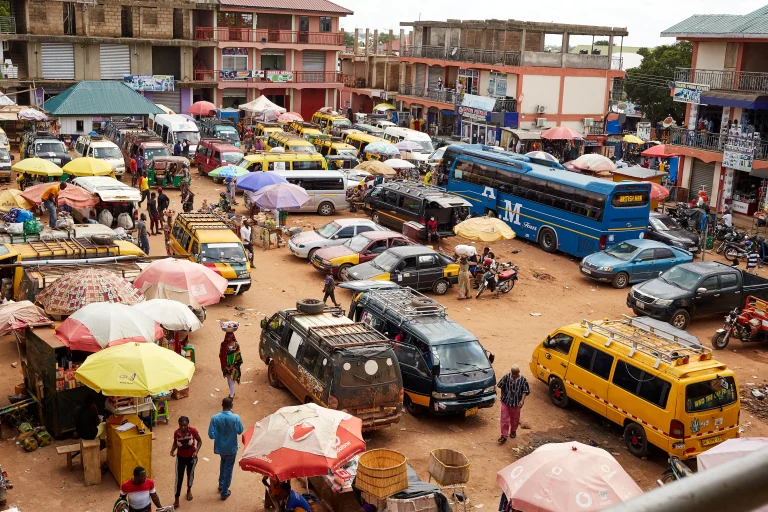
Tamale, as the regional capital, is home to the Central Mosque, one of the largest mosques in Ghana. The city's bustling markets, including the Tamale Central Market, provide an authentic experience of daily life and commerce in northern Ghana. Visitors can explore the city's craft markets, which sell traditional textiles, leather goods, and pottery.
The region's natural attractions include forest reserves and wildlife areas. The Gbele Resource Centre, located on the borders of several districts, is a protected area that supports conservation and eco-tourism. The region's savannah landscape, with its baobab and sheanut trees, offers opportunities for nature walks and bird watching.
Culturally, the region's festivals are major tourist draws. The Damba festival, celebrated in Tamale and Yendi, attracts visitors with its colorful processions of chiefs on horseback, traditional drumming, and dancing. These festivals offer an immersive experience of the region's living traditions and are among the most accessible ways for visitors to engage with Dagbon culture.
Related Entries