

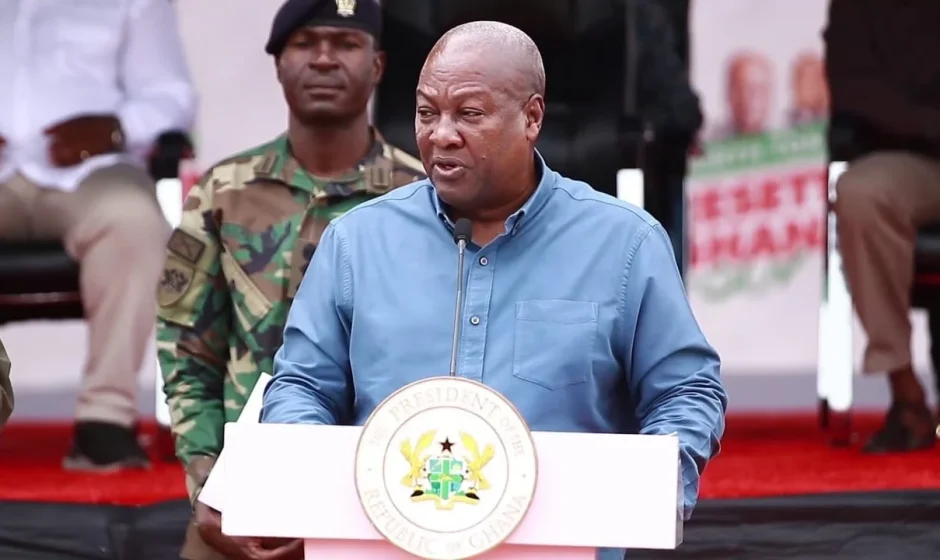

President John Dramani Mahama has announced that the government will recruit 16,000 trained teachers in 2026, more than double an earlier commitment of 7,000 posts made in April. He made the announcement on July 17 while inspecting a new assembly hall at the Peki College of Education in the Volta Region, part of a two day “Resetting Ghana Tour” of the region.
In plain terms, this is Ghana’s second and much larger wave of teacher hiring this year. The Ministry of Education says financial clearance for the 16,000 posts is being processed, not yet finalized, so the timeline for when applications open has not been confirmed.
The announcement matters most to two groups: trained teachers from the 2022 to 2025 graduating cohorts who are still waiting for a posting, and Ghanaian families in rural and underserved districts where classroom shortages are most severe. Education Minister Haruna Iddrisu has told Parliament that the country actually needs between 50,000 and 90,000 more teachers, so 16,000 posts is a significant step but still leaves a large gap.
Quick links (related guides):
What President Mahama Announced
Speaking at Peki College of Education, President Mahama said government will recruit at least 16,000 trained teachers this year. According to the President, the recruitment process would begin once the necessary financial clearance is secured, and teachers still waiting for postings after that would be brought on gradually as resources allow.
Mahama framed the move as part of a broader push to cut graduate unemployment while making sure schools have enough qualified staff to improve outcomes. He also used the visit to praise Peki College of Education for its role in training teachers and pledged continued government support for the institution’s infrastructure.
Education Minister Haruna Iddrisu, who joined the President on the tour, added a second announcement: government plans to build about 50,000 teachers’ bungalows nationwide to fix the accommodation problems that push teachers away from rural postings.
One important nuance here. The reporting from the event describes government as having “commenced the process” of securing financial clearance for the 16,000 posts, not completed it. That is a meaningful difference from the April announcement, where the Ministry of Finance had already signed off before the portal opened. Readers should treat the 16,000 figure as a firm target, not a confirmed, funded, ready to apply intake.
Comparing the Two 2026 Recruitment Waves
This is not Ghana’s first teacher recruitment news of 2026. In April, the Ministry of Education opened a portal for 7,000 posts after receiving financial clearance from the Ministry of Finance. That intake closed at the start of July, and applications are still being verified. The July announcement effectively starts a second, larger wave on top of that one.
| Detail | First Wave (April 2026) | Second Wave (July 2026) |
|---|---|---|
| Announced by | Education Minister Haruna Iddrisu | President John Dramani Mahama |
| Positions | 7,000 teachers | At least 16,000 teachers |
| Eligible cohorts | Graduates from 2022 to 2025 | Remaining trained teachers still awaiting postings |
| Financial clearance | Secured before the portal opened | Process underway, not yet finalized |
| Status as of July 20, 2026 | Portal closed, applications under review | No application portal or date announced |
Put together, the two waves point toward roughly 23,000 new teaching posts for the year if both go through in full, though the second wave still depends on the Ministry of Finance completing its review.
Why Ghana Needs So Many New Teachers
The scale of these announcements only makes sense against the size of the shortage. Addressing Parliament on June 18, Minister Iddrisu said the country needs between 50,000 and 90,000 additional teachers to meet demand across basic and secondary schools, but that budget approvals had limited this year’s clearance to 7,000. He pointed to reforms that split staffing between the Ghana Education Service and the Commission for Technical and Vocational Education and Training, which has widened the gap between what schools need and what government can currently fund.
That context helps explain why the 16,000 figure is being welcomed by trained teachers, and why it still falls well short of eliminating the shortage. For a district with a handful of understaffed schools, an extra few hundred teachers can be the difference between manageable class sizes and relying on unqualified community teachers to fill gaps, something Iddrisu has separately flagged as a growing problem in constituencies like Prestea-Huni Valley.
The 50,000 Teacher Bungalows Plan
The housing announcement is not brand new, but it was reaffirmed alongside the 16,000 figure, which is worth understanding. Government first raised a 50,000 unit teacher housing plan in November 2025, building on a smaller “Teacher Adabre” program that had budgeted 400 bungalows. Officials said at the time that the expanded plan would draw funding from the District Assemblies Common Fund, GETFund, and teacher pension funds, and that proposals were still being reviewed.
Iddrisu’s comments in Peki confirm the 50,000 unit target is still the government’s benchmark. The logic is straightforward: teachers posted to rural and deprived communities often turn down or abandon those postings because there is nowhere suitable to live. Better housing is meant to support retention in the same underserved districts that the new recruitment wave is supposed to staff, so the two initiatives are designed to reinforce each other rather than stand alone.
What Happens Next
Three things are worth watching before treating the 16,000 figure as a done deal.
- Financial clearance. Until the Ministry of Finance formally signs off, there is no confirmed budget line for the 16,000 posts, and the number could shift.
- Portal timing. No application window has been announced. Based on the April precedent, expect the Ghana Education Service to publish portal dates once clearance is confirmed.
- District allocation. Priority will likely go to rural and underserved communities, consistent with how the 7,000 post intake was structured earlier this year.
Trained teachers who have not yet been posted should keep their Ghana Education Service documentation, national service completion records, and teacher licensure exam results current, since incomplete paperwork has slowed past recruitment rounds.
Who This Affects and What to Watch
If you are a trained teacher waiting for a posting: this announcement does not open a new application window by itself. Watch for a Ghana Education Service circular once financial clearance is confirmed, and use the waiting period to make sure your certificates and licensure documents are in order.
If you already applied through the April 7,000 post intake: that process closed at the start of July and is separate from this announcement. Continue tracking your application status through the existing GES channels rather than assuming the 16,000 figure changes your current application.
If you are a diaspora Ghanaian or returnee with a teaching background: Ghana’s public teacher recruitment generally requires a Ghana Education Service license and completed national service, so a foreign teaching credential alone will not qualify you for these posts. If you are exploring work in Ghana more broadly, our guide on finding jobs in Ghana covers routes that do not require GES licensure.
If you are a parent or community member in an underserved district: the teacher bungalows program is the piece most likely to affect whether new hires actually stay in your area long term, so it is worth tracking alongside the recruitment numbers themselves.
Sources
- Ghana News Agency: “Mahama announces recruitment of 16,000 teachers this year” (July 17, 2026)
- Rainbow Radio Online: “Govt clears recruitment of 16,000 newly trained teachers – Mahama” (July 16, 2026)
- GBC Ghana Online: “Ghana needs up to 90,000 more teachers – Haruna Iddrisu” (June 18, 2026)
- Graphic Online: “Education Minister on how ‘Teacher Adabre’ policy will feed into 50,000-unit teacher housing plan” (November 20, 2025)
- Ghanamma.com: “Haruna Iddrisu details when government will begin recruitment of 7,000 new teachers” (April 2, 2026)