

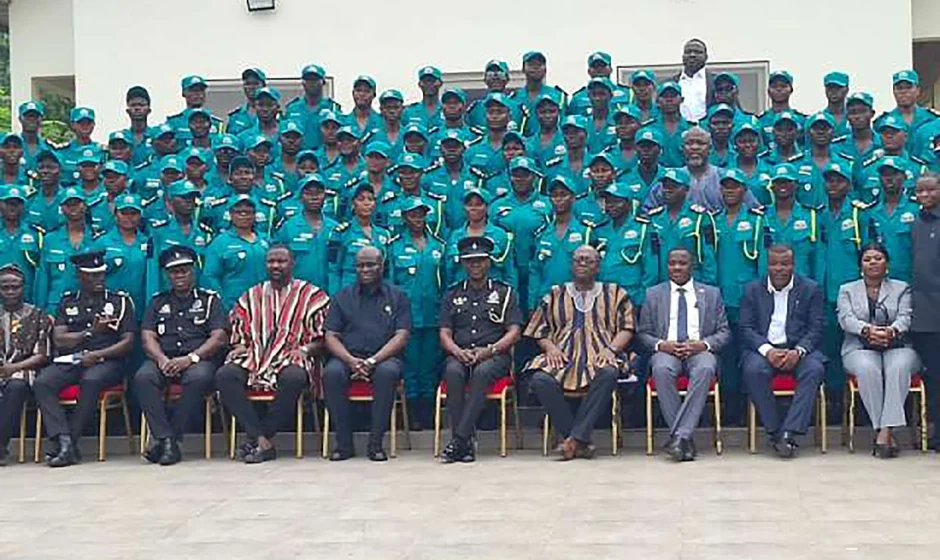

Ghana’s Ministry of Food and Agriculture has deployed 506 Feed Ghana Brigade officers across the country to strengthen agricultural extension services and support farmers, agribusinesses, and institutions nationwide.
In plain terms, the government just added hundreds of trained agricultural workers to a system that has long struggled with too few extension officers reaching too many farmers. These brigadiers are meant to close that gap, connecting national farming policy to what actually happens on the ground in the districts.
The rollout matters for anyone tracking Ghana’s push to boost food production, and it matters even more for agribusinesses, because private companies are already requesting brigadiers before the program has fully gotten off the ground.
Quick links (related guides):
What Happened
The 506 officers passed out on Wednesday, July 8, 2026, at a ceremony held at the National Police Training School (NPTS) in Tesano, Accra. The graduates completed a two-week training program that combined agricultural extension work with discipline, teamwork, and public service training, a deliberate pairing given the venue.
Minister for Food and Agriculture Eric Opoku presided over the event and framed the deployment as a turning point for the Feed Ghana Programme, the government’s flagship initiative to raise domestic food production and rebuild the country’s agricultural extension network. He told the graduates they were leaving as “ambassadors of production, discipline, hard work, and national renewal.”
The brigadiers were drawn from Colleges of Agriculture and other recognized tertiary institutions. According to the Minister, they were already qualified agricultural professionals before the training began. The Police Training School component was added specifically to build discipline and resilience, not technical skills the recruits already had.
What the Brigadiers Will Do
The officers will work directly with farmers, agribusinesses, households, schools, and public and faith based institutions. Their core duties include agricultural advisory services, coordinating program activities, monitoring implementation, collecting field data, and flagging challenges that need attention from district agriculture offices.
Some brigadiers will also serve as master gardeners, a role focused on household food production, nutrition, and environmental stewardship rather than commercial farming. That distinction matters because it shows the program is designed to reach ordinary households, not just large farms and agribusinesses.
Bright Demordzi, National Coordinator of the Feed Ghana Programme, said the training blended technical agricultural knowledge with leadership, ethics, communication, and conflict resolution. The goal, he said, is for brigadiers to complement the extension officers already working in the field rather than duplicate their work.
The Minister was direct about this point. He told the officers they were not being deployed to create a parallel agricultural system, and that success would depend on cooperation with existing District Directors of Agriculture rather than competition with them.
Private Sector Demand Before Rollout
What stands out about this deployment is the timing of private sector interest. According to Minister Opoku, the Ministry began receiving requests from agribusiness companies for brigadiers before the passing out ceremony had even taken place. One company requested 20 brigadiers on its own. Another asked for two.
That early demand is a useful signal for anyone evaluating the agribusiness sector in Ghana right now. Companies do not typically request unproven labor ahead of schedule unless they see a real gap they need filled. The Minister described the requests as evidence of confidence in the program and in the pool of disciplined, trained agricultural talent it is producing.
The Ministry has said it will continue recruiting and training additional brigadiers to meet this demand. Officials have described the current cohort of 506 as the first phase of a larger rollout, with future classes drawn from the same pool of Colleges of Agriculture and tertiary graduates.
Why This Matters
For readers watching Ghana’s agriculture and business environment, this deployment touches a few different groups.
Farmers and smallholders may see more direct contact with trained extension staff, something that has been in short supply in many districts for years. Agribusinesses now have a formal channel to request trained agricultural labor through the Ministry, which could ease hiring for companies scaling up production or processing operations. Job seekers with agricultural training have a new pathway into public service work, with signs that the program will keep expanding.
There is also a policy angle worth watching. The Feed Ghana Programme sits inside a broader government push to reduce food imports and strengthen local agribusiness value chains. Extension officers are one of the least visible but most consequential parts of that effort, since they are the ones translating national targets into what actually gets planted, harvested, and sold at the district level.
What Happens Next
The Ministry has signaled that recruitment will continue beyond this first cohort, with future batches expected to come from the same network of agricultural colleges and universities. Businesses interested in requesting brigadiers can expect the Ministry to formalize a process for handling requests as demand grows, though the exact application procedure for companies has not yet been published.
Readers running or planning an agribusiness in Ghana should watch for official guidance from the Ministry of Food and Agriculture on how to formally request brigadiers, since the current process appears to be handled directly through Ministry channels rather than a public portal.
Sources
- MyJoyOnline: “Gov’t deploys 506 Feed Ghana Brigade officers nationwide to strengthen agricultural extension services” (July 8, 2026)
- ModernGhana: “Private Agribusinesses Rush for Feed Ghana Brigadiers Even Before Official Deployment” (July 9, 2026)