

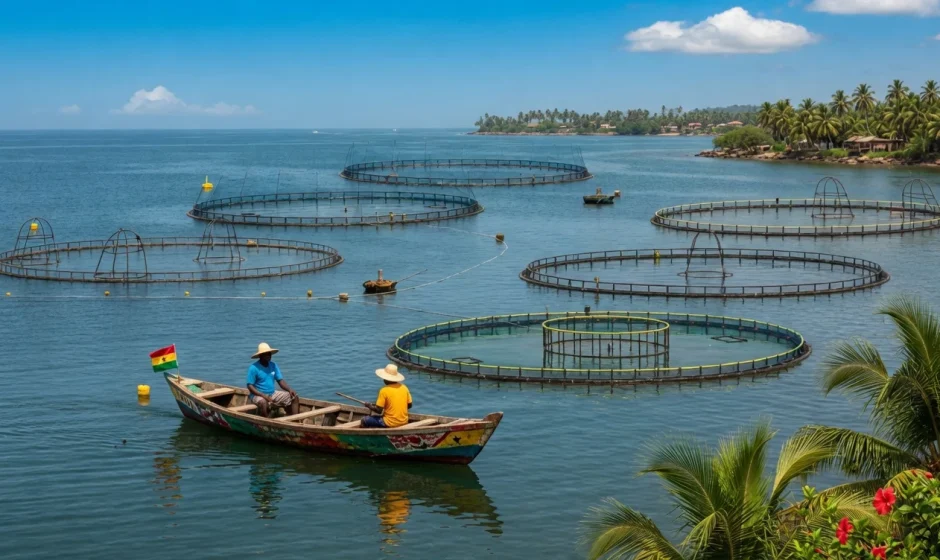

Ghana’s fisheries sector is a major food security and export pillar, with seafood exports valued at more than $425 million annually and underpinning the food security of more than 30 million people. The sector spans a 550-kilometer Atlantic coastline, the 8,480-square-kilometer Lake Volta, and a fast-growing aquaculture industry that added over 121,000 metric tons of farmed fish in 2024 alone.
In plain terms: Ghana produces less fish than its population consumes. Some sector estimates put theoretical national fish demand above 800,000 metric tons per year if supply were unconstrained, though the Ministry of Fisheries and Aquaculture Development’s (MoFAD) own planning data shows actual domestic fish availability at closer to 595,000-600,000 metric tons when production, imports, and exports are accounted for. The gap between actual supply and potential demand is not just a food security concern. It is an investment opportunity, particularly in aquaculture, cold chain infrastructure, fish feed, and value-added processing.
The legal environment has also changed significantly. In August 2025, President John Dramani Mahama signed the Fisheries and Aquaculture Act, 2025 (Act 1146), replacing legislation that had been in place since 2002. The new law restructures governance, introduces electronic monitoring, doubles the protected inshore zone for artisanal fishers, and is widely credited with reducing the risk that Ghana could lose access to European Union seafood markets. For foreign investors and exporters, understanding this new framework is the practical starting point.
Table of Contents
- Ghana’s Fisheries Sector: Size and Structure
- The New Legal Framework: Fisheries and Aquaculture Act, 2025
- Marine Fisheries: Tuna, Pelagics, and Industrial Fishing
- Aquaculture: Ghana’s Fastest-Growing Sub-Sector
- Investment Entry Points Across the Value Chain
- Export Markets and Trade Access
- Risks and Practical Challenges
- What Investors and Exporters Should Do Next
- Licensing Requirements Under Act 1146
- Land and Water Rights for Aquaculture
- Financing Options for Fisheries Investors
- Expatriate Staffing and Work Permits
- Taxation for Fisheries and Aquaculture Businesses
- Key Companies Operating in Ghana’s Fisheries Sector
- Sources
Ghana’s Fisheries Sector: Size and Structure
Fish is the single most important animal protein in the Ghanaian diet. The Ministry of Fisheries and Aquaculture Development’s 2025 budget estimates put per capita fish consumption at approximately 18 kilograms in 2024, with a government planning target of 20 kg by 2025-2026. Some sector studies using apparent food supply methodology cite higher figures; the key point across all measures is that Ghana ranks among the higher fish-consuming countries in Africa. Older sector studies commonly cite fisheries and aquaculture as contributing around 4.5% of national GDP and about 12% of agricultural GDP, though the CGIAR/IWMI 2024 technical brief notes that the sector’s measured GDP share has declined in recent years, reaching approximately 1.04% in 2021 as marine catch volumes fell.
The industry divides into three main sub-sectors.
Marine fisheries account for the largest share of production. The Ministry of Fisheries and Aquaculture Development’s 2025 budget estimates reported 442,361 metric tons of marine fish produced in 2024, up from 425,361 metric tons in 2023. The fleet includes artisanal canoe fishers operating out of more than 187 coastal communities, a semi-industrial segment of wooden inboard-engine vessels, and an industrial fleet of steel-hulled trawlers and tuna vessels operating from the deepwater ports of Tema and Takoradi.
Inland fisheries produced approximately 131,552 metric tons in 2024, according to MoFAD’s 2025 budget estimates, down from 147,583 metric tons in 2023. Production from this sub-sector is variable year to year. Lake Volta remains the dominant inland fishing area and is one of the world’s largest man-made reservoirs at 8,480 square kilometers. This sub-sector is dominated by small-scale operators using canoes and traditional fishing methods.
Aquaculture is the fastest-growing segment and is the primary focus of current government and private investment. Output reached approximately 121,809 metric tons in 2024, up from 116,108 metric tons the previous year. The government’s National Aquaculture Development Plan (2022-2026) targets an increase in the market share of commercially farmed fish from 14% in 2021 to 25% by 2027, which would require roughly doubling current output.
Total 2024 production across all three sub-sectors reached approximately 695,722 metric tons according to MoFAD’s 2025 budget estimates. Ghana also exports a significant volume of fish, principally tuna, and imports fish to supplement domestic supply, primarily frozen whole pelagic species from European and Asian sources. The ministry’s priority is to grow domestic production, particularly through aquaculture expansion, to reduce import dependence over time.
| Sub-Sector | Annual Production (approx.) | Primary Species | Key Locations |
|---|---|---|---|
| Marine (artisanal + semi-industrial + industrial) | 442,361 metric tons (2024, MoFAD) | Sardinella, anchovy, tuna, shrimp, demersal species | 187 coastal communities; Tema, Takoradi |
| Inland fisheries | 131,552 metric tons (2024, MoFAD) | Tilapia, catfish | Lake Volta, rivers |
| Aquaculture | ~121,809 metric tons (2024) | Tilapia, catfish | Volta Region, Brong-Ahafo, peri-urban farms |
The New Legal Framework: Fisheries and Aquaculture Act, 2025
The Fisheries and Aquaculture Act, 2025 (Act 1146) is the most significant legal development in Ghana’s fisheries sector in over two decades. It was passed by Parliament in July 2025 and signed into law by President Mahama on August 21, 2025, replacing the Fisheries Act, 2002 (Act 625).
The immediate trigger for the reform was a “yellow card” warning issued by the European Commission in 2021 over inadequate measures against illegal, unreported, and unregulated (IUU) fishing. That warning carried the threat of a trade ban that would have cut off access to EU markets and cost Ghana an estimated $425 million in annual export revenue. Act 1146 was designed, in part, to close those compliance gaps.
The key provisions investors need to know:
- Independent Fisheries Commission. A fully autonomous body has replaced the previous commission structure, with a mandate to manage, develop, and conserve fisheries and aquaculture resources without political interference.
- Electronic Monitoring System. Industrial and foreign fishing vessels are now subject to electronic monitoring requirements under Act 1146, supporting the catch documentation and traceability standards expected by EU and US seafood markets.
- Expanded Inshore Exclusive Zone. The IEZ has been doubled from six to 12 nautical miles, reserving that coastal band for artisanal fishers and protecting breeding grounds. Industrial vessels must operate beyond this zone.
- Stricter IUU penalties. IUU fishing currently costs Ghana between $14.4 million and $23.7 million per year. The new law introduces significantly higher fines and vessel seizure provisions.
- Aquaculture Development Fund. A new financing mechanism has been established to improve access to capital for fish farmers, support infrastructure development, and promote job creation across the aquaculture value chain.
For investors, the practical effect is twofold. The law creates a more stable regulatory environment with clearer rules, and it substantially reduces the risk of Ghana losing access to the EU market, which is the primary destination for premium Ghanaian seafood exports. Operating under the old Act 625 framework carried significant market access risk; that risk has now materially decreased.
Aquaculture investment and export operations also fall within Ghana’s broader foreign investment framework, which is itself in active transition. Under the Ghana Investment Promotion Centre Act, 2013 (Act 865), foreign investors in joint ventures with Ghanaian partners were required to contribute a minimum of USD 200,000 in equity capital. However, Parliament passed the Ghana Investment Promotion Authority (GIPA) Bill, 2026 on April 2, 2026, which removes these minimum capital thresholds for joint ventures and wholly foreign-owned enterprises, and reconstitutes the GIPC as the Ghana Investment Promotion Authority. The main exception is trading enterprises, where the Bill retains a USD 500,000 minimum capital threshold, reduced from the previous USD 1,000,000. As of publication, the Bill was awaiting presidential assent and had not yet taken effect as law. Investors should verify current registration requirements directly with the GIPC or GIPA, as the new law may be in force by the time they begin formal registration. Joint-venture arrangements with Ghanaian partners remain the standard route for fishing fleet operations regardless of which framework applies.
Marine Fisheries: Tuna, Pelagics, and Industrial Fishing
Ghana’s tuna sector is the most internationally recognized part of the fishing industry. GEPA records approximately 30 registered tuna vessels operating from Tema and Takoradi, producing around 74,000 metric tons per year. The Ghana Tuna Association’s active fleet numbers 37 vessels (20 pole-and-line and 17 purse seiners), representing the commercial core of that total. The fleet operates in the Atlantic High Seas and the exclusive economic zones of Ghana, Cote d’Ivoire, Benin, and Liberia.
On January 22, 2026, the Marine Stewardship Council announced that the Ghana Tuna Association’s purse seine and pole-and-line fleets had received MSC certification for skipjack and yellowfin tuna, following an independent assessment by Control Union (UK) Limited. This is significant. MSC certification can help Ghanaian tuna exporters access major EU and US retail buyers that require or strongly prefer certified sustainable seafood, and it formally confirms that Ghana’s tuna operations meet international standards for sustainable fishing, stock management, and governance. Pioneer Food Cannery, the Tema-based subsidiary of Thai Union Group that produces StarKist and other brands, was specifically recognized for leading the certification drive and has invested $14 million in a new cold storage facility to support year-round processing.
Act 1146 carries forward the vessel ownership framework from the old Act 625, but the rules differ by vessel type. For tuna fishing vessels, at least 50% of the shares must be beneficially owned or controlled by Ghanaian qualifying persons. For all other Ghanaian industrial and semi-industrial fishing vessels, the ownership requirement is stricter: the vessel must be owned or controlled entirely by Ghanaian citizens, the government, or companies whose shares are beneficially owned wholly by Ghanaian citizens or public bodies. The exact provisions applicable to a specific vessel type should be verified against the current Act 1146 text and any regulations issued under it, as subsidiary rules may apply. Foreign investors entering the marine fishing sector must identify a local equity partner, and the structure of that partnership depends directly on the vessel category involved.
Artisanal marine fishing is a different story. The sub-sector involves over 12,000 wooden canoes operating across 187 coastal communities and supports approximately 2.7 million livelihoods. It is not a sector open to conventional commercial investment, but it feeds directly into processing and trade opportunities, particularly for smoked fish, salted fish, and anchovies destined for regional West African markets.
Ghana’s first Marine Protected Area was declared on April 14, 2026, covering approximately 703 square kilometers in the greater Cape Three Points area at the southernmost tip of the country. The MPA includes a core no-fishing zone and multiple-use zones where regulated fishing continues. Its purpose is to protect spawning and nursery grounds for small pelagic species. Investors in or near that coastal zone should factor MPA boundaries and compliance requirements into any site planning.
Aquaculture: Ghana’s Fastest-Growing Sub-Sector
Aquaculture is where the clearest investment case exists. Tilapia and catfish dominate production, and demand for both species far outpaces domestic supply. In 2021, Ghana produced around 68,700 metric tons of tilapia and 20,660 metric tons of catfish through aquaculture. By 2024, total aquaculture output had climbed to 121,809 metric tons, and the government’s 2022-2026 Aquaculture Development Plan targets a roughly 130,000 metric ton increase by 2027.
That target requires a significant scaling of farm capacity, and it is attracting serious private capital. In late 2024, Tropo Farms, the largest tilapia producer in Ghana and one of the largest in Sub-Saharan Africa, secured a $10 million investment from UK-based agribusiness investor AgDevCo to build a modern processing facility and expand production capacity to 30,000 metric tons annually. Tropo employs over 900 people and supplies fish through nearly 3,000 market traders across Ghana. The AgDevCo investment illustrates two things: that institutional investors with Africa mandates are actively backing this sector, and that integrated operations combining production with processing have better economics than farming alone.
Catfish production is also gaining ground. The Bono regional director of the Fisheries Commission has noted that catfish output is growing quickly and could approach tilapia volumes within a few years. Catfish tolerates lower water quality and requires less expensive feed, which makes it attractive for smaller-scale operators in areas without reliable water infrastructure.
The government launched the Aquaculture for Food and Jobs (AFJ) program specifically to scale the sector. Under this initiative, 60 direct jobs and 180 indirect jobs were created, and 382.8 million fingerlings were produced, contributing to the 2024 output figures. A companion Aquaculture Development Fund is designed to unlock private-sector participation beyond what state programs alone can deliver.
Lake Volta remains the backbone of inland aquaculture, despite being exposed to seasonal floods that destroyed numerous cage farms in recent years. Cage farming on the lake, primarily tilapia, has been the main growth driver over the past decade. However, investors need to account for both weather risk and the reality that fingerling supply, quality fish feed, and cold chain access remain genuine bottlenecks across the inland system.
Investment Entry Points Across the Value Chain
The fisheries sector in Ghana is not just about catching or farming fish. The value chain has distinct entry points that suit different investor profiles and capital levels. The industries with the best return potential in this sector tend to be the ones that solve infrastructure or logistics problems rather than the production-only plays.
Fish Feed Production
Fish feed is the single largest input cost in commercial aquaculture, and Ghana imports most of it. Tilapia and catfish feed are both in acute shortage relative to farm demand. Local feed production using domestically available ingredients (maize bran, fishmeal from low-value pelagic species, soybean meal) is an underdeveloped opportunity with a ready domestic market. Small and mid-scale feed mills operating near major aquaculture zones have low competition and clear customers.
Cold Chain and Processing Infrastructure
Approximately 60% of fish consumed in Ghana is smoked using traditional methods. Post-harvest losses are high, particularly during the peak fishing season from July to September. Modern cold storage, ice plants, and hygienic processing facilities are scarce outside Tema. Pioneer Food Cannery’s $14 million cold store investment reflects the commercial logic here at the high end. But mid-market cold chain facilities serving regional distribution or export prep are equally viable and require far less capital.
Cage Aquaculture on Lake Volta
Commercial cage farming on Lake Volta is the most established aquaculture model in Ghana. Entry costs are moderate by global standards, and the lake’s surface area offers significant scaling potential. The risk profile includes flood exposure, competition for lake space, and the need to manage feed logistics over water. Operations near Yeji and Kpando have the most established supply chain infrastructure.
Tuna Processing and Canning
With MSC certification now in place for the Ghana tuna fleet, the conditions for expanding tuna processing capacity have improved. Ghana Free Zones Authority (GFZA) status is available for export-oriented processors, providing tax advantages and simplified customs procedures. Cosmo Seafoods, which operates under GFZA, processes tuna, sardines, pilchards, and mackerel. New entrants in tuna processing or value-added frozen seafood for EU/US markets can leverage the MSC certification and the electronic monitoring infrastructure established under Act 1146.
Artisanal Fleet Support Services
Ghana’s artisanal fishing communities are structurally underserved in terms of outboard motor parts, boat maintenance, premix fuel distribution, and basic processing equipment. Supply businesses serving these 187 communities at scale are not glamorous, but they address persistent gaps and operate across a geographically distributed customer base with reliable recurring demand.
| Investment Type | Capital Range (Approximate) | Key Advantage | Primary Risk |
|---|---|---|---|
| Fish feed production (small mill) | USD 80,000 – 300,000 | Import substitution; ready buyers | Raw material price volatility |
| Cold storage/ice plant | USD 150,000 – 1,000,000 | Reduces post-harvest losses; scalable | Power reliability; site selection |
| Cage aquaculture (Lake Volta) | USD 50,000 – 500,000 | Established model; domestic demand | Flooding; feed logistics |
| Tuna processing/canning (GFZA) | USD 2,000,000+ | EU/US market access; MSC-certified supply | Regulatory compliance burden |
| Fleet support services | USD 30,000 – 200,000 | Underserved market; recurring demand | Geographic distribution |
Capital figures are approximate and based on publicly available project references. Investors should conduct independent feasibility analysis and consult a qualified adviser before committing capital. Exchange rate conversions: USD 300,000 is approximately GH₵4,350,000, GBP 236,000, or RMB 2,178,000, based on May 2026 indicative rates.
Export Markets and Trade Access
The European Union has historically been Ghana’s most valuable seafood export market, especially for tuna and other higher-value species. The $425 million annual seafood export figure cited by MoFAD and GNA is primarily driven by EU-destined tuna. Act 1146’s electronic monitoring requirement and the Ghana Tuna Association’s MSC certification together address the compliance issues that had put that market access at risk since 2021.
Ghana Export Promotion Authority (GEPA) coordinates export certification, quality standards, and buyer connections for seafood exporters. The Ghana Standards Authority (GSA) issues the product certifications required for EU market entry. Exporters targeting the EU must comply with EU Regulation 1224/2009 on catch documentation and traceability, which the new electronic monitoring system is specifically designed to support.
The United States market is a secondary but growing destination. US import requirements under the Seafood Import Monitoring Program (SIMP) track specific species including tuna and shrimp back to the point of harvest. Ghana’s new traceability infrastructure makes compliance more achievable than it was under the previous regulatory framework.
Regional West African markets should not be overlooked. Ghana exports processed and smoked fish to landlocked countries including Burkina Faso, Mali, and Niger, primarily through the port of Takoradi, which also serves as a transit hub. The Ghana-Burkina Faso trade corridor is a natural channel for processed fish products at the lower end of the value spectrum. Regional demand for frozen and smoked fish is substantial and less documentation-intensive than EU or US trade.
China is an emerging destination for Ghanaian seafood. See the broader context in the Ghana-China export guide for current trade dynamics. Chinese buyers have shown interest in processed tuna and frozen pelagics, and several Chinese-linked processing operations are active in the wider West African region.
Labeling, certification, and inspection requirements differ by destination. EU buyers typically require MSC certification or equivalent, EU-approved processing establishment numbers, and catch certificates. US buyers require SIMP documentation for listed species. Regional African trade is primarily governed by ECOWAS standards, which are less burdensome for processed products.
Risks and Practical Challenges
The investment case for Ghana’s fisheries sector is real, but several structural challenges need honest assessment before any capital commitment.
Depleted marine stocks. Marine pelagic fish populations, particularly sardinella and anchovy, have been under severe pressure for years. The Fisheries Commission has noted declining catch per unit effort across much of the artisanal sector, and the 2026 MPA declaration reflects the seriousness of the conservation challenge. Any marine-catch-dependent business model needs to price in the possibility of further regulatory restrictions, seasonal closures, or reduced catch volumes. The government’s 2025 and 2026 Closed Fishing Seasons are designed to let stocks recover, but the recovery timeline is uncertain.
IUU fishing and enforcement gaps. Despite Act 1146’s tougher penalties, IUU fishing remains a significant problem. Foreign industrial vessels have repeatedly encroached on Ghana’s inshore zone, competing directly with artisanal fishers. The expanded IEZ and electronic monitoring create better legal tools, but enforcement depends on resources and institutional follow-through from the new Independent Fisheries Commission, which is still building operational capacity.
Cold chain and power infrastructure. Processing and storage operations are directly exposed to Ghana’s power reliability challenges. Investors in cold storage or processing should budget for generator backup, which adds to operating costs. The coastal and lakeside areas where fishing is most active are not always well served by the national grid.
Import competition in domestic markets. Frozen tilapia from China and mackerel from Europe compete directly with domestically produced fish in Ghanaian markets, often at lower prices due to subsidized production in origin countries. Aquaculture operators selling domestically need a cost structure that can compete with these imports, which historically has been challenging for smaller farms without economies of scale.
Regulatory transition risk. Act 1146 is recent law. The Independent Fisheries Commission it establishes is new, and detailed subsidiary regulations, licensing procedures, and operational guidance are still being developed and published. Investors entering the sector now should expect some regulatory ambiguity during the transition from the Act 625 framework and should budget for legal and compliance advisory costs accordingly.
What Investors and Exporters Should Do Next
If you are evaluating a fisheries investment in Ghana, the following sequence is practical and grounded in how this sector actually works:
- Get current on Act 1146. Read the Fisheries and Aquaculture Act, 2025 (Act 1146) and any subsidiary regulations published by the Ministry of Fisheries and Aquaculture Development (MoFAD). The full text is available through the Ghana Law Reform Commission. Pay particular attention to licensing categories, joint-venture requirements for vessels, and the electronic monitoring obligations if you are targeting export markets.
- Engage the Fisheries Commission and GEPA early. The Independent Fisheries Commission handles licensing for commercial and industrial fishing operations. GEPA handles export certification, buyer introductions, and market access support. Both operate from Accra. Early engagement saves time and clarifies which regulatory approvals your specific business model requires.
- Register your investment with GIPC/GIPA. Foreign investors must register with Ghana’s investment promotion body before commencing operations. As of May 2026, this is the Ghana Investment Promotion Centre (GIPC) under Act 865, but the Ghana Investment Promotion Authority (GIPA) Bill, 2026 passed Parliament on April 2, 2026 and was awaiting presidential assent. Registration provides legal protection, facilitates repatriation of profits and dividends, and can improve access to government incentives. Confirm current requirements directly with the GIPC or GIPA before beginning the process.
- Conduct a feasibility study with local partners. Market conditions, input costs, and logistics realities vary significantly by region and sub-sector. A desk analysis from overseas is not a substitute for on-the-ground due diligence. Partnering with a Ghanaian agribusiness consultant or established operator before committing capital materially reduces execution risk.
- Understand the Ghana Free Zones option for exporters. If you are building a processing operation primarily targeting export markets, Ghana Free Zones Authority status offers significant tax benefits, including full exemption from import duties on equipment and raw materials, a 10-year corporate income tax holiday, and a 15% CIT rate on export income after the holiday (versus the standard 25%). Cosmo Seafoods’ model is the established reference point for this structure in the seafood processing space.
The step-by-step guide to starting a business in Ghana as a foreigner covers the general company registration and compliance process that applies across all sectors, including fisheries.
Licensing Requirements Under Act 1146
Act 1146 establishes several distinct licence categories. All applications go to the Independent Fisheries Commission, which sets the form, manner, and fee schedule. For aquaculture projects, Act 1146 Section 50 provides for a Fisheries Impact Assessment where an activity is likely to substantially affect fisheries or aquatic resources, in addition to any environmental approvals required by the Environmental Protection Authority. Applications for an aquaculture licence should identify the species to be farmed and the proposed aquaculture method. Investors should confirm the exact documentation required with the Fisheries Commission and the EPA before applying, as requirements vary by scale and location.
The main categories relevant to investors are:
| Licence Type | Who Applies | Issuing Body | Key Condition |
|---|---|---|---|
| Ghanaian industrial fishing vessel licence | Ghanaian-owned vessels (trawlers, tuna) | Independent Fisheries Commission | Vessel must be registered under Merchant Shipping Act and approved seaworthy |
| Ghanaian semi-industrial vessel licence | Wooden inboard-engine vessels | Independent Fisheries Commission | 100% Ghanaian ownership; Commission may route application through district |
| Tuna fishing vessel licence | Tuna operators (joint venture eligible) | Independent Fisheries Commission | At least 50% Ghanaian ownership required; electronic monitoring device mandatory |
| Foreign fishing vessel licence | Non-Ghanaian vessels operating in Ghanaian waters | Independent Fisheries Commission | Permitted only beyond the 12-nautical-mile IEZ; electronic monitoring device mandatory |
| Aquaculture licence | Fish farms (pond, cage, or recirculating systems) | Independent Fisheries Commission | May trigger Fisheries Impact Assessment (Section 50) and separate EPA environmental approval; species and method to be stated in application |
| Fishing-related activity licence | Processing plants, fish meal factories, fish feed operations | Independent Fisheries Commission | Covers value chain operators who are not catching fish directly |
The government announced at the Aquaculture Ghana 2025 conference in October 2025 that a one-stop aquaculture licensing regime is being developed to reduce the number of separate approvals required. Until that regime is operational, aquaculture investors should expect to engage multiple regulatory bodies, including the Fisheries Commission, the Environmental Protection Agency, and the Water Resources Commission, before commencing operations.
Land and Water Rights for Aquaculture
Accessing land and water for aquaculture in Ghana involves separate approval processes depending on the type of operation.
Pond aquaculture on land follows Ghana’s standard land tenure framework. Foreign individuals cannot own land freehold in Ghana, but foreign-registered companies can hold leasehold interests for up to 50 years, renewable. In practice, most commercial aquaculture operators lease land through the Lands Commission. Site selection near water sources also triggers buffer zone rules: the National Aquaculture Code of Practice requires a minimum 50-metre buffer between a hatchery and any water body shoreline.
Cage aquaculture on Lake Volta involves three separate approvals. First, a Water Use Permit from the Water Resources Commission (WRC), which maintains the national water use register and has issued permits to commercial cage operators including Tropo Farms. Second, a site allocation approval from the Volta River Authority (VRA), which governs the lake itself. The VRA framework requires a geodetic survey of the proposed cage site, minimum water depth of 2 metres between cage bottom and the lake bed, and a separation distance of at least 1 kilometre from other cage operations or water users. Third, an Environmental Permit from the Environmental Protection Agency (EPA), with the level of assessment required depending on production capacity. The EPA threshold tiers range from a Preliminary Environmental Report for smaller operations to a full Environmental Impact Statement for larger ones.
Investors should engage the WRC, VRA, and EPA at the earliest stage of site planning, as the combined approval process typically runs in parallel with the Fisheries Commission aquaculture licensing application. The VRA’s geodetic survey work must be completed before any physical cage installation begins.
Financing Options for Fisheries Investors
Access to capital has historically been the most commonly cited barrier to expanding commercial aquaculture and fish processing in Ghana. Several financing mechanisms are now available or emerging.
Aquaculture Development Fund. Established under Act 1146 and formally launched on October 30, 2025 at the Aquaculture Ghana 2025 conference in Accra, this fund is designed to improve access to finance for fish farmers and aquaculture value chain businesses, support infrastructure development, and accelerate research and technology transfer. The fund is administered by the Ministry of Fisheries and Aquaculture Development. Application and disbursement procedures are still being finalized; investors should contact MoFAD directly for current operational details.
Ghana Blue Food Innovation Hub. MoFAD announced plans in late 2025 for a Blue Food Innovation Hub designed to support technology adoption, processing innovation, and sustainable practices across the fisheries and aquaculture sectors. Investors interested in this facility should contact MoFAD directly to confirm current operational status and access conditions.
Development Finance Institutions. AgDevCo, the UK-backed African agriculture investor, has demonstrated its willingness to commit to Ghana’s aquaculture sector, as evidenced by its $10 million investment in Tropo Farms in 2024. Other DFIs with active Ghana mandates include the British International Investment (BII), the Netherlands Development Finance Company (FMO), and the African Development Bank (AfDB), all of which have financed agribusiness and food processing projects in West Africa. Investors building a structured business case with independently verified financial projections are the most likely candidates for DFI consideration.
Commercial banks. Agricultural and agribusiness lending is available from Ghanaian commercial banks including Absa Bank Ghana, Stanbic Bank Ghana, and Ecobank Ghana. Loan terms, collateral requirements, and sector-specific appetite vary by institution. Interest rates on Ghanaian commercial credit remain relatively high; investors should factor local financing costs into any financial model and explore blended finance structures where possible.
Expatriate Staffing and Work Permits
Foreign investors operating in Ghana need to plan their staffing structures within Ghana’s expatriate quota framework. Under the GIPA Bill, 2026 (awaiting presidential assent), the quota structure has been substantially liberalized compared to the previous GIPC Act, 2013. The new framework allows up to 12 expatriate quota holders depending on the level of investment, compared with a maximum of 4 under the old law.
| Paid-Up Capital | Expatriate Quota (GIPA Bill) |
|---|---|
| USD 50,000 to USD 500,000 | Up to 2 persons |
| USD 500,000 to USD 1,000,000 | Up to 4 persons |
| USD 1,000,000 to USD 5,000,000 | Up to 6 persons |
| USD 5,000,000 to USD 10,000,000 | Up to 10 persons |
| Above USD 10,000,000 | Up to 12 persons |
Quota approval is subject to conditions set by GIPA on the advice of the Ghana Immigration Service, which retains discretion to refuse a visa even where a quota is approved. For processing and aquaculture operations that depend on specialized technical expertise not locally available, early engagement with the immigration service is advisable. These figures apply once the GIPA Bill receives presidential assent; until then, the existing GIPC Act quotas apply.
Taxation for Fisheries and Aquaculture Businesses
Understanding the applicable tax framework is a practical prerequisite for financial modeling. The main taxes affecting fisheries and aquaculture businesses are corporate income tax, VAT, and withholding tax on profit repatriation.
Corporate Income Tax (CIT). The standard corporate income tax rate in Ghana is 25%, as confirmed by the Ghana Revenue Authority (GRA). Exporters of non-traditional products, which includes processed seafood, are eligible for a concessionary CIT rate of 8% on qualifying export income. This is a significant incentive for processing operations that generate export revenue. Companies operating under Ghana Free Zones Authority (GFZA) status benefit from a full 10-year CIT holiday. After the holiday expires, the applicable rate on export income outside the domestic market is 15%, with domestic sales taxed at the standard 25% rate, per PwC Tax Summaries (March 2026) and the US State Department Investment Climate Statement. Investors should note that the original Free Zones Act 504 (1995) referenced a post-holiday maximum of 8%, and some older sources still cite this figure; the 15% rate reflects current operative practice as reported by the most recent authoritative references.
Value Added Tax (VAT). The effective VAT rate in Ghana, following the reforms introduced by the Value Added Tax Act, 2025 (Act 1151) which took effect on January 1, 2026, is 20% (comprising 15% VAT, 2.5% NHIL, and 2.5% GETFund levy). Exports of goods and services are zero-rated, which is directly relevant to tuna processors and other seafood exporters. Investors should confirm the VAT classification of specific fish products they intend to sell domestically, as the GRA’s exemption schedule covers live animals but the treatment of processed fish products depends on the nature of the supply.
Withholding Tax on Repatriation. Dividends paid to non-resident shareholders are subject to an 8% withholding tax. Branch profit remittances are subject to a 10% withholding tax. These rates can be reduced under applicable double taxation agreements. Ghana has active tax treaties with several countries including the UK, Germany, France, Italy, South Africa, and Singapore.
Growth and Sustainability Levy (GSL). This levy applies to profits before tax for entities in designated sectors and runs through 2028. Most fisheries and aquaculture businesses fall outside the sectors targeted by the GSL, but investors with diversified operations should verify applicability with a qualified tax adviser.
The Ghana corporate tax rates guide covers the full tax framework in more detail.
Key Companies Operating in Ghana’s Fisheries Sector
The table below covers the principal commercial operators across the marine, aquaculture, and processing segments. It is not exhaustive; there are hundreds of small-scale operators and cooperatives active across the sector. Company details, ownership, operating status, and product lines can change. Verify directly before relying on this table for business decisions.
| Company | Website | What They Do |
|---|---|---|
| Pioneer Food Cannery (PFC) | pfcghana.com | Tuna canning and processing in Tema; Ghanaian subsidiary of Thai Union Group; produces StarKist, John West, and Petit Navire brands; led the Ghana Tuna Association’s MSC certification drive; invested $14 million in a new cold storage facility in 2024 |
| Cosmo Seafoods Company Limited | cosmoseafoods.com | Canned seafood manufacturer in Tema operating under Ghana Free Zones Authority; processes tuna, sardines, pilchards, mackerel, and saury for export; established 2011 |
| Tropo Farms | tropofarms.com | Ghana’s largest tilapia producer; cage and pond aquaculture with distribution to approximately 3,000 market traders nationally; received $10 million from AgDevCo in 2024 to expand capacity toward 30,000 MT per year |
| Volta Catch | voltacatch.com | Tilapia aquaculture and fish distribution; cage farming on Lake Volta and distribution depots in Kumasi and Accra; supplies fresh and processed tilapia to domestic retail and wholesale markets |
| Ghana Tuna Association (GTA) | ghanatuna.com | Industry body representing Ghana’s tuna fleet of 37 vessels (20 pole-and-line, 17 purse seiners); led the January 2026 MSC certification for skipjack and yellowfin tuna; coordinates fleet management and export standards |
| Fisheries Commission of Ghana | fishcom.gov.gh | Regulatory body reconstituted and strengthened under Act 1146, replacing the Fisheries Commission under Act 625; issues all fishing licences and aquaculture permits; oversees fleet monitoring, IUU enforcement, and compliance across all sub-sectors |
| Water Resources Commission (WRC) | wrc.gov.gh | Issues Water Use Permits for cage aquaculture on Lake Volta and other water bodies; publishes the national water use register; provides technical guidelines for sustainable cage operations |
| Volta River Authority (VRA) | vra.com | Manages Lake Volta; responsible for site allocation approvals for cage aquaculture; conducts geodetic surveys required for cage farm establishment; jointly developed the Framework for Aquaculture Development on the Volta Lake |
Sources
- Ghana News Agency: “President Mahama Assents to the Fisheries and Aquaculture Bill, 2025” (August 21, 2025)
- GBC Ghana Online: “Parliament Passes Fisheries and Aquaculture Bill to Combat IUU Fishing” (July 17, 2025)
- Marine Insight: “Ghana Passes Landmark Fisheries Law to Tackle Illegal Fishing” (August 25, 2025)
- Marine Stewardship Council: “Ghanaian Atlantic Ocean Skipjack and Yellowfin Tuna Fisheries Meet MSC Sustainability Benchmark” (January 22, 2026)
- FAOLEX: Fisheries and Aquaculture Act, 2025 (Act 1146) Full Text
- Mongabay: “Ghana Declares Its First Marine Protected Area” (April 2026)
- GlobeNewswire: “Tropo Farms Secures $10m from AgDevCo to Expand Tilapia Fish Production in Ghana” (October 29, 2024)
- The High Street Journal: “Fish Farming Gains Ground as Ghana Expands Aquaculture Production” (March 16, 2026)
- Republic of Ghana: Ministry of Fisheries and Aquaculture Development 2025 Budget Estimates (MOFEP)
- CGIAR / IWMI: “Review of Fisheries and Aquaculture Policies in Ghana” (2024)
- Ghana Export Promotion Authority (GEPA): Tuna from Ghana
- GIPC: “Parliament Passes Ghana Investment Promotion Authority (GIPA) Bill” (April 2, 2026)
- The Business and Financial Times: “The New Investment Promotion Bill: What Investors Need to Know” (April 15, 2026)
- Ministry of Fisheries and Aquaculture: “Fisheries Sector Charts Stronger Performance Path” (February 4, 2026)
- Volta River Authority: Implementation Guidelines for the Framework for Aquaculture Development on the Volta Lake
- Water Resources Commission: Technical Guidelines for Sustainable Cage Aquaculture (2025)
- MyJoyOnline: “Government to Launch Aquaculture Development Fund” (November 4, 2025)
- SeafoodSource: “Ghanaian Tilapia Firm Tropo Farms Receives USD 10 Million Investment” (October 2024)
- Mondaq / Afriwise: “Ghana’s New Investment Promotion Bill: What Investors Need to Know” (April 2026)
- PwC Tax Summaries: Ghana Corporate Income Tax (March 2026)
- Ghana Revenue Authority: VAT Reform under Act 1151 (effective January 1, 2026)
- GhanaCitizenship.com: Ghana Corporate Tax Rates 2026 Investor Guide