
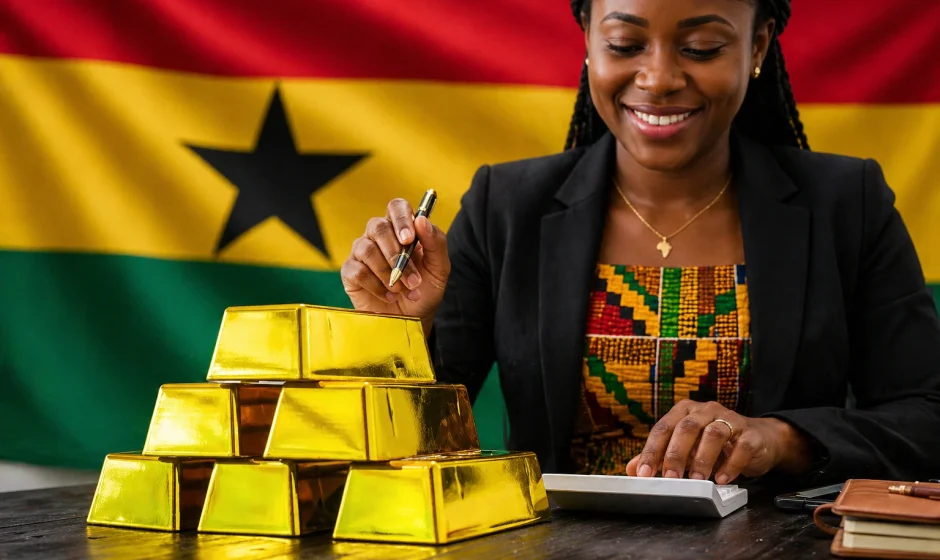

Engineers and Planners Limited (E&P) has sold 100 percent of the Damang Mine’s first gold output to the Ghana Gold Board (GoldBod) and the Bank of Ghana, channelling every ounce of the mine’s opening production directly into national reserves. GoldBod CEO Sammy Gyamfi confirmed the transaction on April 30, 2026, calling it unprecedented in the country’s private mining history. No Ghanaian private gold mining company has ever committed its full initial production to state-backed institutions for reserve accumulation. That has now changed.
For Ghana’s economy, the timing matters. The Bank of Ghana spent much of 2024 and 2025 rebuilding the country’s foreign reserves after years of pressure, and gold has been the engine driving that recovery. A domestic mine routing all of its first output into that system, rather than selling on the open market, sends a clear signal about the direction the government wants Ghana’s mining sector to take.
Table of Contents
Quick links (related guides):
- Ghana Gold Output 2025: Record Production and What It Means
- Ghana Economy 2026: Key Indicators and Outlook
- 543 Business Ideas to Start in Ghana – Get the E-book
- Engineers and Planners Damang Mine Takeover Explained
- Ghana Mining Local Content Rules and Wages Explained
- Ghana Foreign Investment Guide for New Investors
Damang Mine: 30 Years Under Gold Fields, Now Under Ghanaian Ownership
The Damang Mine sits in Ghana’s Western Region and has been one of the country’s major gold-producing assets for three decades. South Africa’s Gold Fields Ghana Limited held the mining lease for roughly 30 years, during which the mine produced more than four million ounces of gold. That lease expired in April 2025.
Rather than renew it, the government granted a one-year extension to allow for an orderly handover and launched a competitive tender process open to Ghanaian-owned companies. The formal transfer took place on April 18, 2026, when Lands and Natural Resources Minister Emmanuel Armah-Kofi Buah performed the symbolic handover at the mine site. For the first time in its history, Damang is operating under full Ghanaian ownership.
How Engineers and Planners Won the Mine
Local reports indicated four companies submitted bids before the March 31, 2026, deadline, while some earlier international reporting cited three bidders. The four named were Engineers and Planners Limited, Vortex Resources, Heath Goldfields, and Maripoma Mining. The Minerals Commission’s Tender Committee evaluated each on technical expertise, financial capacity, and operational readiness. Bidders were required to demonstrate access to at least USD 500 million in funding. Engineers and Planners scored highest and was awarded the lease on April 7, 2026.
E&P is not new to Damang. The company, founded in 1997 by Ibrahim Mahama, had served as the primary mining contractor at the site for years under Gold Fields – a role that gave it detailed knowledge of the mine’s geology, production systems, and workforce before it ever filed a bid. Gold Fields senior vice president Elliot Twum acknowledged in a November 2025 letter that E&P was well-positioned to support continued operations depending on the final ownership structure.
Ibrahim Mahama’s broader business interests include Dzata Cement, which operates Ghana’s largest single cement facility at 2.6 million tonnes per year capacity, Asutuare Poultry Farms, and vehicle distribution through Man Bosch Ghana. He is also the younger brother of President John Dramani Mahama, a fact that generated political scrutiny throughout the tender process (addressed in the controversy section below).
What GoldBod Is and Why the Sale Matters
The Ghana Gold Board – GoldBod – was established under the Ghana Gold Board Act (Act 1140), signed into law on April 2, 2025. It operates under the Ministry of Lands and Natural Resources and holds exclusive authority to buy, assay, sell, and export gold produced by licensed artisanal and small-scale miners in Ghana. GoldBod has also negotiated agreements to purchase portions of gold output from large-scale mining companies, including arrangements covering about 20 percent of production.
GoldBod was allocated a revolving fund equivalent to USD 279 million in the 2025 national budget to support its weekly gold purchasing operations, targeting a minimum of three tonnes per week. Its broader mandate is to reduce gold smuggling, direct revenue into the formal economy, and build Ghana’s foreign exchange reserves through structured gold exports. The Bank of Ghana is the primary off-taker in this chain – GoldBod sources and aggregates gold domestically, then sells it on behalf of the central bank.
For diaspora members, investors, and expats watching Ghana’s economic stability, GoldBod’s role is directly connected to the cedi’s strength. When domestic gold is routed through GoldBod to the Bank of Ghana rather than exported through informal channels, it strengthens the central bank’s reserve position and reduces pressure on the cedi. That is the mechanism this Damang transaction feeds into.
Why This Transaction Is Called Historic
Sammy Gyamfi’s language on April 30 was deliberate. “This has never happened in the history of Ghana, where a private gold mining company commits all of its initial production to state-backed institutions for reserve accumulation,” he stated. That framing – a private large-scale miner voluntarily routing 100 percent of its first output to GoldBod and the Bank of Ghana – is the core of why this is being treated as a landmark.
Under GoldBod’s mandate, large-scale mining companies are not obligated to sell all of their output to the board. GoldBod holds the right to buy a portion, but a 100 percent voluntary sale is not a regulatory requirement – it is a commercial and political decision by E&P. Bobby Banson, E&P’s legal representative, framed it in terms of national duty: “This should serve as an example to other miners across the country that this Ghana we want to build can be built in our small ways.”
Gyamfi added that the move “reflects a strong alignment between private sector participation and national economic priorities,” and expressed hope that it could become a template for how mining companies engage with GoldBod going forward. That’s a significant ambition given that most large-scale miners – foreign and domestic – have historically sold gold on international markets at open-market prices rather than directing output to the central bank at rates set domestically.
Political Scrutiny and Transparency Questions
The award of the Damang lease to E&P has not been without criticism. The central concern raised by commentators and opposition figures is straightforward: Ibrahim Mahama is the younger brother of the sitting president. Critics questioned whether a company with that direct connection to the presidency should have been permitted to win the tender for a major national asset, regardless of the evaluation scores.
The government’s position has been consistent. The Ministry of Lands and Natural Resources has maintained that the process was conducted transparently through the Minerals Commission’s Tender Committee. The Ministry’s April 7, 2026, announcement pointed to the competitive nature of the process and E&P’s evaluation framework score. E&P itself has emphasised that its interest in Damang predates President Mahama’s return to office – documented correspondence shows the company began pursuing the acquisition in 2022 under the previous administration, when E&P first approached Gold Fields with a purchase proposal.
Those documents include a September 2023 letter from Gold Fields notifying E&P to demobilise contractor equipment, which E&P responded to with a formal purchase proposal. A December 2025 letter from the Minister of Lands confirmed that E&P had approached Gold Fields about share acquisition and that the ministry had included E&P in the transition team as early as that point. A no-objection letter had been granted in March 2024, under the previous government.
Political connections in Ghana’s mining sector are not new, and the documented trail of engagement does provide context. That said, the controversy has not been fully resolved in public discourse, and some observers continue to raise questions about whether a family relationship with the presidency should disqualify a company from large public asset bids regardless of process. That debate is ongoing.
GoldBod’s Financial Performance: The Numbers Behind the Policy
The Damang sale comes as GoldBod’s 2025 financial results paint a striking picture of the organisation’s rapid growth. According to audited financial statements for the year ended December 31, 2025, GoldBod recorded total revenue of GH₵5.554 billion – up from GH₵308.14 million in 2024. Total expenditure fell from GH₵129.7 million to GH₵109.4 million over the same period. The operational surplus came in at GH₵909.71 million, with an overall surplus of about GH₵5.44 billion to GH₵5.46 billion.
Those figures reflect GoldBod’s dual role: it generates revenue through assay fees, service charges, registration fees, and inspection fees from large-scale miners, while the bulk of the reserve-building value flows through it to the Bank of Ghana.
The practical result for Ghana’s economy has been measurable. The Bank of Ghana’s gold holdings reached 38.04 tonnes by October 2025, up from 8.78 tonnes in May 2023. Ghana’s international reserves rose to nearly USD 14 billion by end-2025. The cedi appreciated approximately 35 percent against the US dollar over the course of the year – the first sustained appreciation since 2007.
It is worth noting that the programme has not been without criticism. The IMF reported that the Bank of Ghana incurred approximately USD 214 million in losses linked to the structure of the gold trading model by the end of September 2025. GoldBod and the government dispute the characterisation of these as operational losses, arguing they reflect exchange rate translation and the cost structure of buying gold at competitive prices to prevent smuggling. That debate is still active, and independent audits of the central bank’s gold programme for 2025 are not yet fully complete.
What Comes Next for Damang
Beyond the gold sale, Ibrahim Mahama has outlined an ambitious infrastructure agenda for the Damang area. Speaking at the April 18 handover ceremony, he pledged to build a concrete road linking Damang to Cape Coast within two years and to develop an airport serving the mine within six months. E&P has applied for the airport permit, according to Mahama. He has also referenced plans for healthcare and sports infrastructure in surrounding communities.
The investment commitment tied to the lease is significant: authorities set planned investment in the hundreds of millions of dollars, with estimates ranging from about USD 500 million to as high as USD 1 billion depending on redevelopment scope. Production targets are in the range of 100,000 to 150,000 ounces of gold per year. Whether E&P can sustain those targets on an asset that Gold Fields described as having depleted known reserves is one of the more closely watched questions in Ghana’s mining sector over the coming years.
E&P’s advantage is operational knowledge. Its years as a contractor at Damang give it a base the company argues no other bidder could match. The 100 percent GoldBod sale on first output is also a strategic move – it builds goodwill with both GoldBod and the Bank of Ghana at the start of what will be a long operating relationship under the new lease. At the same time, the financial sustainability of routing all output to domestic buyers at GoldBod pricing rather than international open-market rates will be a commercial consideration that E&P will need to balance against its investment obligations.
For the mining sector more broadly, GoldBod CEO Gyamfi’s hope is clear: that Damang’s first-output sale becomes a reference point that other Ghanaian mining companies – large-scale and small – look to when deciding how to structure their relationships with the state. Whether voluntary 100 percent sales become a pattern or remain a one-time statement depends on the commercial terms GoldBod offers and whether the economics work for operators over the long run.
Thinking about investing or doing business in Ghana? Our e-book 543 Business Ideas to Start in Ghana covers sectors from mining support services to agribusiness and tech. Get your copy here.
Sources
- MyJoyOnline: “Damang Mine sells 100% of first gold output to GoldBod, BoG in historic move” (April 30, 2026)
- MyJoyOnline: “E&P’s gold sale vindicates Damang bid – Sammy Gyamfi” (April 30, 2026)
- MyJoyOnline: “E&P’s 100% gold sale to GoldBod sets benchmark – Legal Rep” (April 30, 2026)
- MyJoyOnline: “Engineers and Planners officially assume control of Damang Mine concession” (April 18, 2026)
- Graphic Online: “Ibrahim Mahama unveils airport and road projects after Damang mine takeover” (April 18, 2026)
- Ecofin Agency: “Ghana picks local firm to take over Damang Gold Mine after Gold Fields exit” (April 2026)
- Ghanaian Times: “GoldBod generates unprecedented overall surplus of GH₵5.46bn in 2025” (April 2026)
- Ghana Gold Board (GoldBod) – Official Website
- Wikipedia: Ghana GoldBod