

250 Things to Know Before Moving to Ghana
Quick links (related guides):
Table of Contents
- Major Ethnic Groups at a Glance
- How Ghana Ethnic Groups Were Shaped by Migration
- Ethnicity vs Language in Ghana
- Akan (Asante, Fante, Akuapem, Akyem, Bono)
- Mole-Dagbani (Dagomba, Mamprusi, Nanumba)
- Ewe
- Ga-Adangbe
- Guan
- Gurma (Kusasi, Konkomba, Bimoba)
- Grusi (Gurunsi Peoples)
- Other Groups
- Ethnic Diversity in Ghana’s Cities
- Culture Is Not Frozen: Modern Ghanaian Identity
- Timeline of Migrations & Historical Milestones
- Why Ethnic Identity Still Matters in Ghana
- What Connects Ghana’s Diversity
- Sources
Ghana ethnic groups shape the country’s languages, regional identities, local customs, and parts of everyday social life. Ghana is home to dozens of ethnic communities, often grouped into a few major ethnolinguistic families. The largest is the Akan (roughly 46% of the population), followed by the Mole-Dagbani (18-19%), the Ewe (12-14%), and the Ga-Adangbe (7%). The remaining groups (Guan, Gurma, Grusi, and smaller Mande or Hausa communities) make up the rest.
If you are planning to move to Ghana, invest, or simply understand daily life, here is why this matters: ethnic identity still shapes politics, chieftaincy disputes, land ownership rules, and even social etiquette. Understanding who lives where, what languages are spoken, and what customs matter locally can make daily life and business much easier.
This guide breaks down each major group: where they live, what they speak, how they worship, and why their history still shows up in modern Ghanaian life. But first, a note on how Ghana’s ethnic map came to be.
How Ghana Ethnic Groups Were Shaped by Migration
Many of Ghana’s present-day ethnic communities developed through long periods of migration and interaction. Groups moved across West Africa over centuries, settled new regions, intermarried, traded, and formed new political systems. Modern identities are real and important, but they were shaped over time rather than appearing all at once.
For example, the Guan are often described as “aboriginal” settlers, while the Akan, Ewe, and Mole-Dagbani arrived later from various directions. Some groups, like the Gonja, formed through conquest and assimilation, blending Mande ruling dynasties with Guan-speaking populations. Understanding this movement helps explain why you will find related languages spoken far apart and why some ethnic labels cover multiple historical layers.
Ethnicity vs Language in Ghana
An ethnic group and a language group are not always the same thing. Some communities share similar languages but have distinct identities, histories, and traditions. In daily life, people may identify by ethnicity, region, religion, nationality, or profession depending on context.
Broadly speaking, many northern languages belong to the Gur language family, while many southern languages belong to the Kwa branch of the Niger-Congo family. These are linguistic categories, not rankings or divisions of importance. Within those families, you will find multiple distinct ethnic groups who may or may not understand each other’s dialects.
Also important: population shares for ethnic groups can vary depending on census methods, self-identification, migration, and whether related subgroups are counted together or separately. The percentages below are based on Ghana Statistical Service 2021 census categories, combined with rounded ethnographic estimates where subgroup totals are discussed.
Major Ethnic Groups at a Glance
Data drawn from Ghana Statistical Service (2021 census) and ethnographic sources. Figures are rounded.
| Ethnic Group (Major Subgroups) | Population (est.) | Primary Regions | Language Family | Dominant Religion(s) |
|---|---|---|---|---|
| Akan (Asante, Fante, Akuapem, Akyem, Bono) | ~46% (approx. 15 million) | Southern and central Ghana (Ashanti, Central, Eastern, Western, Bono, Ahafo) | Akan (Kwa) | Christianity (majority), with enduring ancestral traditions |
| Mole-Dagbani (Dagomba, Mamprusi, Nanumba) | ~18-19% | Northern Region, North East, Savannah | Gur (Mole-Dagbani) | Islam (majority), traditional, minority Christian |
| Ewe | ~12-14% | Volta Region, Oti Region | Gbe (Volta-Niger) | Christianity (majority), with enduring traditional spiritual practices in some communities |
| Ga-Adangbe (Ga, Dangme/Krobo) | ~7% | Greater Accra, Eastern coast (Ada, Krobo Hills) | Ga-Dangbe (Kwa) | Christianity, with enduring traditional spiritual practices |
| Guan (Gonja, Larteh, Efutu, Likpe, etc.) | ~3% (approx. 1 million) | Scattered enclaves (Upper East, North East, Eastern, Volta, Central) | Guan languages (Western) | Christianity, traditional practices |
| Gurma (Kusasi, Konkomba, Bimoba) | ~6% (approx. 2 million) | Upper East, Northern Region | Gurma (Gur) | Islam, Christianity, ancestral and earth rituals |
| Grusi (Kassena, Frafra, Sissala) | ~2.7% (approx. 830,000) | Upper East, Upper West | Gurunsi (Gur) | Christianity, Islam in some areas, and traditional earth-shrine systems |
| Mande (Busanga/Dyula, Bisa) | ~2% (approx. 620,000) | Northern Region (trading centers), Tamale, Bolgatanga | Mande | Islam (majority) |
Note: Percentages are rounded and may vary depending on census grouping, self-identification, and whether related subgroups are counted together or separately.
Akan (Asante, Fante, Akuapem, Akyem, Bono)
The Akan are Ghana’s largest ethnic family, making up nearly half the population. They speak Akan languages – mainly Twi (Asante Twi, Akuapem Twi) and Fante. The Asante (Ashanti) in central Ghana and the Fante on the coast are the most well-known subgroups.
Some oral traditions and historical interpretations trace Akan-speaking migrations from northern or Sahel-linked regions into the forest zones of modern Ghana. Traditional Akan society is organized around matrilineal clans. Each lineage keeps a sacred stool that symbolizes its ancestors, and descent (inheritance) is traced through the mother’s line.
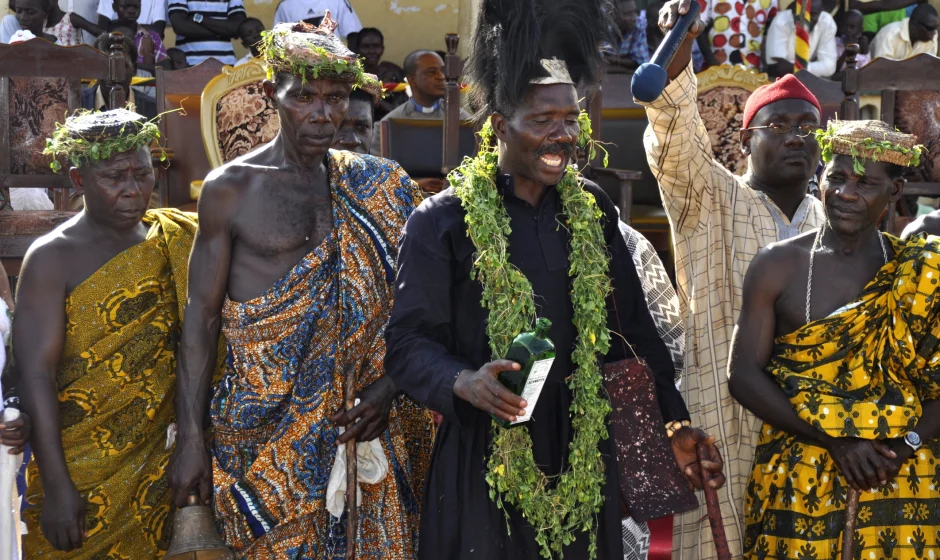
Akan religion centers on a Supreme Deity (Nyame), lesser spirits, and a strong ancestor veneration. Rituals such as the Adae festivals honor lineage ancestors through libations poured on the stools. These ceremonies reinforce social unity and moral codes. The Asantehene (king of the Asante) and queen-mothers are living embodiments of ancestral authority. Annual festivals – Asante’s Adae-Akwasidae cycles, Fante’s Aboakiyir and Bakatue, Akuapem’s Odwira – celebrate harvests or the royal stools.
Economically, Akans are traditionally farmers (yam, plantain, cocoa, oil palm) and traders. The Asante Empire (17th-19th century) dominated West African gold and kola trades. Today most Akan are Christian (Protestant, Catholic, Pentecostal), though many still keep beliefs in ancestors and deities alongside Christianity. Culturally, they are known for kente cloth weaving, Adinkra printing, woodcarving (stools, gold weights), and highlife music rooted in Akan rhythms.
Mole-Dagbani (Dagomba, Mamprusi, Nanumba)
The Mole-Dagbani cluster comprises related Gur-speaking peoples in northern Ghana. The largest are the Dagomba of Dagbon (Dagbani speakers) and the Mamprusi of Mamprugu (Mamprui speakers), plus smaller groups like the Nanumba. Tradition holds that the founders descended from a common ancestor, Naa Gbewaa (15th century), who established a state at Pusiga. His sons later founded Mamprugu, Dagbon, and Nanumba. Historical calculations based on Dagomba king lists place Sitobo, founder of the Dagomba state, at approximately 1430 AD. Thus the chieftaincies (Yawura, Nayira lineages) are genealogically linked.
Dagomba society is highly centralized under the Yaa-Naa (paramount king). Lineage heads (patrilineal “dabs”) control ancestral shrines and enforce moral codes. Land and political power pass down the paternal line. Subsistence relies on dry-season and shifting cultivation of millet, sorghum, maize, yams and groundnuts. Many families raise cattle, sheep and goats, mainly for bridewealth or ritual offerings.
Traditional Dagomba religion revolves around an ancestor cult and an earth deity (Buguli). But Islam has been influential since the 17th century. Today many Dagbon and Mamprusi are Muslim, though ancestral and cult practices persist, especially at funerals and festivals. The Bugum (Fire Festival) and Damba festival of Dagbon – Damba combines Islamic observance of the Prophet Muhammad’s birth with honor to Dagbon chiefs, featuring drumming and sacrifice.
Cultural markers include the Drum (Lunsi) tradition of Dagbon – royal drums that transmit history – leather crafts (drum-making), and the tall smock cloth (fugu) common in the north. Historically, Dagbon fought 17th-century wars with Gonja (a kingdom with a Mande-Dyula ruling dynasty, though its population is largely Guan-speaking and the GSS classifies Gonja under the Guan ethnic grouping). Dagbon also had conflicts with southern Akan states. Dagbon submitted to British rule in 1901.
Ewe
The Ewe (12-14% of the population) live in southeastern Ghana (Volta and parts of Oti Region) and across the border into Togo and Benin. They speak Ewe, a Gbe language. According to widely shared oral tradition, many Ewe groups migrated from Notsie after escaping the harsh rule of King Agokoli, moving westward in the 17th-18th century.
Ewe society is traditionally patrilineal and organized in decentralized chiefdoms or clan towns – there was never a unified Ewe kingdom. Their traditional religion centers on a creator deity (Mawu) and numerous spirits (trwo), with strong ancestor veneration. Divination and possession trances are common. Popular festivals like Hogbetsotso in Anlo-land (celebrating the escape from Notsie) and annual New Yam festivals feature drumming, dancing and libations to ancestors.
Today most Ewe are Christian (especially Presbyterian and Pentecostal), but many syncretize Christianity with belief in vodun and ancestor spirits. Farming (cassava, maize, cocoa) and fishing (Volta Lake or coastal lagoons) remain key livelihoods. The Ewe have contributed Ghana’s famous highlife musicians and the dynamic Adzogbo and Gahu drumming-dance traditions.
Ga-Adangbe
The Ga-Adangbe peoples (about 7% of the population) live in and around Accra and along the eastern coast. The Ga (southern group) traditionally centered on Accra; the Dangme/Krobo occupy lands to the east (Krain, Ada, Krobo Hills). Some oral traditions trace Ga-Adangbe origins to areas east or northeast of present-day Ghana, though accounts differ across communities. Linguistically they speak Ga-Dangbe (Kwa) languages. Society is largely patrilineal, organized into extended family clans with shia (lineage houses).
Traditional religion centers on the great sea deity Nai and lagoon gods such as Sakumo and Korle, along with ancestral spirits. The Homowo (“hooting at hunger”) harvest festival of the Ga (celebrated August-September) commemorates overcoming past famines, featuring food offerings and parades. The Dangme Klyom and Ngramyem festivals similarly celebrate harvests and deities. Chiefs (mantsemei, sing. mantse) and priests maintain shrines to local gods.
Ga-Adangbe peoples were historically fishermen, salt producers and traders. They exported salt and fish, importing foodstuffs and later European goods. In precolonial times, Ga merchants acted as middlemen on the coast. Today fishing and market trade remain important, though many Ga are urban workers in Accra. Most Ga-Adangbe are Christian (Catholic, Presbyterian, Pentecostal), but traditional customs like pouring libations and consulting priests endure. The Ga have given Ghana the highlife music tradition and the street dance Kpanlogo.
Guan
The Guan (about 3% of the population) are scattered across Ghana in disparate enclaves. They are often described as “aboriginal” peoples – some of the earliest inhabitants of modern Ghana. Oral tradition and linguistics suggest they migrated from the Mossi-Dagbon savanna zone around 1000 AD. Guan groups include the Gonja (Northern Region, though many now speak Gonja), the Kpeshie (Greater Accra), Nawuri (Oti Region), Larteh, Anum, Efutu (Central Region), Likpe, Akpafu, and others across 12 regions. Over time many Guan assimilated major languages; today few speak distinct Guan tongues except in rural communities like Larteh and Kpeshie.
Guan traditional religion involves ancestor worship and minor deities. They are noted for tolerance and syncretism. In modern Ghana, most Guan are Christian (often Protestant) with enduring traditional spiritual practices. Economically they practice subsistence farming (millet, yam) and local crafts. Politically they had no unified state; each Guan town has its own chief. Because Guan are dispersed and have intermarried widely, many coastal Akan (some Fante/Ashanti groups) and even Nzema trace partial Guan ancestry. The Efutu subgroup on the Central coast still preserves a Guan language (Efutu).
Gurma (Kusasi, Konkomba, Bimoba)
The Gurma cluster (about 6% of the population) lives in northeastern Ghana. Prominent subgroups are the Bimoba (northern Upper East) and Konkomba (Northern Region), plus smaller Gurma proper. Their languages belong to the Gur (Voltaic) family. Oral histories vary: the Bimoba say they migrated from Burkina Faso, the Konkomba from Togo/Benin centuries ago – reflecting a complex nomadic past.
Traditionally, most Gurma are subsistence farmers (sorghum, millet, maize, yams) and cattle herders. Dry-season farming is crucial; many migrate south after the rains. Social organization is segmentary and largely patrilineal, with clan elders leading villages. Ancestral spirits (via shrines) and an earth cult are central to religion. Some practiced wife inheritance.
Since the 19th century, Islam and later Christianity spread among the Gurma. Today many Kasena/Korana and Bimoba/Konkomba are Muslim or Christian (Pentecostal), but they often retain customs like offerings at ancestral shrines and divination. Festivals include annual harvest rites and libations to earth gods. Cultural practices include slit-gong talking drums (Konkomba) and wicker work.
Kusasi (Kusaal) are usually classed as part of Gurma (speaking Kusaal). They live around Bawku (Upper East). The Kusasi claim they have long inhabited the area – oral traditions say no large migration. They are devoted farmers (rice, sorghum, millet) and known for salt ponds and cattle. About 60% of Kusasi are Christian today, with sizable Muslim and traditionalist minorities. Their paramount chief (Zugraan Naba, also called Bawku Naba) reigns at Bawku. The Kusasi keep unique indigenous music (rote beating), straw mat-making and the Samanpiid harvest festival.
Grusi (Gurunsi Peoples: Kassena, Frafra, Sissala)
The Grusi (Gurunsi) peoples (about 2.7% of the population) inhabit the northern savanna and Upper East – often called the Gurunsi region. The term “Grusi” (also Gurunsi or Grunshi) was originally a colonial-era label applied by outsiders; the peoples it covers are now classified under this grouping by the Ghana Statistical Service. Major subgroups include the Kassena (Nankam) and Nankana in Kassena-Nankana District, the Frafra (Gurunne) around Bolgatanga, and the Sissala in the northwest. Their languages form a sub-branch of Gur (Voltaic).
Historically, Grusi have been shifting agriculturalists (millet, yam, rice) under periodic drought stress. They raise livestock (cows, sheep) mainly for dowries and rituals. Grusi society tends to be segmented (small chiefdoms or clan groups). Most are patrilineal; each village has traditional priests (earth priests). Arts like basketry and pottery are common.
Their religions combine belief in a creator and earth spirits with a pervasive ancestor cult. The earth shrine (tindana system) remains a central institution. Today many Grusi are Christian (Catholic, Protestant), but they hold elaborate harvest festivals (Bugum/Fao/Gologo) and divination traditions. Despite mobility, some Gurunsi maintain cultural quirks: for example, Kassena erect thatched granaries atop compounds to honor spirits. In inter-ethnic relations they practice playful taunts to alleviate past conflicts.
Other Groups (Mande, Hausa, Fulani, Nzema)
- Mande (Busanga): Comprising small Mande-speaking traders (Wangara/Dyula, Bisa), these (about 2%) migrated during the 19th century across West Africa. Settled mainly in Tamale and Bolgatanga, they are renowned Muslim merchants and Islamic scholars. The Dyula helped Islamize northern Ghana and still run trading caravans.
- Nzema, Sefwi, Ahanta: These border groups (combined roughly 2%) have Akan origins but distinct history – for example, Nzema kings resisted British rule. They farm cocoa and celebrate the Mwin and Kundum festivals.
- Hausa and Fulani: A few hundred thousand (mostly traders and nomadic herders) live in Accra, Kumasi, and other urban centers. They speak Hausa and practice Islam, often living in long-established zongo and trading communities, with some Fulani also engaged in cattle herding.
- Other minorities: Ghana also has Ga-Dangme splinters (Krobo, Ada), migrant Lebanese/Asians (traders), and smaller indigenous groups (Awe, Bimoba subsets, etc.).
Ethnic Diversity in Ghana’s Cities
Cities such as Accra, Kumasi, Takoradi, and Tamale bring together people from many backgrounds. It is common for workplaces, schools, churches, and neighborhoods to include multiple ethnic communities. In urban Ghana, you will hear several languages spoken in the same market, and many families are mixed by marriage. This daily mixing has created a more fluid sense of identity, especially among younger generations.
That said, even in cities, people often know each other’s ethnic background. It is not a taboo subject, but it is also not usually the most important thing about a person. Urban Ghanaians tend to prioritize shared interests, profession, religion, or neighborhood over ethnicity in daily interactions.
Culture Is Not Frozen: Modern Ghanaian Identity
Culture in Ghana continues to evolve. Urbanization, education, migration, religion, media, and intermarriage have changed how many people identify and live today. Many Ghanaians balance local traditions with a strong national identity. While ethnic identity remains meaningful, many people primarily identify simply as Ghanaian, especially in cities and among younger generations.
You will see this in everyday life: a young Accra professional might speak Twi at home, English at work, and Pidgin with friends. She might celebrate Homowo with her Ga family, attend a Pentecostal church, and eat jollof rice at a Christmas party. None of these identities cancel each other out. They exist side by side.
Timeline of Migrations & Historical Milestones
| Year / Period | Event |
|---|---|
| ~1000 AD | Guan peoples settle in southern Ghana |
| ~1400 | Dagbon (Dagomba) state established (based on Dagomba king lists) |
| ~1695–1701 | Unification of Asante chiefdoms under Osei Tutu (foundation of Asante kingdom) |
| ~1700 | Ewe migrate westward from Notsie (legendary) |
| 1874 | British establish Gold Coast colony (southern Ghana) |
| 1901 | British annex Northern Territories (Dagbon, etc.) |
| 1957 | Ghana gains independence |
Why Ethnic Identity Still Matters in Ghana
You might think ethnicity only matters for festivals and food. In Ghana, it also shapes everyday life in three concrete ways:
- Politics: Regional and ethnic loyalties can influence voting patterns, alongside economic concerns, leadership style, and local political history. The two main parties have historical bases – the NDC is stronger in Volta (Ewe) and northern areas, while the NPP is stronger in Ashanti (Akan) and parts of the south. That doesn’t mean everyone votes as a block, but you will hear people talk about “which party is associated with which group.”
- Chieftaincy and land: Land ownership is largely customary, controlled by stools or skins (traditional councils). Disputes between ethnic groups (e.g., Konkomba vs. Nanumba in the north) sometimes turn violent because land and chieftaincy titles are tied to ethnic identity.
- Social norms: Marriage customs, funeral rites, and even greetings vary. In Akan areas, you inherit from your mother’s brother; in northern patrilineal groups, inheritance passes from father to son. If you marry a Ghanaian, knowing their ethnic background tells you which family members hold authority.
That said, urbanization and intermarriage have softened many boundaries. In Accra, you will meet people who speak three languages and celebrate Homowo, Eid, and Christmas in the same month. But the old lines still run deep, especially outside the capital.
What Connects Ghana’s Diversity
Understanding Ghana’s ethnic diversity is useful, but it is equally important to understand what connects the country: shared institutions, national pride, hospitality, entrepreneurship, and a growing modern identity that crosses traditional lines. Ghana has managed, with occasional tensions, to remain one of West Africa’s most stable democracies. Part of that stability comes from a constitution that protects chieftaincy while promoting a unified national identity, and from everyday Ghanaians who navigate multiple loyalties without conflict.
For visitors and new residents, the practical takeaway is simple: learn a few greetings in the local language of the area you live in, show respect for elders and chiefs, and do not assume you know someone’s background from their appearance or surname. Many Ghanaians are happy to explain their culture if you ask respectfully. That openness is as much a part of the country’s identity as any single ethnic tradition.
Get your copy here
Sources
- Britannica: “Akan” (2025)
- Britannica: “Dagomba | History, Gonja, Region, Culture, & Ghana” (2025)
- Britannica: “Grusi | Ethnic Group, West Africa, Ghana” (2025)
- Ward, W.E.F. A History of Ghana. Routledge, 1948 (repr. 2022). Historical dating of Asante, Dagomba, and northern states.
- Parker, John. Making the Town: Ga State and Society in Early Colonial Accra. Heinemann, 2000. Ga social organization, religion, and economy.
- Manoukian, Madeline. Akan and Ga-Adangme Peoples of the Gold Coast. International African Institute / Routledge, 1950 (repr. 2017). Ga social organization, lineage structure, and economy.
- Lentz, Carola. Ethnicity and the Making of History in Northern Ghana. Edinburgh University Press / IAI, 2006. Colonial construction of northern ethnic labels; Grusi and Dagara social organization.
- MyJoyOnline: “Ghana Month: Ethnic groups in Ghana and their distribution” (2025)
- Ghana Statistical Service (2021 census data)
- Ghana National Commission on Culture – festival and tradition archives