

Quick links (related guides):
Ghana Turkey defence cooperation is moving back into the spotlight after Ghana’s Deputy Minister for Defence, Ernest Brogya Genfi, held high-level talks in Turkey with senior Turkish officials. The discussions reportedly focused on defence cooperation, security collaboration, capacity building, and the need to move outstanding defence memoranda of understanding from paper into practical action.
In plain English, this is not just another diplomatic photo opportunity. Ghana appears to be looking at Turkey as a serious partner for defence training, institutional support, and possible defence industrial development. Turkey, meanwhile, has been expanding its engagement across Africa through diplomacy, trade, construction, education, aviation, development assistance, and security partnerships.
For Ghanaians, investors, diaspora readers, and people watching West African security, the question is simple: what does closer Ghana-Turkey defence cooperation actually mean? It may mean more training and technical exchange. It may mean future defence manufacturing partnerships. It may also signal Ghana’s attempt to diversify its security partnerships beyond its traditional Western partners.
What happened in the Ghana-Turkey defence talks?
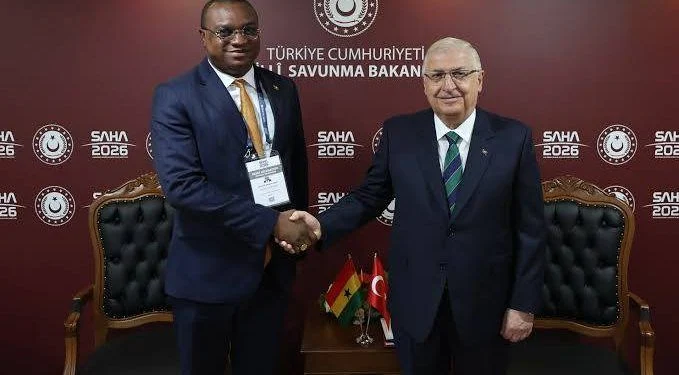
According to Ghanaian media reports, Ghana’s Deputy Minister for Defence, Ernest Brogya Genfi, held bilateral discussions with Turkey’s Minister of National Defence, Yasar Guler, during a working visit to Ankara.
Class FM reported that the talks were aimed at deepening defence cooperation between Ghana and Turkey. The same report said both sides agreed on the need to expedite action on outstanding memoranda of understanding on defence cooperation so that planned areas of collaboration can move into implementation.
The meeting reportedly included Ghana’s Ambassador to Turkey, Nasiru-Deen, and Brigadier General Joseph Vander-Pallen, Director of Plans, Research and Development of the Ghana Armed Forces. That detail matters because it suggests the conversation was not only political. It also involved military planning and institutional development.
Other reports stated that the Ghanaian delegation also engaged with Turkish institutions connected to investment and industrial development. Diplomatic Times reported that the visit included industrial discussions linked to Ghana’s Defence Industries Holding Company, also known as DIHOC, and possible technology transfer discussions with Turkish defence-sector actors.
| Reported area of cooperation | What it could mean | Level of confirmation |
|---|---|---|
| Defence cooperation | Broader security and military collaboration between Ghana and Turkey | Reported by multiple Ghanaian media outlets |
| Outstanding defence MOUs | Existing pending agreements may be moved toward implementation | Reported by Class FM, Onua, and related coverage |
| Capacity building | Training, institutional support, planning, and technical knowledge sharing | Reported by Ghanaian media |
| Defence industrial development | Possible support for local defence manufacturing or technology transfer | Reported by Diplomatic Times, but should be treated as developing |
| Broader bilateral relations | Expansion of a relationship that already includes trade, education, development, and diplomacy | Corroborated by Turkish MFA and Ghana Embassy sources |
What is confirmed, and what still needs caution?
The broader Ghana-Turkey relationship is well established. The Turkish Ministry of Foreign Affairs says diplomatic relations between Ghana and Turkey were established in 1958, shortly after Ghana’s independence. It also notes that Turkey’s embassy in Accra first opened in 1964, closed in 1981, and reopened in 2010. Ghana’s embassy in Ankara opened in 2012.
Ghana’s own embassy in Ankara gives a similar history. It also says Ghana and Turkey have continued to deepen cooperation in trade, investment, education, and other areas of mutual interest. That gives the current defence talks a real diplomatic foundation. This is not a brand-new relationship.
The caution is this: the specific May 2026 defence meeting appears to be based mainly on Ghanaian media reports and public statements attributed to the Deputy Minister. As of publication, GhanaCitizenship.com did not find an official Ghana Ministry of Defence release confirming a newly signed defence agreement.
That does not mean the reports are false. It means readers should separate high-level defence talks from a finalized defence deal. Ghana and Turkey are clearly discussing deeper defence cooperation. There are reports of outstanding MOUs and industrial discussions. But readers should wait for the actual signed documents before assuming that new weapons purchases, local factories, or binding defence commitments have already been approved.
| Claim | Fact-check status | Best wording to use |
|---|---|---|
| Ghana and Turkey held defence talks | Supported by multiple Ghanaian media reports | Ghana and Turkey held high-level defence talks |
| Ernest Brogya Genfi met Yasar Guler | Supported by Class FM and Onua reporting | Genfi held bilateral discussions with Yasar Guler |
| New defence MOUs were signed | Not verified from available official sources | Both sides discussed expediting outstanding MOUs |
| DIHOC and industrial cooperation were discussed | Reported by Diplomatic Times, but still developing | Industrial cooperation was reportedly part of the visit |
| Ghana and Turkey have long-standing diplomatic ties | Confirmed by official Turkish and Ghanaian sources | Diplomatic relations date back to 1958 |
Why Turkey matters to Ghana’s defence strategy
Turkey has become a more visible security, trade, and industrial actor across Africa. Its approach is not limited to formal diplomacy. Turkey may appeal to some African governments because its partnerships often combine diplomacy, trade, construction, aviation, education, development assistance, and security engagement rather than focusing on one lane only.
For Ghana, this matters because the country sits in a region facing growing security pressure. The Sahel has experienced coups, extremist violence, cross-border instability, and growing competition among foreign powers. Ghana has not faced the same level of internal security breakdown as some Sahelian states, but northern Ghana is close enough to the regional crisis that border security, intelligence, training, and readiness matter.
Ghana also has a long record of international peacekeeping. That gives the country a practical interest in professional military training, logistics, command systems, and modern equipment. Any serious Ghana-Turkey defence cooperation should be judged by whether it improves Ghana’s ability to protect its territory, support regional stability, and maintain professional civilian control over defence policy.
Turkey may be attractive to Ghana because it can offer a partnership that is not only about finished imports. If cooperation moves in the right direction, it could include training, maintenance, repair, technical support, local assembly, or joint industrial planning. That would be more useful than a relationship based only on buying equipment.
Could Ghana-Turkey defence cooperation support Ghana’s defence industry?
The most important angle is not only military cooperation. It is industrial cooperation. If the Diplomatic Times reporting is confirmed by official releases, Ghana may be looking for a partner that can help it build local capacity in selected defence-sector production.
That could include areas such as basic equipment production, maintenance, repair, vehicle support, protective gear, communications systems, training systems, or other controlled industrial projects. Ghana should be careful here. Defence industrialization is expensive, regulated, technically demanding, and politically sensitive. It is not the same as opening a normal factory.
The best version of Ghana-Turkey defence cooperation would focus on practical capacity that Ghana can sustain. That means maintenance, repair, training, quality control, procurement transparency, and local technical skills. The weakest version would be a headline-driven procurement push that creates debt, imports equipment Ghana cannot maintain, or gives too much control to foreign suppliers.
| Potential benefit | Why it matters | Question Ghana should ask |
|---|---|---|
| Training and capacity building | Improves professional readiness and planning | Will training continue after the visit ends? |
| Technology transfer | Could support local skills and production | Will Ghanaian engineers and technicians actually gain usable skills? |
| Maintenance and repair capacity | Reduces dependence on foreign suppliers | Can Ghana maintain the equipment locally? |
| Industrial partnerships | Could create jobs and support local manufacturing | Are contracts transparent and financially sustainable? |
| Security cooperation | Could strengthen border security and regional readiness | Does it align with Ghana’s national security priorities? |
The risks Ghana should watch carefully
Ghana should not treat foreign defence cooperation as automatically positive. Defence partnerships can help a country modernize, but they can also create long-term dependency. The details matter more than the headlines.
The first risk is procurement opacity. Defence contracts are often shielded from public scrutiny because of national security. Some secrecy is understandable, but too much secrecy can hide inflated costs, weak contract terms, or politically connected middlemen.
The second risk is debt. Ghana has been under fiscal pressure in recent years, so any major defence procurement should be weighed against the country’s broader budget situation. A country can need better security and still need disciplined spending.
The third risk is over-militarizing development. Ghana needs security, but it also needs jobs, border-region development, education, infrastructure, and local economic opportunity. Security policy works best when it is paired with development policy, especially in vulnerable border areas.
The fourth risk is foreign-policy imbalance. Ghana should be free to work with Turkey, the United States, the United Kingdom, China, India, Germany, and other partners where national interest supports it. But Ghana should avoid becoming too dependent on any single external power for critical security systems.
What to watch next
The next major question is whether these talks produce signed agreements, budget allocations, industrial projects, or training programs. A meeting is one thing. Implementation is another.
Readers should watch for a formal statement from Ghana’s Ministry of Defence, Ghana’s Ministry of Foreign Affairs, the Ghana Armed Forces, Turkey’s Ministry of National Defence, or Turkey’s Ministry of Foreign Affairs. Those sources would carry more weight than reposted media summaries.
Also watch whether Parliament becomes involved. If major procurement, financing, or binding national commitments are involved, Ghanaian citizens should expect appropriate oversight. Defence cooperation can be valuable, but it should not become a blank cheque.
| Next signal | Why it matters |
|---|---|
| Official government statement | Confirms the scope of the talks beyond media reporting |
| Signed MOU or agreement | Shows whether cooperation is formal or still exploratory |
| Budget or procurement disclosure | Reveals whether the talks involve major spending |
| Training program announcement | Shows practical implementation beyond diplomacy |
| Industrial partnership details | Clarifies whether Ghana will gain local jobs, production, or technology transfer |
Bottom line
Ghana-Turkey defence cooperation appears to be entering a more serious phase. The relationship between the two countries is not new, and official Turkish and Ghanaian diplomatic sources confirm that Ghana and Turkey have built decades of ties in diplomacy, trade, education, and development.
The specific defence talks in Ankara are important because they point toward a possible shift from general friendship to more structured security and industrial cooperation. That could help Ghana if it leads to training, maintenance capacity, technology transfer, and better institutional planning.
But Ghana should move carefully. Defence cooperation should be transparent where possible, financially disciplined, and tied to Ghana’s real security needs. The strongest outcome would be a partnership that improves Ghana’s capacity without creating dependency, waste, or unnecessary secrecy.
Sources
- 3News: Ghana, Turkey deepen defence cooperation following high-level bilateral talks
- Onua: Ghana, Turkey deepen defence cooperation following high-level bilateral talks
- GhanaWeb: Ghana strengthens defence cooperation with Turkey with Deputy Minister’s visit
- Class FM: Ghana, Turkey discusses strengthening defence cooperation
- Diplomatic Times: Ghana targets defence industrial growth with Turkey visit
- Republic of Turkey Ministry of Foreign Affairs: Relations between Turkey and Ghana
- Embassy of the Republic of Ghana in Ankara: Ghana-Turkey Relations
- Ghana Ministry of Foreign Affairs: Letters of Credence and Ghana-Turkey relations