

250 Things to Know Before Moving to Ghana
- Starting a Business in Ghana – Step by Step
- Ghana Investment Guide – Opportunities and Regulations
- Ghana Cannabis License Applications – How to Apply
- Moving to Ghana – Complete Relocation Guide
- Investing in Ghana – Guide for Foreign and Diaspora Investors
- Ghana Property Title Search Costs – What Buyers Need to Know
- 543 Business Ideas to Start in Ghana
Table of Contents
- What Just Happened? A Full Regulatory Programme, Not Just an Announcement
- Current Legal Framework – Recreational Use Remains Illegal
- The Five-Point Roadmap (A Proposal, Not Yet Law)
- Licensing 101 – 11 Categories, Eligibility, and Application Requirements
- Economic Potential – What the Numbers Actually Say
- Understanding the Health and Safety Risks
- Who Should Take Action Next? Investor and Farmer Implications
At the Fifth Rastafari Cannabis Conference in Accra, policy experts including Professor Yegandi Imhotep Paul Alagidede presented a five-point framework that calls for moving from outright prohibition to a regulated cannabis market. The proposals include decriminalization, Rastafari sacramental protections, equity-based licensing, expungement of old convictions, and state investment in cannabis research.
Here is what that means in plain English: Ghana already allows low-THC cannabis for medicinal and industrial purposes – but possession for personal use remains a criminal offense. The experts argue that this disconnect creates pointless enforcement costs and misses an economic opportunity. Their roadmap is not yet government policy. It represents advocacy from policy experts and the Rastafari Council, not legislation. Still, the fact that senior academics and researchers are pushing this publicly signals where the debate is heading.
Why this matters for you: If you are a farmer, investor, or entrepreneur, the current licensing window for low-THC cannabis is already open. But the rules are strict, and recreational use is still illegal. Understanding exactly what is allowed today – and what is only proposed for tomorrow – can save you from costly mistakes.
What Just Happened? A Full Regulatory Programme, Not Just an Announcement
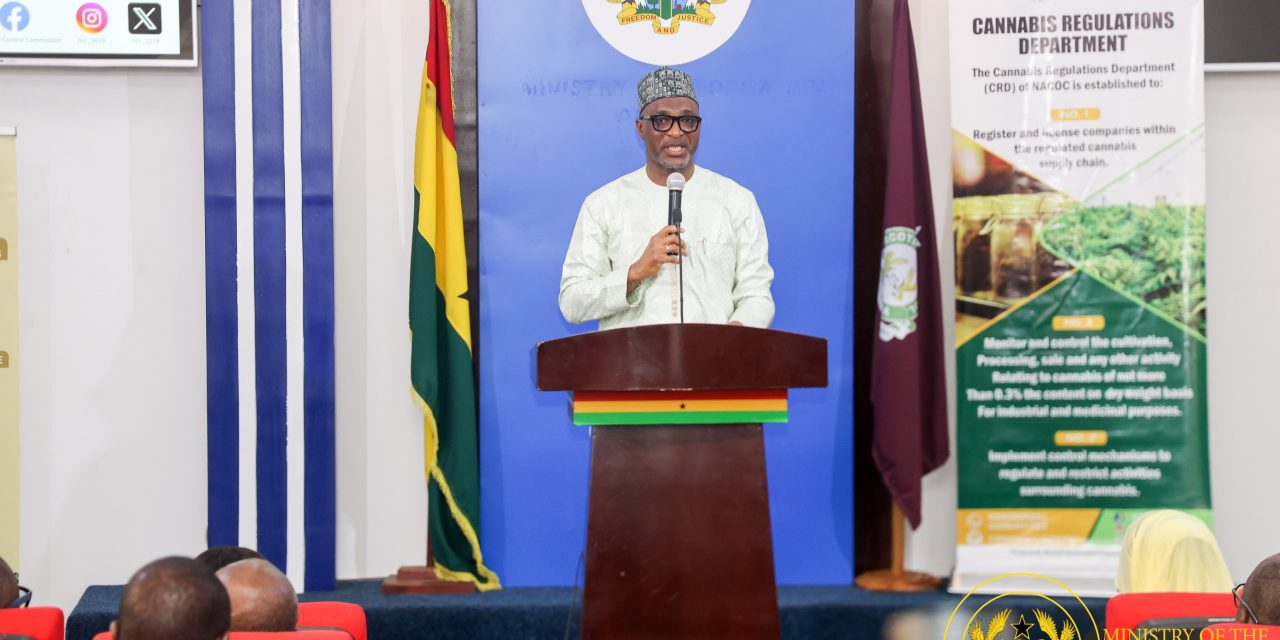
On February 26, 2026, the Minister for the Interior, Muntaka Mohammed-Mubarak, formally launched Ghana’s Cannabis Regulatory Program for medicinal and industrial low-THC cannabis cultivation and management. This was not a vague policy statement. The launch created a controlled operational framework for the cultivation and management of low-THC cannabis. In other words, Ghana moved from law-on-paper to active implementation, with licensing, compliance, and enforcement systems now in place.
That shift matters because many countries pass cannabis laws but never build the regulatory machinery to enforce them. Ghana now has published regulations (L.I. 2475), an official licensing framework, and regulatory oversight through the Narcotics Control Commission (NACOC).
Eligible applicants can apply through the official NCC online licensing portal at portal.ncc.gov.gh. For investors, this means the opportunity is real and regulated – not speculative.
On April 27, 2026, Professor Yegandi Imhotep Paul Alagidede – the Bank of Ghana Chair of Finance and Economics at the University of Ghana – presented a five-point roadmap building on this framework. Sedem Ofori, a researcher and anti-prohibition advocate, also addressed the conference, arguing that the government should reclassify medical and industrial cannabis as an agricultural-industrial commodity. These proposals are not yet law, but they show where advocates want to take the system.
At the conference, researcher Sedem Ofori estimated the annual cost of maintaining an inmate to be between $1,500 and $2,500 (approximately GHS 17,000 to GHS 28,500, GBP 1,200 to 2,000, RMB 11,000 to 18,000). Ofori argued that decriminalization could deliver immediate budgetary savings while redirecting resources toward treatment and legitimate industry.
Current Legal Framework – Recreational Use Remains Illegal
Recreational cannabis remains illegal in Ghana. The program applies only to licensed low-THC medicinal and industrial activities. Anyone caught using, possessing, or cultivating cannabis without a license faces criminal prosecution under Section 45 of the Narcotics Control Commission Act, 2020 (Act 1019).
The legal foundation for the licensed activities rests on Section 43 of Act 1019, as amended by the Narcotics Control Commission (Amendment) Act, 2023 (Act 1100). That section empowers the Minister for the Interior to grant licenses to cultivate cannabis with a THC content not exceeding 0.3% on a dry weight basis, for industrial purposes (fibre or seed) or for medicinal purposes. The Narcotics Control Commission (Cultivation and Management of Cannabis) Regulations, 2023 (L.I. 2475) provide the detailed operational framework.
The Minister stressed that this is not about legalizing “wee” for personal consumption but about building a world-class, Ghanaian-controlled industrial hemp and therapeutic cannabis sector. The government’s stated policy intent is to ensure that Ghana’s natural and economic resources primarily benefit Ghanaians.
What the Law Explicitly Forbids
Unlicensed possession, cultivation, or use of any cannabis (including high-THC varieties) is a criminal offense. Licensed facilities must not be located within 100 meters of schools or residential areas, and operators are required to submit quarterly returns. NACOC has also warned that no individual, group, or association is authorized to facilitate, broker, or secure cannabis licenses on behalf of applicants. Anyone claiming to be an agent or intermediary is running a scam.
The Five-Point Roadmap (A Proposal, Not Yet Law)
Professor Alagidede’s framework goes far beyond the current licensing regime. These are policy proposals, not enacted legislation. Here is what his five pathways would do.
| Pathway | What It Would Do | Who It Affects |
|---|---|---|
| 1. Full Decriminalization | Remove criminal penalties for personal use, possession, and small-scale cultivation; redirect enforcement toward a public health model | Individuals with small amounts; reduces prison overcrowding; saves enforcement budget |
| 2. Cultural Recognition | Formally protect Rastafari sacramental use and indigenous cannabis practices under Ghanaian law | Rastafari community; traditional cannabis users; religious freedom |
| 3. Equity-Based Licensing | Priorities local farmers and cooperatives over foreign investors for cultivation and processing licenses | Ghanaian smallholders; local cooperatives; rural economies |
| 4. Reparative Justice | Expunge criminal records for non-violent cannabis offenses; reinvest enforcement savings into affected communities | Individuals with past cannabis convictions; communities harmed by enforcement |
| 5. State Investment in Cannabis Science | Fund research, innovation, and industrialization; lead a continental African cannabis framework | Research institutions; pharmaceutical industry; export sectors |
The most immediate proposal is full decriminalization. That would mean no more arrests, court cases, or prison sentences for possessing small amounts or growing a few plants for personal use. Enforcement resources would shift toward treatment and harm reduction. For the thousands of Ghanaians with cannabis-related convictions, pathway four offers a clean slate – expunging records so people can get jobs, access credit, and participate in the formal economy without a permanent criminal mark.
The equity-based licensing pathway addresses a real concern: in other African countries that opened cannabis markets, foreign investors often captured most of the value while local farmers remained on the margins. By prioritizing Ghanaian citizens, cooperatives, and smallholders, the framework aims to keep wealth inside the country.
The fifth pathway looks outward. Professor Alagidede called on the State to invest in Ghanaian cannabis science and lead efforts toward a continental African framework. That means Ghana positioning itself as the regulatory and research leader for West Africa, not just a producer of raw materials.
Licensing 101 – 11 Categories, Eligibility, and Application Requirements
While headlines may focus on legislation, Ghana has introduced a tightly regulated licensing system rather than opening recreational cannabis use. The framework covers 11 separate license categories across cultivation, processing, trade, research, storage, transport, and laboratory services. Applicants must meet ownership, compliance, and documentation standards, signalling that this is being positioned as a formal industrial sector rather than a casual market.
If you are a Ghanaian citizen, permanent resident, or business entity interested in Ghana’s licensed low-THC medicinal and industrial cannabis sector, here is exactly what NACOC requires under the current licensing framework. Eligible applicants can apply through the official NCC online licensing portal at portal.ncc.gov.gh. For a full market analysis, see our detailed guide on Ghana’s Cannabis Regulatory Programme market analysis.
Basic Eligibility (Non-Negotiable)
- Be 18 years or older
- Be a Ghanaian citizen or permanent resident
- Corporate applicants must maintain at least 50% Ghanaian ownership
- Majority of directors must be Ghanaian
These are hard rules. The Minister for the Interior stated clearly: “This is non-negotiable. Ghana’s resources must benefit Ghanaians first”.
The 11 Licence Categories
NACOC issues 11 activity-specific license types. Each is non-transferable. You cannot cultivate under a processing license, and you cannot transport without a transport permit. The full list is:
- Cultivation (tiered by land size from less than one hectare to over 15,000 hectares)
- Breeding
- Processing
- Import
- Export
- Laboratory testing
- Storage
- Transport
- Distribution & Sale
- Research & Development
- Advertisement & Promotion
Full details on each category are available on NACOC’s official portal.
Required Documentation and Compliance
Applicants must submit a substantial dossier, demonstrating that this is a serious regulated industry:
- Property documentation (lease or title deed)
- National identification (Ghana Card or passport)
- Financial Information Form
- Police Clearance Certificate
- Business formation documents
- Security plan
- Tax Clearance Certificate (from Ghana Revenue Authority)
- SSNIT registration
- Standard Operating Procedures (SOPs) and recordkeeping documentation
- Off-taker agreements (if the organisation will not process its own cannabis)
- Environmental permit and pest management plan
Compliance and Monitoring Systems
Licensed operators are subject to ongoing oversight, including unannounced inspections, traceability requirements, and broader compliance controls across the value chain. Regulators have the authority to enter, search, seize, and prosecute under Sections 54 and 59 of Act 1019.
Critical Warning from NACOC
The Narcotics Control Commission has warned the public to avoid anyone claiming to facilitate cannabis licenses. No individual, group, or association is authorized to act as an agent, intermediary, or consultant. All licensing processes are conducted only by the Commission through its Cannabis Regulations Department. Do not pay money to any third party claiming to help secure a license. Official fees will be published by the Commission upon approval by Parliament.
543 Business Ideas to Start in Ghana
Economic Potential – What the Numbers Actually Say
The revenue estimates vary, but all point in the same direction: a regulated cannabis industry could significantly boost Ghana’s economy.
| Projection Source | Annual Revenue Estimate (Range) | Notes |
|---|---|---|
| Professor Alagidede (Rastafari Conference) | GHS 2.1 billion to 15.5 billion (USD 180 million to 1.33 billion, GBP 144 million to 1.06 billion, RMB 1.3 billion to 9.6 billion) | Full decriminalization scenario (proposed) |
| Chamber of Cannabis Industry Ghana | At least USD 1 billion (approximately GHS 11.6 billion, GBP 800 million, RMB 7.2 billion) | Under current restricted framework |
| Mark Darko (CEO, Cannabis Chamber) | USD 10,000 per hectare | Conservative per-hectare revenue estimate |
Professor Alagidede told the conference that regulated cultivation, processing, and exports could generate between 2.1 billion and 15.5 billion Ghana cedis annually. The Chamber of Cannabis Industry Ghana, citing the global medicinal cannabis market projected to reach nearly USD 149 billion (approximately GHS 1.66 trillion, GBP 119 billion, RMB 1.07 trillion) by 2031, estimates the sector could generate at least USD 1 billion annually for Ghana once fully operational under the current restricted framework.
For context, Canada’s federal excise duties from cannabis reached CAD 894.6 million in the 2022-2023 financial year – surpassing combined excise duties from beer, wine, and spirits. That figure reflects tax revenue only, not total industry sales. Still, it shows what a regulated market can generate. Ghana aims to capture similar benefits through responsible regulation. The global cannabis market, valued at USD 25.7 billion (approximately GHS 286 billion, GBP 20.5 billion, RMB 185 billion) in 2021, is projected to grow to USD 148.9 billion (approximately GHS 1.66 trillion, GBP 119 billion, RMB 1.07 trillion) by 2031.
Industrial Hemp Use Cases (Expanded)
Low-THC cannabis and industrial hemp can be processed into a wide range of products:
- Fiber for textiles, rope, and biodegradable materials
- Seeds for food products, nutritional supplements, and animal feed
- Construction materials (hempcrete, insulation)
- Biofuels
- Therapeutic applications and pharmaceutical ingredients
- Manufacturing inputs for paper, plastics, and composites
For context: Ghana imported over USD 166 million worth of paper and paperboard products in 2023, and between 2017 and 2021 spent USD 348 million on toilet paper imports alone. Hemp paper production could displace many of those imports while creating local manufacturing jobs.
Understanding the Health and Safety Risks
A balanced view of cannabis regulation must acknowledge legitimate risks. Here is what the evidence shows.
Health Risks of Cannabis Use
Cannabis use, especially frequent or high-THC use, carries documented health risks. According to the U.S. National Institute on Drug Abuse, long-term or heavy cannabis use has been linked to anxiety, depression, and increased risk of psychosis or schizophrenia in vulnerable individuals. Cannabis impairs short-term memory, motor coordination, and judgment – which significantly increases the risk of driving accidents. Some studies also suggest that regular cannabis use during adolescence may affect brain development.
The Food and Drugs Authority has issued public warnings about unapproved alcoholic beverages laced with cannabis extracts. In May 2025, the FDA announced that laboratory analysis confirmed that Kings Orange Flavored Liqueur and Jupiter 1990 contained marijuana extracts and were unsafe for consumption. The FDA stressed that the unauthorized infusion of cannabis into food or drinks violates Ghana’s Public Health Act (Act 851) and poses serious safety concerns, including potential irreversible liver and kidney damage from those specific unregistered products.
Illegal Market and Enforcement Reality
The illegal cannabis market remains active despite prohibition. In February 2026, police in the Oti Region discovered 91 bales of suspected cannabis concealed in bottled water cartons, with an estimated street value exceeding GHS 1.4 million (approximately USD 120,000, GBP 96,000, RMB 865,000). In Tamale, a suspected supplier was arrested after attempting to bribe officers with GHS 20,000 (approximately USD 1,720, GBP 1,375, RMB 12,400). NACOC and the Customs Division also intercepted 84 bags of dried cannabis in a joint operation in October 2025, demonstrating the scale of the illicit trade.
The current approach has not stopped supply or demand. Professor Alagidede noted that prohibition has failed its objectives, with sustained usage rates suggesting that criminalization pushes consumption underground rather than eliminating it. Licensed production of low-THC cannabis offers farmers a legal, profitable alternative to illegal high-THC cultivation – but only if the licensing process is accessible and the regulatory burden does not become prohibitive.
Who Should Take Action Next? Investor and Farmer Implications
Here is how different groups should respond to Ghana’s evolving cannabis landscape.
For Ghanaian Farmers and Cooperatives
If you currently cultivate cannabis illegally, the licensed pathway now exists. Low-THC industrial hemp offers a legal crop with established off-taker requirements – meaning you need a buyer before you can get a license, but once you have one, you operate in the open. Prepare your land documentation, register with SSNIT and GRA, and contact NACOC’s Cannabis Regulations Department directly or use the official NCC online portal at portal.ncc.gov.gh. Do not pay any third party claiming to facilitate licenses. For a step-by-step walk through, see Starting a Business in Ghana as a Foreigner.
For Investors and Entrepreneurs
Licensing is open for cultivation, processing, research, import/export, and laboratory services. You will need to demonstrate at least 50% Ghanaian ownership and a majority Ghanaian board. Off-taker agreements are required before cultivation licenses are issued. The Commission has published an official online licensing portal – eligible applicants can apply through portal.ncc.gov.gh. Expect unannounced inspections and strict compliance monitoring.
For investors, farmers, and manufacturers, the biggest opportunity may be in value-added processing rather than raw cultivation alone. Exporting dried biomass is the lowest margin; processing into oils, pharmaceuticals, textiles, or construction materials captures far more value and qualifies for Ghana’s industrial incentives.
For more on investment rules, read Ghana Investment Guide – Opportunities and Regulations. If you are looking for cannabis-specific application details, our guide on Ghana cannabis licence applications covers the process in depth.
For Individuals with Past Cannabis Convictions
Under the proposed reparative justice pathway, non-violent cannabis offenses could be expunged. This framework is not yet law, but advocacy groups are pushing for legislative action. Track updates from the Rastafari Council Ghana and the Chamber of Cannabis Industry for developments.
For Relocation and Expat Readers
If you are considering moving to Ghana, understand that recreational cannabis remains strictly illegal regardless of the regulatory changes for industrial and medical use. Possession for personal use can still lead to arrest, prosecution, and imprisonment. The legal market applies only to licensed operators dealing with low-THC industrial hemp and medicinal cannabis – not to personal consumption.
For anyone serious about entering the legal side of this emerging industry, professional legal guidance is essential. Regulatory requirements are complex, and compliance failures carry severe penalties including license revocation and criminal prosecution.
Get the full guide:
543 Business Ideas to Start in Ghana
Sources
- Multimedia Group: “Experts outline path to legal cannabis market in Ghana” (April 27, 2026)
- GhanaWeb: “Experts outline path to legal cannabis market in Ghana” (April 27, 2026)
- Ministry of the Interior: “Ghana Begins Medicinal and Industrial Cannabis Cultivation” (February 26, 2026)
- Narcotics Control Commission: Cannabis Regulations – Official Licensing Guidelines (March 2026)
- NACOC Licensing Portal (official)
- Graphic Online: “NCC opens online applications for industrial and medicinal cannabis business licences” (2026)
- Ghanaian Times: “Recreational Cannabis Still Illegal – Interior Minister” (March 3, 2026)
- The Independent Ghana: “Cannabis cultivation licences to soon be issued” (April 9, 2026)
- Narcotics Control Commission: “No Entity Authorised to Facilitate Cannabis Licences” (September 2025)
- NACOC: “NACOC Cracks Down on Drug Trade: 84 Bags of Cannabis Seized” (October 2025)
- Graphic Online: “Police retrieve GH¢1.4m worth of suspected cannabis hidden in mineral water cartons” (February 25, 2026)
- FDA Ghana: “Public Caution – Kings Orange Flavoured Liqueur and Jupiter 1990 are Unsafe for Consumption” (May 2025)
- Cannabis Law Report: “Rastafari Council Pushes Five-Point Cannabis Reform Roadmap for Ghana” (April 2026)
- MJBizDaily: “Canadian federal cannabis tax revenue outpaces beer, wine” (2023)
- National Institute on Drug Abuse: “Cannabis (Marijuana)”
- OEC: Ghana Imports of Paper and Paperboard (2023)
Compliance note: Anyone intending to engage in cannabis-related business activities in Ghana must follow the official licensing procedures published by the Narcotics Control Commission. No unauthorized third parties are permitted to facilitate or broker cannabis licenses.