

Quick links (related guides):
Table of Contents
- Did Africans Sell Africans?
- The Asante Kingdom and the Slave Trade
- Elmina and Cape Coast: Where the Trade Happened
- Who Controlled the Transatlantic Slave Trade?
- African Slavery vs. Transatlantic Slavery
- How Many People Were Taken?
- Why Ghana Still Supports Reparations
- The CARICOM Reparations Framework
- Who Should Receive Reparations?
- Frequently Asked Questions
- The Real Takeaway
Did Africans sell Africans is one of the most debated and misunderstood questions in the global reparations conversation. You will see it in online arguments, political speeches, and comment sections, especially when Ghana or other African countries voice support for reparations. The answer is yes – but that one-word answer, without context, misleads more than it informs.
Some African rulers and merchants did capture and sell people during the era of the transatlantic slave trade. That is a documented historical fact and not seriously disputed by mainstream historians. What is disputed is what that fact means – whether it justifies dismissing reparations, shifts primary responsibility away from European powers, or changes the long-term impact that the trade had on Africa and the diaspora.
This guide breaks down who did what, who controlled what, what the numbers actually show, and why Ghana – a country with a complicated role in this history – still actively supports reparations and diaspora reconnection today.
Did Africans Sell Africans?
Yes, and the historical record is clear on this. Various African groups, particularly along the coast of West Africa, participated in the sale of captives to European traders beginning in the 15th century and accelerating through the 18th century. These transactions were real, documented, and significant in scale.
However, stopping the conversation there strips the system of its context. Participation took many forms. Some rulers sold war captives under long-standing practices that predated European contact. Others were drawn into the trade by the economic incentives that European demand created – firearms, textiles, and metals that shifted the balance of power among competing kingdoms. The arrival of European trade goods restructured local economies and political relationships in ways that made resistance to the trade increasingly difficult for some groups.
African participation in the slave trade was real. It was also uneven, coerced in some contexts, and concentrated among a relatively small number of coastal intermediaries rather than spread across the continent. Many African societies had no involvement in the transatlantic trade at all. Some actively resisted or were themselves victimized by slave-raiding from more powerful neighbors. The Soninke of Gajaaga in the upper Senegal River region, documented by historian Makhroufi Ousmane Traoré in “Slavery, Resistance, and Identity in Early Modern West Africa” (Cambridge University Press, 2024), organized armed resistance to slave-caravan drivers, attacked caravans, freed captives, and absorbed displaced people into their community rather than selling them. Treating the entire continent as a single actor misrepresents the historical record as much as denying participation entirely does.
The Asante Kingdom and the Slave Trade
No honest account of this history can avoid naming the Akan-speaking Asante (also spelled Ashanti) Kingdom, which was one of the most powerful states in the region that is today Ghana. The Asante were significant participants in the slave trade. They conducted military campaigns that produced captives, many of whom were sold to European merchants at the coastal forts, including Elmina and Cape Coast Castle.
This is not a fringe historical claim. It is well-documented in Ghanaian academic scholarship – including the work of historian Akosua Adoma Perbi, whose book “A History of Indigenous Slavery in Ghana: From the 15th to the 19th Century” (Sub-Saharan Publishers, 2004) addresses indigenous slavery and the trade in the Gold Coast region specifically – and it is widely acknowledged within Ghana itself. Ghanaian traditional rulers and public figures have made statements recognizing African complicity in the trade, though a formal state apology from the Ghanaian government has not been issued.
Acknowledging the Asante role is not a concession that undermines the reparations argument. It is the intellectually honest foundation that makes the argument credible. A reparations case built on selective history is weaker than one that confronts the full record.
Elmina and Cape Coast: Where the Trade Happened

If you want to understand the physical reality of how the trade worked in Ghana, the two most important sites are Elmina Castle and Cape Coast Castle. Both are UNESCO World Heritage Sites and among the most visited historical landmarks in West Africa.
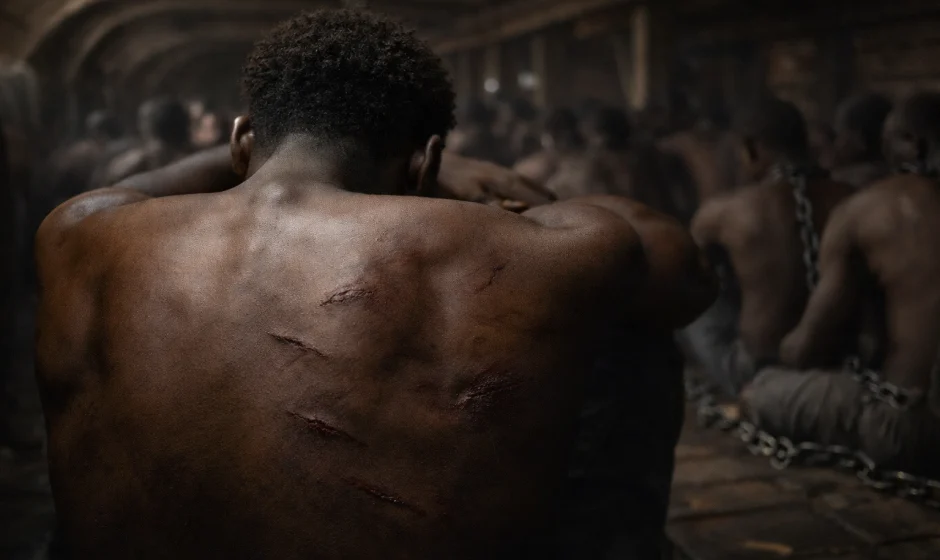
Elmina Castle, built by the Portuguese in 1482, was the first permanent European trading post in sub-Saharan Africa. It later passed to the Dutch and eventually the British. Cape Coast Castle became the largest British slave-trading fort on the Gold Coast. Both were major nodes in the Gold Coast trade – holding sites where captives delivered by interior networks were loaded onto ships bound for the Americas and passed through what became known as the “Door of No Return.”
African captives arrived at these forts primarily through interior trade networks controlled by local rulers, including the Asante. European traders waited at the coast. The handoff between African intermediaries and European ship captains is the specific moment where the two systems connected. After that handoff, the enslaved person entered a completely different system – one that was European in design, finance, and operation.
The mechanics of that handoff were sometimes more predatory than the phrase “war captives” implies. Rev. Carl Christian Reindorf, a Gold Coast native historian writing in 1895 from oral traditions, documented how groups like the Akwamu not only sold war prisoners but kidnapped travellers, enticed community members to the coastal forts under false pretenses, and sold even fellow Akwamus into the trade. Reindorf, writing from inside the Gold Coast community, called this practice “nefarious” – a moral condemnation that complicates any reading of African participation as purely customary or honorable exchange.
Today, these castles are central to the Year of Return and ongoing diaspora tourism. Many African Americans and Caribbean visitors travel specifically to stand in the dungeons and walk through those doors. The experience is deliberately confrontational with history, not avoidant of it.
Who Controlled the Transatlantic Slave Trade?
European powers built and controlled the infrastructure that made the transatlantic slave trade possible at industrial scale. African participation was localized and fragmented. European control was global and systematic. That distinction matters when assigning historical responsibility.
What European powers controlled:
- The shipping networks that moved people across the Atlantic
- The plantation economies in the Americas that created demand
- The firearms trade that reshaped power dynamics inside Africa
- The financial systems – including insurance markets and banking – that turned slavery into a global industry
- The legal frameworks in their colonies that made slavery hereditary and race-based
A coastal African ruler who sold captives to a European ship had no visibility into, or control over, what happened after that ship left port. The plantation system in the Americas, the legal classification of enslaved people as property, the multigenerational transmission of enslaved status – these were European inventions, maintained by European law, and enforced by European colonial governments.
Participation does not equal control. That sentence is the key analytical distinction in this entire debate. Eric Nellis, in his academic survey “Shaping the New World: African Slavery in the Americas, 1500-1888” (University of Toronto Press, 2013), puts it precisely: African agents and intermediaries controlled the supply of captives in the interior, but European powers shaped the trade by expanding its scale, keeping it profitable, and building the Atlantic infrastructure that made it global.
The reparations argument rests on a further distinction: between moral complicity and primary liability. A coastal ruler who sold captives to a European ship was morally complicit in the transaction. But the enduring legal and financial architecture of racial slavery – the statutes that defined Black people as property, the insurance contracts on human cargo, the plantation credit systems, and the colonial inheritance laws that passed enslaved status from mother to child – was European in design and enforcement. That architecture created multigenerational wealth transfers on one side and multigenerational dispossession on the other. Complicity in a transaction is different from building the system. Primary liability follows the system-builder.
African Slavery vs. Transatlantic Slavery
A related misunderstanding is the assumption that slavery in Africa before and during the transatlantic era was equivalent to chattel slavery in the Americas. It was not. The differences are substantial and matter for how we assign historical responsibility. Traoré frames this precisely in his chapter title: “African Slavery versus the Slave Trade(s): Social Stratification Is Not Merchant Slavery” – meaning that the existence of bondage within African social hierarchies does not make those systems equivalent to the race-based, European-driven commercial trade.
| Aspect | Traditional African Bondage Systems | Transatlantic Chattel Slavery |
|---|---|---|
| Basis of status | War, debt, or criminal punishment | Race – inherited at birth regardless of circumstances |
| Social mobility | Possible in some societies; integration over time | None – status was permanent and hereditary |
| Scale | Localized within regional political systems | Global industrial system spanning three continents |
| Duration of status | Often temporary or conditional | Generational and lifelong by law |
| Legal framework | Customary and variable by society | Codified in colonial law across multiple empires |
| Who profited | Local rulers and intermediaries | European states, merchants, banks, and plantation owners at global scale |
It is worth noting that traditional African bondage systems were also capable of serious abuses, and historians disagree about how benign or harsh particular systems were. The point is not that pre-colonial Africa was free of coercion. The point is that the transatlantic system was categorically different in its racial logic, its permanence, and its global reach. It is that specific system – and its long aftermath – that drives the modern reparations argument.
How Many People Were Taken?
The Trans-Atlantic Slave Trade Database, maintained at Emory University and accessible at slavevoyages.org, is the most comprehensive scholarly record of the trade. According to that database, approximately 12.5 million Africans were embarked on slave ships between the 16th and 19th centuries. Of those, roughly 10.7 million survived the Middle Passage and arrived in the Americas.
The Gold Coast – the region that is today Ghana – contributed a substantial share of that total. The SlaveVoyages database allows region-level filtering, and scholarly estimates for the Gold Coast vary across sources. What is consistent across the literature is that the Gold Coast was one of the more significant departure points in the West African trade, and that the population loss over the full duration of the trade had real economic and demographic consequences for the region.
Walter Rodney, the Guyanese historian, argued in his 1972 work “How Europe Underdeveloped Africa” that the slave trade disrupted agricultural production, depopulated fertile areas, and redirected African political energy toward raiding rather than building. That argument has been debated, refined, and partially supported by subsequent economic research, including work by economists Nathan Nunn and Leonard Wantchekon, who found statistically significant links between the intensity of the slave trade in a given African region and lower levels of economic trust and development in those areas today.
Why Ghana Still Supports Reparations
Ghana’s position on reparations is not a claim of innocence. It is a position grounded in long-term consequences and forward-looking partnership.
Ghana, like other African nations, experienced documented harm from both the slave trade and the colonial period that followed: population loss, disrupted trade systems, extraction of resources, and delayed institutional development. On March 25, 2026, the UN General Assembly adopted a Ghana-led resolution formally designating the transatlantic chattel slave trade as the “gravest crime against humanity” – stronger and more precise language than any prior UN framing. Ghana’s role in bringing that resolution forward reflects a consistent position at the international level. For more background on the UN’s designation of the slave trade as a crime of the gravest order, see our separate guide.
It is also worth being direct about a point that critics sometimes sidestep: modern Ghana is not the same political entity as the precolonial kingdoms that participated in the slave trade. The Asante Kingdom, the Fante states, and other polities that existed on the Gold Coast were sovereign entities with no continuity of government to the Republic of Ghana, which was established in 1957. Ancestral participation by rulers of defunct precolonial states does not strip a modern democratic government of standing to support reparations any more than modern Germany’s moral stance on Holocaust reparations is undermined by what the Third Reich did.
Domestically, Ghana has backed its rhetoric with policy. The Year of Return in 2019 drove a major surge in diaspora tourism and international arrivals. The Beyond the Return initiative extended that invitation into an ongoing framework. And the Historic Diaspora Community citizenship pathway, formally announced by Ghana’s Ministry of the Interior, offers a legal route for people of African descent to claim Ghanaian citizenship without requiring Ghanaian ancestry.
These are concrete actions, not symbolic gestures. They reflect a government that sees diaspora reconnection as both a moral obligation and a development strategy.
The CARICOM Reparations Framework
The most developed institutional framework for reparations discussions is the CARICOM Reparations Commission, established by Caribbean Community member states. In 2014, CARICOM adopted a ten-point reparatory justice plan that called on former colonial powers – specifically Britain, France, the Netherlands, Spain, and Portugal – to engage in formal reparations negotiations.
The ten points include a formal apology, debt cancellation, funding for public health programs to address the legacy of disease brought during the colonial era, and investment in cultural institutions and psychological rehabilitation programs. The plan specifically targets European governments, not African ones. This distinction is often lost in public debate.
Ghana has aligned itself with the spirit of this framework, focusing on trade access, development investment, and diaspora integration rather than direct financial transfers to individuals. The AU has also passed resolutions calling for reparations discussions at the continental level, though these remain non-binding.
Who Should Receive Reparations?
There is no global agreement on this, and the debate genuinely involves competing legitimate interests. Three broad positions exist:
Diaspora-focused: Descendants of enslaved people in the Americas should receive reparations directly from former slave-holding states and their governments. This is the position most common in the United States reparations debate.
Africa-inclusive: African nations also experienced harm through population loss, disrupted development, and subsequent colonialism. Reparations should therefore flow to African governments as well as to diaspora communities.
Structural investment model: Rather than individual payments, reparations should take the form of systemic investment – debt relief, trade access, healthcare funding, and institution-building across both Africa and the diaspora. This is closest to the CARICOM framework and to Ghana’s stated position.
Ghana generally supports the third model. The practical argument is that structural investment creates lasting change, whereas individual payments raise complex definitional questions about who qualifies and risk becoming a one-time settlement rather than a long-term commitment.
Some critics argue that shared African participation should imply shared financial responsibility. Most reparations frameworks reject that conclusion because they distinguish between participation in transactions and control over the system that generated enduring global inequality. Not everyone involved played the same historical role, and liability is typically assigned most heavily to the states and institutions that built, financed, legalized, and profited from the full transatlantic system across centuries.
Frequently Asked Questions
Did the Ashanti sell slaves to Europeans?
Yes. The Asante Kingdom was one of the most significant African participants in the Gold Coast slave trade. Asante military campaigns produced captives who were sold to European merchants at coastal forts including Elmina and Cape Coast Castle. This is documented in Ghanaian academic scholarship and widely acknowledged within the country.
Did Ghana apologize for its role in the slave trade?
A formal state apology from the Ghanaian government has not been issued. Ghanaian traditional rulers and public figures have made statements recognizing African complicity in the trade, and there are ongoing discussions within Ghana about whether a formal acknowledgment is warranted. Some scholars and activists argue that Ghana’s credibility as a reparations advocate depends on taking that step publicly and officially.
Should African countries pay reparations?
This is contested. The dominant position among reparations advocates is that African nations are not the primary payers because they did not design or control the transatlantic system, did not own its global legal and financial infrastructure, and themselves experienced severe harm through population loss and later colonial domination. The CARICOM framework directs reparations demands specifically at former European colonial powers. That said, some scholars argue that African nations should acknowledge their role, and a small number suggest some form of shared moral responsibility – though not financial liability – may be appropriate.
Is the “Africans sold Africans” argument used to oppose reparations?
Yes, frequently. It is often raised to argue that responsibility is shared equally, and therefore European nations owe nothing specific. Historians and reparations advocates respond that shared participation is not the same as shared control or shared profit. The infrastructure of the transatlantic slave trade – the ships, the plantations, the colonial law, the financial markets – was European. That is where the industrial-scale harm was produced and where primary accountability lies.
What is the difference between the African slave trade and the transatlantic slave trade?
The two systems were connected but structurally different. Slavery within Africa predated European contact and varied significantly across societies. In some systems, enslaved people could eventually integrate into the community. Status was not always hereditary. The transatlantic system introduced race as the permanent, hereditary basis for enslavement and scaled it into a global industry that moved over 12 million people across an ocean. The long-term consequences – including racial hierarchies that persist today – are specific to the transatlantic model.
The Real Takeaway
The statement “Africans sold Africans” is historically accurate in a narrow sense and misleading in a broader one. It is accurate that some African groups, including the Asante in the territory that is today Ghana, participated in selling captives to European traders. It is misleading if it implies that African and European responsibility were equivalent in scale, control, or long-term consequence.
A complete picture requires holding three things at once: some African rulers participated; European powers designed, funded, and scaled the system; and the long-term global impact continues to shape economic inequality across Africa and the diaspora today.
Ghana’s approach to this history – naming it, opening its castles, extending citizenship to the diaspora, and supporting reparations at the international level – is not a claim of innocence. It is a claim that honest reckoning and forward partnership are more useful than deflection on either side.
250 Things to Know Before Moving to Ghana
Sources
- Emory University: Trans-Atlantic Slave Trade Database – Slave Voyages (2023)
- UNESCO World Heritage Centre: “Forts and Castles, Volta, Greater Accra, Central and Western Regions” (Listed 1979)
- CARICOM Reparations Commission: “Ten-Point Plan for Reparatory Justice” (2014)
- United Nations General Assembly: A/80/L.48 – Resolution designating the transatlantic chattel slave trade the “gravest crime against humanity” (adopted March 25, 2026)
- The Guardian: “UN votes to describe slave trade as ‘gravest crime against humanity'” (March 25, 2026)
- Ghana Ministry of the Interior: “Granting of Citizenship for Historic Diasporan Community”
- Carl Christian Reindorf, History of the Gold Coast and Asante (Basel, 1895) – primary Gold Coast historical account based on oral traditions; available via Internet Archive
- Akosua Adoma Perbi, A History of Indigenous Slavery in Ghana: From the 15th to the 19th Century (Accra: Sub-Saharan Publishers, 2004)
- Eric Nellis, Shaping the New World: African Slavery in the Americas, 1500-1888 (Toronto: University of Toronto Press, 2013)
- Makhroufi Ousmane Traoré, Slavery, Resistance, and Identity in Early Modern West Africa: The Ethnic-State of Gajaaga (Cambridge: Cambridge University Press, 2024)