



Related Ghana guides:
- Cost of Living in Ghana vs USA: Real Monthly Expenses Breakdown
- What US Salary Do You Need to Live Comfortably in Ghana?
- Ghana Economy 2026: Growth, Inflation, and What It Means for You
- How to Find Jobs in Ghana: Real Strategies That Actually Work
- Top Industries in Ghana That Make Money (2026 Guide)
- 543 Startup Ideas For Entrepreneurs (eBook)
Ghana Gen Z income in 2026: what the numbers actually show
There is no official dataset that breaks income neatly by age group in Ghana. Instead, this article builds a realistic estimate using multiple verified labor market indicators.
These include unemployment data, informal sector trends, wage benchmarks, and regional labor market differences.
This is a structured estimate based on real labor market data
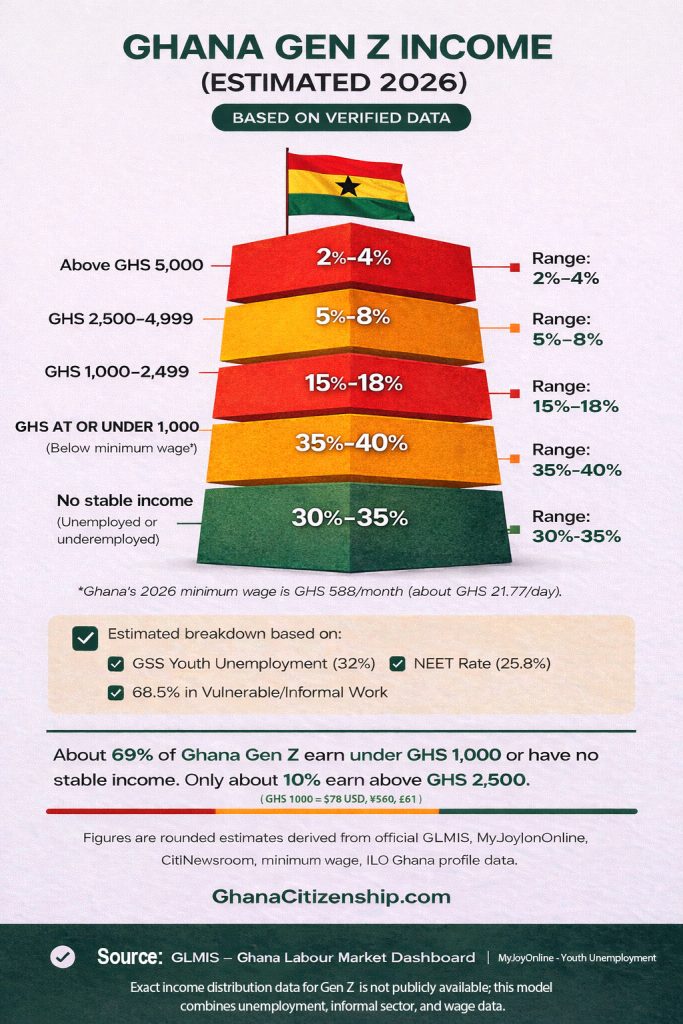
How this estimate was built
Because Ghana does not publish income distribution by age group, we combined:
– Youth unemployment data
– NEET statistics
– Informal employment trends
– Minimum wage benchmarks
– Regional unemployment data
This approach allows us to model how income is distributed across young people. Approximately 68% of workers in Ghana are in vulnerable or informal employment, meaning income is often unstable.
What the verified data actually shows
Official unemployment rate
– 13.1% (AHIES 2024)
(GLMIS Dashboard)
Regional variation
– Greater Accra: 21.5% (highest)
– Bono: 6.6% (lowest)
– National average: ~11%
This shows that unemployment is significantly higher in urban areas, especially among young people entering the workforce.
Youth unemployment
– Around 30%+ for ages 15 to 24
(source)
NEET population
– Nearly 2 million youth not working or in education
(source)
Minimum wage (2026)
– GHS 21.77 per day
– ~GHS 588 per month
(source)
Gender employment patterns (PEA data)
– Male: 72.4%
– Female: 27.6%
This data comes from Private Employment Agency (PEA) placements, not the entire labor market. It shows that men make up the majority of placements through formal recruitment channels.
This suggests that women may face barriers to accessing formal employment pipelines, and are more likely to be represented in informal or self-employed work across the broader economy.
These data points consistently show a labor market where income is concentrated at the lower end.
Estimated Ghana Gen Z income breakdown (2026)
| Income Level | Estimated Share | Justification |
|---|---|---|
| No stable income | 30% to 35% | Youth unemployment (~30%) + NEET data |
| Under GHS 1,000 | 35% to 40% | Minimum wage (~GHS 588/month) + informal economy |
| GHS 1,000 to 2,499 | 15% to 18% | Entry-level and lower formal sector jobs |
| GHS 2,500 to 4,999 | 5% to 8% | Skilled workers and small business owners |
| Above GHS 5,000 | 2% to 4% | Top earners in limited sectors |
*The following breakdown is a modeled estimate, not an official income distribution dataset
Key takeaway:
Around 65% to 75% of young people in Ghana earn under GHS 1,000 or have no stable income.
Why income is low in Ghana
1. Youth unemployment is structurally high
Even though official unemployment is around 13%, youth unemployment is significantly higher. This creates a situation where a large portion of young people are not earning at all or are struggling to enter the workforce.
2. Informal economy dominance
Most jobs are informal, meaning income is unstable and often low. Workers rely on daily earnings rather than fixed salaries, which limits overall income growth.
3. Low minimum wage
The minimum wage sets a very low baseline at around GHS 588 per month. This keeps entry-level earnings low across both formal and informal sectors.
4. Regional inequality
Unemployment varies widely across regions, with urban centers like Accra experiencing significantly higher unemployment. This creates competition for jobs and downward pressure on wages.
5. Limited high-paying opportunities
High-income jobs are concentrated in a few industries and require specialized skills. This limits upward mobility for most young workers.
How youth unemployment could be improved
Even with 65–70% of Gen Z earning below GHS 1,000, there are concrete steps, some already underway that could shift these numbers. The solutions below are not theories; they are based on existing Ghanaian programs, regional successes, and structural reforms that address the root causes of low youth income.
1. Skills development that matches real jobs
Formal education alone has not translated into employment. The Ghana Statistical Service data shows that even among tertiary graduates, underemployment remains high. What is needed is targeted, demand-driven training.
The National Entrepreneurship and Innovation Plan (NEIP) already runs skills programs, but scaling them to reach rural youth and aligning curricula with sectors that actually hire—like agribusiness, logistics, and digital services—would make a difference. Ghana’s digital hubs in Accra, Kumasi, and Takoradi have demonstrated that six‑month coding or data analytics courses can place graduates into remote jobs earning upwards of GHS 2,500/month.
2. Support for small businesses (where most jobs come from)
Over 70% of workers are in vulnerable employment, mostly in micro‑enterprises. These businesses rarely have access to formal credit or expansion capital.
Initiatives like YouStart (the government’s youth employment programme) attempt to fill this gap, but implementation has been uneven. A more effective approach would combine:
– Guaranteed small‑dollar loans through rural banks and savings groups,
– Simplified business registration (the Registrar General’s Department has made progress with paperless systems),
– Shared workspaces and equipment for artisans, reducing startup costs.
When small businesses can formalize and grow, they hire more—and offer stable income instead of daily “by‑the‑way” work.
3. Digital economy expansion (remote work as a bypass)
The digital economy offers a rare chance to decouple income from the local job market. Ghanaian freelancers on platforms like Upwork and Toptal often earn in USD, far exceeding local wage benchmarks.
However, access is uneven. Expanding national broadband infrastructure and creating public co‑working hubs outside major cities could open this pathway to youth in the Northern, Volta, and Central regions. The Ghana Digital Centres Project (formerly RICs) is a start, but its scope remains limited.
A practical next step: embed digital skills training into the National Service Scheme, so young graduates leave with both a certificate and a marketable portfolio.
4. Industrial growth that creates stable jobs
Most of Ghana’s industrial base is concentrated in small‑scale manufacturing and processing. The One‑District‑One‑Factory (1D1F) initiative was designed to create anchor employers, but many factories operate below capacity due to power costs and supply chain gaps.
Long‑term stability requires:
– Consistent electricity tariffs for industrial users,
– Local sourcing incentives so factories buy from nearby farmers and producers,
– Export facilitation to move beyond the domestic market.
When factories run full shifts, they create the kind of predictable, formal employment that moves workers from the “under GHS 1,000” bracket into the middle tier.
What these four areas share is a shift from treating youth employment as a social problem to treating it as an economic infrastructure problem. The data shows the gap. The mechanisms to close it already exist in parts of Ghana—they just need to be scaled and made consistent.
Sources
- GLMIS – Ghana Labour Market Dashboard
- MyJoyOnline – Youth unemployment
- CitiNewsroom – NEET data
- Minimum wage data
- ILO Ghana profile