

The Akan are the largest ethnic group in Ghana, representing approximately 45 to 50 percent of the national population. They are a West African ethnolinguistic group centered primarily in Ghana and neighboring Côte d’Ivoire, speaking Central Tano (Kwa) languages including Asante-Twi, Fante, and Bono.
Here is what that means in practice: when you travel through southern and central Ghana, the cultural traditions, language you hear most frequently, and many of the chieftaincy structures you encounter are rooted in Akan civilization.
Understanding the Akan matters because their matrilineal kinship system, political history (including the Asante Empire), and cultural exports (kente cloth, Adinkra symbols, Anansi stories) have shaped modern Ghana and its diaspora. If you are researching Ghanaian heritage, citizenship, or relocating to Ghana, this background provides essential context.
Origins and Migrations
The Akan are indigenous to the forest-savanna transition zone of what is now Ghana. Contrary to colonial-era theories about migration from a “Ghana Empire” or Egypt, archaeological and oral-historical evidence points to long-term Akan settlement in the forest and forest-savanna zones of present-day Ghana, with major Bono and Adanse centers emerging well before the colonial era.
Early states like Bono-Manso and Begho grew around the gold trade. Akan oral traditions include creation myths (emerging from sacred caves or the sky) and memories of migrations. For example, certain Akyem and Akuapem clans recall origins in the north or Bono country. These serve cultural identity more than literal history, and scholars treat them carefully.
By the 17th century, coastal Fante-Akan states like Mankessim formed, linked by trade with Europeans. Between the 17th and 18th centuries, the Asante kingdom unified inland Akan peoples under Osei Tutu, founded around 1701 with the Golden Stool ritual. They dominated the region until British conquest in the late 19th century.
Major Akan Subgroups
The Akan comprise several interrelated subgroups, each with its own dialect and traditional territory. Key subgroups include the Asante (Ashanti) in central Ghana, Fante along the central coast, Bono (Brong) in central Ghana, and Akyem and Akuapem in the Eastern Region. The population figures below are approximate estimates, as official census data groups at the broader Akan level rather than providing clean national subgroup totals.
The table below compares the largest groups:
| Subgroup | Approx. Population (Ghana) | Region (Ghana) | Language/Dialect | Historical State |
|---|---|---|---|---|
| Asante (Ashanti) | ~3.7 million (estimate) | Ashanti Region | Asante Twi | Asante Empire (1701–1900) |
| Fante | ~2.5 million (estimate) | Central/Western coasts | Fante | Fante Confederacy (17th–19th c.) |
| Bono (Brong) | ~4.6% of national pop. (estimate) | Bono, Bono East, Ahafo | Bono Twi | Bono states, flourishing by the late medieval period |
| Akyem | ~3.4% of national pop. (estimate) | Eastern Region | Akyem Twi | Akyem states |
| Akuapem | ~2.9% of national pop. (estimate) | Eastern Region | Akuapem Twi | Akuapem kingdoms |
All speak Akan (Central Tano) languages, with Twi as the inland dialect continuum and Fante on the coast. Notable historical polities include the Asante Empire, Fante Confederacy, Bono states, and the Akyem/Akuapem kingdoms. Each subgroup maintains unique stool chiefs and royal lineages. Other smaller Akan groups include Denkyira, Ahafo, Wassa, and Nzema.
Matrilineal Kinship and Social Structure
Akan society is traditionally matrilineal. Descent, inheritance, and succession are traced through the mother’s line. Children belong to their mother’s abusua (clan), and property traditionally passes from mothers to daughters (and often from maternal uncles to nephews).
There are eight principal Akan clans: Asona, Agona, Aduana, Oyoko, Asene, Biretuo, Ekuona, and Asakyiri. Clan membership is exogamous (one may not marry within one’s clan). Each clan venerates a common ancestor and maintains its own abusua stools and totems.
Socially, Akan families organize into extended lineages. The mother’s brother (maternal uncle) plays an important role in raising and mentoring children. Chiefs’ succession follows matrilineal lines; often the son of the previous chief’s sister becomes heir. Succession to the Asantehene (king of Asante) and other chiefs thus passes among matrilineal relatives.
Constitutional law now grants children inheritance rights, but customary matrilineal practice remains dominant in many areas. Some scholars suggest urbanization is gradually shifting these norms, though strong evidence on the pace of change is limited.
Languages and Classification
Akan refers to a cluster of closely related languages and dialects in the Central Tano branch of Niger-Congo. The main dialect groups are Twi (inland: Asante Twi, Akuapem Twi, Bono Twi) and Fante (coastal). All are mutually intelligible to varying degrees.
In Ghana, Akan languages are the most widely spoken. Asante Twi alone is used by an estimated 15 percent of the population, Fante by approximately 10 percent. These figures are language-use estimates rather than settled national counts. Standard orthographies exist for Twi and Fante, and written literature has grown since the 20th century.
The Central Tano (Akan) subgroup sits under Kwa (Volta-Niger) within the broader Niger-Congo language family.
Religion, Cosmology and Syncretism
Traditional Akan religion is hierarchical, centered on Nyame, with abosom and ancestors playing major roles in daily spiritual life. The supreme creator god (Nyame, also called Nyankopon, Odomankoma) is considered distant from daily affairs. Asase Yaa, the earth spirit, is second only to Nyame in reverence in many Akan traditions and receives honor through agricultural rites.
Beneath them are numerous lesser deities (abosom) tied to natural forces (rivers, forests, sky). These abosom are worshipped through priests who offer libations and sacrifices for health, fertility, and protection. Ancestors (Nsamanfo) are also venerated; libations and prayers are offered to departed lineage heads at family shrines and ceremonial occasions.
In folklore, the spider Anansi is a culture hero and trickster deity associated with wisdom and storytelling. Akan religion today is often syncretic with Christianity (and to a lesser extent Islam in southern Ghana). Many Akan Christians also consult the abosom or observe libation rituals on special occasions, blending beliefs.
Cultural Practices
Festivals
Akan societies celebrate annual festivals tied to the calendar, ancestors, and harvests. The Ashanti observe Akwasidae and Adae festivals every six weeks to honor the Golden Stool and ancestors. These involve palatial drumming, libations, and public durbars of chiefs. The Adae Kese (Great Adae) is the largest Asante festival, reinforcing loyalty to the Asantehene.
Akuapem, Akyem, and some Fante towns celebrate Odwira (“purification”) in autumn, marking the yam harvest. Odwira is a purification festival associated with harvest, renewal, and in some traditions, remembrance of the 1826 anti-Asante victory. It includes cleansing rites, path-clearing, and communal feeding of ancestors with newly harvested yams.
Day Naming
A distinctive Akan custom is day-naming: children receive a “day name” based on the weekday of birth. For instance, Kofi (male) and Afia (female) are Friday-born, Kwame and Ama for Saturday, Kwadwo and Adwoa for Monday. These names carry meanings associated with character and remain widely used among modern Ghanaians.
Funerary Rites
Akan funerals are elaborate multi-stage ceremonies. The deceased is usually buried within days, with mourners wearing traditional cloths. Funerals celebrate the life and status of the deceased, with processions, drumming, and votive gifts. For chiefs and elders, grand state funerals can last several days.
Art, Textiles and Adornment
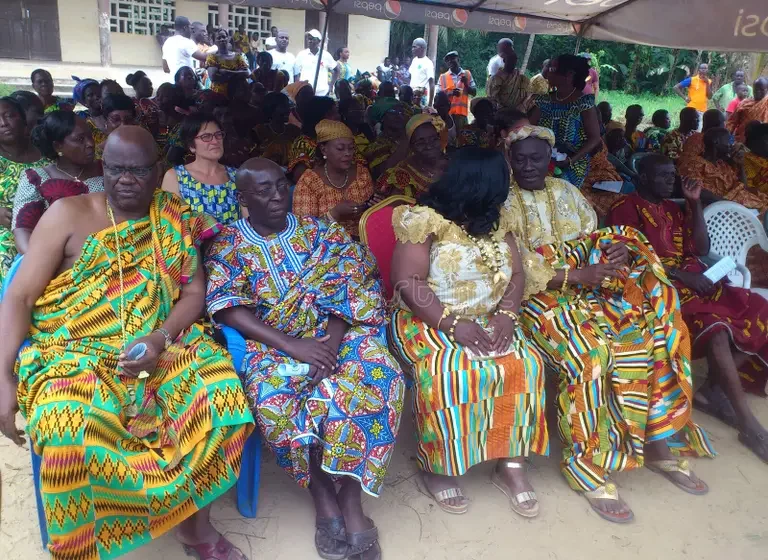
The Akan are renowned for kente cloth, a woven silk or cotton textile of bright, symbolic patterns originating with the Asante. Kente is worn on special occasions and has become a pan-Ghanaian symbol of heritage. Adinkra cloth (stamped with symbolic motifs) also originates from the Akan (Asante Denkyira region).
Akan goldweights, small brass weights used historically to measure gold dust, reflect Akan cosmology. They are cast using the lost-wax method with motifs of animals, tools, and proverbs. Wood carving (stools, figures) and pottery (particularly by Akan women in Bono lands) are other significant art forms.
Proverbs and Oral Literature
Proverbs are highly esteemed in Akan culture. Skillful use of proverbs is considered a mark of wisdom and education. For example, “okto nwo anoma” (“A crab does not give birth to a bird”) underscores parent-child resemblance. Akan elders and speakers commonly quote proverbs in speeches and disputes.
The oral tradition also includes folk tales (most famously those of Anansi the spider) that teach morals and reflect social values. Many Akan stories, including stool histories and heroic narratives, are preserved by royal and clan historians (sekafuo).
Political History and Modern Role
Akan political history centers on several precolonial states. The earliest major Akan political formations included Bonoman (Bono state), with roots extending well before the 15th century. By the 17th and 18th centuries, southern Akans formed influential kingdoms: Denkyira, Akwamu, and the Fante states, and eventually the Asante Empire.
Under King Osei Tutu (reigned c. 1680–1717), Asante united Asante and allied Akan states. The Golden Stool symbolized Asante unity. Around 1701, Asante decisively defeated Denkyira and became dominant. The Asante Empire expanded, controlling much of central Ghana through alliances and conquest.
From the 19th century, the British pushed inland from the coast, leading to repeated Anglo-Asante Wars. British forces captured Kumasi in 1874 (Third War) and again suppressed a 1900 uprising (Yaa Asantewaa’s War). After the 1900 war, the British formally annexed the Ashanti kingdom in 1902, placing it under colonial rule along with the Gold Coast colony. Under colonial administration, Akan chiefs retained some influence, but real power shifted to colonial authorities.
During the nationalist era, Akan leaders played key roles. Ghana’s independence movement was led by Kwame Nkrumah, who was of Nzema heritage (Nzema is considered Akan-related, though sometimes treated separately in political and ethnic discourse). The new nation of Ghana (1957) drew on Akan political traditions of centralized chieftaincy and proverbs of unity.
In modern Ghana, Akan ethnic identity remains politically significant. Major political parties and leaders often draw on Akan support. Ghana maintains multiple-stool chieftaincies (the Asantehene, Omanhene) that coexist with democratic institutions.
Traditional and Modern Economy
Traditional Akan economies combined agriculture, mining, and trade. In forest areas, the Akan practiced shifting cultivation. Staples included yams, plantains, cassava, and maize, along with cash crops like oil palm and kola nuts. Coastal Akans (Fante) engaged heavily in fishing.
From the 15th century onward, gold mining was central to Akan political economy, particularly in the goldfields around what is now Kumasi and broader Ashanti region, where alluvial gold and rock gold were extracted by hand. Gold symbolized wealth and was used in Akan rituals. Artisans produced gold jewelry and goldweights using the lost-wax method.
With the rise of the Atlantic trade, Akan leaders traded gold and enslaved people for European goods including guns and cloth, which fueled the slave era.
In the 20th century, cocoa became vital. Akan areas (particularly Ashanti, Eastern, and Central regions) are among Ghana’s top cocoa producers. Today, gold mining remains significant in Ashanti, along with bauxite, timber, and other minerals. Many Akan are also traders, civil servants, and urban workers. Artisanal crafts (kente weaving, pottery, carving) still contribute to local economies.
Several Akan-majority regions remain central to Ghana’s cocoa production, gold mining, and agricultural trade.
If you are researching Ghanaian citizenship, dual citizenship applications, or need help documenting your Akan heritage for citizenship purposes, personalized legal assistance can make the process smoother. Use the form below to connect with a qualified Ghanaian lawyer:
Sources
- Ghana Statistical Service: 2021 Population and Housing Census
- Harvard University: Akan Abusua Nhyeyee (Akan Family System)
- Britannica: Ghana – Independence
- Britannica: Akan Peoples
- Britannica: Asante Empire
- Berekum.nl: Twi Proverbs
- Britannica: Asase Yaa
- Britannica: Kente Cloth
- Britannica: Odwira Festival
- Britannica: Akan Names
- Britannica: War of the Golden Stool
- Konadu, Kwasi. The Akan Diaspora in the Americas. Oxford University Press.
Compliance note: All money transfer services must be licensed by the Bank of Ghana.