


Ghana has one major vaccination requirement that international travelers should understand before departure: travelers aged 9 months and older are required to provide proof of yellow fever vaccination when entering Ghana.
The document used as proof is the International Certificate of Vaccination or Prophylaxis (ICVP), commonly called the yellow card. The certificate becomes valid for international travel 10 days after a person’s primary yellow fever vaccination.
For international travel purposes, a valid yellow fever certificate remains valid for the lifetime of the person vaccinated. A booster cannot be demanded merely because an older yellow card displays the former 10-year expiration period.
This guide explains Ghana’s yellow fever entry rule, what to do if you cannot medically receive the vaccine, what may happen if you travel without a valid certificate, where to find authorized vaccination centers, which other vaccines are currently recommended, how to prevent malaria, and the health issues travelers should watch in 2026.
Related Ghana travel guides:
Table of Contents
- Ghana Vaccine Requirements Overview
- What Is Yellow Fever?
- The Required Yellow Fever Certificate
- Medical Exemptions and Waivers
- What Happens at Accra International Airport
- What Happens If You Travel Without a Valid Certificate?
- Where to Get the Yellow Fever Vaccine
- Recommended Vaccines for Ghana
- Malaria Prevention in Ghana
- Current Ghana Health Issues in 2026
- Travel Health Tips
- Sources
Ghana Vaccine Requirements Overview
The table below separates Ghana’s actual entry requirement from vaccines and preventive measures recommended because of the country’s disease environment.
| Vaccine / Prevention | 2026 Status | Who Should Consider It? |
|---|---|---|
| Yellow Fever | Required for entry | Ghana requires proof of vaccination for arriving travelers aged 9 months and older. |
| Hepatitis A | Recommended | CDC recommends it for unvaccinated travelers aged 1 year and older, with a special travel dose also recommended for infants aged 6-11 months. |
| Hepatitis B | Recommended | CDC recommends it for unvaccinated travelers of all ages going to Ghana. |
| Typhoid | Recommended for most travelers | Especially important for travelers exposed to local food and water or visiting areas where sanitation may be less reliable. |
| Meningococcal ACWY | Recommended for certain travelers | CDC recommends vaccination for travelers aged 2 months and older visiting areas of Ghana within the meningitis belt during the dry season, roughly December through June. |
| Polio | Routine vaccination should be current | Ghana was removed from CDC’s circulating-poliovirus travel list in March 2026. A special adult booster is not currently recommended solely because someone is traveling to Ghana. |
| MMR and Other Routine Vaccines | Recommended | Travelers should be current on routine vaccinations appropriate to their age and medical history, particularly measles vaccination. |
| Rabies | Consider based on risk | Particularly relevant for animal contact, remote travel, or situations where rapid post-exposure treatment could be difficult to obtain. |
| Mpox | Recommended for certain higher-risk travelers | CDC currently recommends vaccination for adults anticipating specified sexual or intimate-contact exposures during travel. |
| Cholera | May be considered for certain travelers | CDC currently identifies localized areas of cholera transmission in Ghana. Vaccination can be considered depending on itinerary and individual risk. |
| Malaria Medication | Recommended throughout Ghana | CDC recommends prescription malaria prophylaxis for travelers going anywhere in Ghana. |
What Is Yellow Fever?
Yellow fever is a viral disease transmitted primarily through the bites of infected mosquitoes. Ghana is a country where yellow fever transmission can occur, and vaccination is both a health recommendation and an entry requirement.
The World Health Organization says yellow fever is primarily transmitted by mosquitoes including species from the Aedes group in Africa.
How Yellow Fever Progresses
The incubation period is generally 3-6 days.
Initial symptoms can include:
- Fever.
- Headache.
- Body aches.
- Nausea.
- Vomiting.
- Weakness.
Many infected people recover after the initial phase.
WHO estimates that approximately 15% of infected people develop severe disease. Severe symptoms can include:
- Recurring high fever.
- Jaundice.
- Vomiting.
- Bleeding.
- Shock.
- Liver or other organ failure.
WHO states that approximately 50% of patients who enter the severe phase die within 7-10 days.
There is no routinely approved antiviral treatment that cures yellow fever. Medical care is primarily supportive.
The Yellow Fever Vaccine
The vaccine is a live, weakened vaccine.
WHO states that:
- A single dose provides lifelong protection.
- Approximately 80%-100% of vaccinated people develop immunity within 10 days.
- More than 99% develop immunity within 30 days.
For international certificate purposes, the ICVP becomes valid 10 days after primary vaccination.
The certificate remains valid for the holder’s lifetime.
Who Needs Special Medical Advice?
Yellow fever vaccination requires an individualized risk-benefit assessment for some people.
CDC lists precautions including:
- Age 6-8 months.
- Age 60 years or older.
- Pregnancy.
- Breastfeeding.
- Certain forms of HIV infection.
Contraindications can include:
- Age younger than 6 months.
- Severe allergy to vaccine components.
- Certain severe immune deficiencies.
- Some immunosuppressive therapies.
- Malignant neoplasms.
- Organ transplantation.
- Certain thymus disorders.
The Required Yellow Fever Certificate
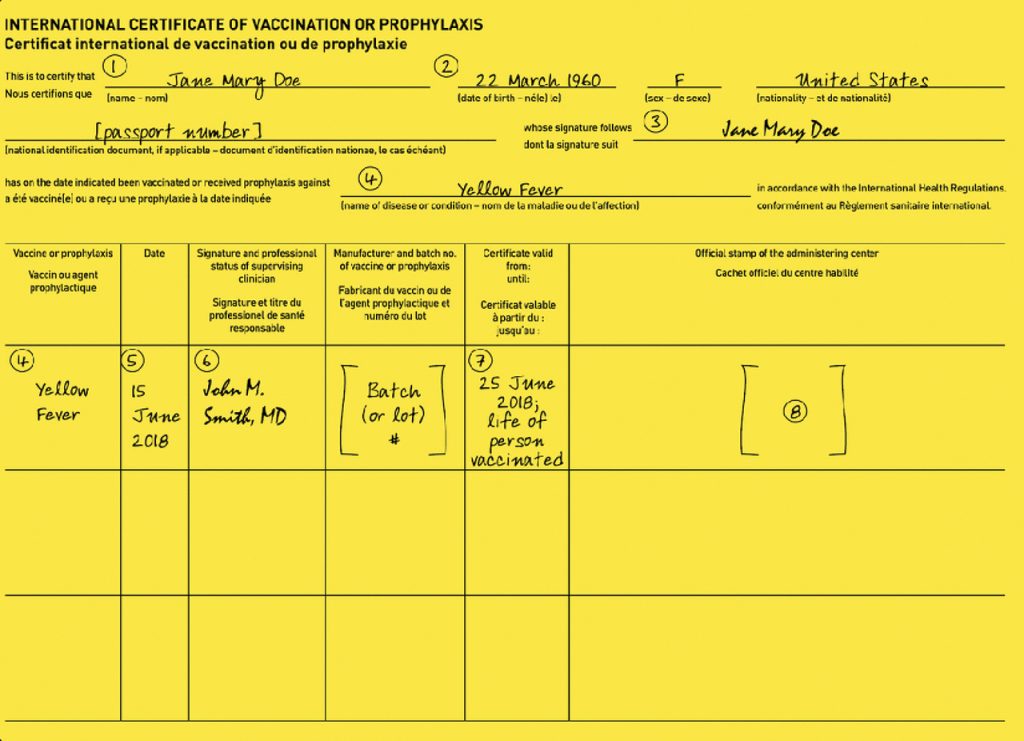
Ghana currently requires yellow fever vaccination for all arriving travelers aged 9 months and older.
The official international document is the International Certificate of Vaccination or Prophylaxis (ICVP).
CDC International Certificate of Vaccination or Prophylaxis guidance
What Makes an ICVP Valid?
A properly completed ICVP includes information such as:
- The traveler’s name matching the passport.
- Date of vaccination.
- Yellow fever as the disease covered.
- Vaccine manufacturer and batch or lot number.
- Handwritten signature of the authorized clinician.
- Official stamp of the designated yellow fever vaccination center.
- The date from which the certificate becomes valid.
The certificate becomes valid 10 days after the date of a person’s primary yellow fever vaccination.
Does an Old Yellow Card Expire?
No, not merely because the card was originally printed with a 10-year validity period.
The International Health Regulations were amended so that yellow fever vaccination certificates are valid for the life of the person vaccinated.
The lifetime-certification rule took effect internationally on July 11, 2016.
A country cannot require a booster simply because more than 10 years have passed since the vaccination shown on an otherwise valid certificate.
Medical Exemptions and Yellow Fever Waivers
Travelers who cannot safely receive yellow fever vaccine for a legitimate medical reason can discuss a formal medical waiver with an authorized yellow fever vaccination provider.
For a U.S.-issued waiver, CDC recommends that the authorized clinician:
- Complete the medical-contraindication section of the ICVP.
- Validate it with the yellow fever center’s official stamp.
- Provide a signed and dated waiver letter on letterhead explaining the medical contraindication.
A medical waiver should not be treated as a guaranteed substitute for vaccination.
CDC warns that destination countries may not accept a waiver.
Under the International Health Regulations, travelers with a recognized medical exemption may be permitted entry but can still be subject to public-health measures such as surveillance or quarantine depending on the circumstances.
What Happens at Accra International Airport?
Ghana officially reverted the name Kotoka International Airport to Accra International Airport (AIA) in February 2026.
You may still see the former name or the abbreviation KIA on older websites, signs, travel bookings, third-party airport databases, and historical material.
Ghana Airports Company Limited states that Port Health is located in Terminal 3 and provides yellow fever vaccination and other primary health services.
Keep the Original ICVP Accessible
Travel with the original yellow fever certificate and keep it somewhere that can be reached without unpacking checked baggage.
A valid ICVP contains standardized information including:
- Your name.
- Vaccination date.
- Clinician signature.
- Vaccine manufacturer and batch number.
- Official authorized-center stamp.
A photograph or scan of the card is useful as a backup record but should not be assumed to replace the original internationally recognized certificate at the border.
Can You Get Vaccinated at Accra International Airport?
Yes. Ghana Airports Company Limited currently lists yellow fever vaccination through Port Health in Terminal 3.
GACL currently publishes a vaccination rate of US$20 for both Ghanaian and foreign nationals.
However, this should be treated as a health service, not as a strategy for satisfying Ghana’s entry rule at the last minute.
A newly administered primary yellow fever vaccination does not produce a valid international certificate until 10 days after vaccination.
Travelers should therefore obtain the vaccine before travel rather than planning to solve the problem at the airport.
What Happens If You Travel Without a Valid Yellow Fever Certificate?
Traveling without a valid certificate creates several possible problems.
Your Airline May Stop You Before Departure
Airlines are responsible for checking destination entry documentation in many circumstances.
If the airline determines that you do not meet Ghana’s health-entry requirements, it may refuse boarding.
Airline enforcement can vary, but travelers should never assume that reaching Ghana first and explaining the situation later will work.
Possible Public-Health Measures on Arrival
CDC states generally that travelers who cannot provide a valid ICVP when a destination requires one may face measures including:
- Denial of entry.
- Quarantine.
- Vaccination or revaccination at the point of entry.
The International Health Regulations establish a maximum yellow fever incubation period of six days for relevant quarantine calculations.
The exact measure applied depends on the traveler’s circumstances and the competent public-health authority.
Where to Get the Yellow Fever Vaccine by Country
Only a designated yellow fever vaccination center can properly issue and validate an ICVP.
This does not mean that every pharmacy or general doctor’s office is automatically disqualified. Some pharmacies and medical practices are officially authorized yellow fever centers. The key is whether the particular location has been designated by the country’s competent health authority.
| Country | Where to Start | Important Note |
|---|---|---|
| United States | CDC Yellow Fever Vaccination Clinic Search | Only designated yellow fever vaccination clinics can validate a U.S. ICVP with the required Uniform Stamp. |
| Canada | Public Health Agency of Canada Yellow Fever Centers | Use a center designated by the Public Health Agency of Canada. |
| United Kingdom | NaTHNaC / TravelHealthPro Yellow Fever Centre Search | Yellow fever vaccination is available through designated Yellow Fever Vaccination Centres. |
| China | General Administration of Customs International Travel Health Care Centers | China’s International Travel Health Care Centers provide yellow fever vaccination services. Availability and appointment procedures should be checked with the local center before travel. |
| Nigeria | Federal Ministry of Health Nigeria Yellow Card Portal | Use Nigeria’s official Port Health / yellow-card process and carry the official certificate provided through that system. |
| European Union | National travel-health authority or authorized tropical/travel medicine center | Designation systems differ by EU member state. Verify authorization through the national health authority rather than assuming a private clinic can issue a valid ICVP. |
Recommended Vaccines for Ghana
Yellow fever is the vaccination required for entry. The following recommendations concern protection against diseases travelers may encounter while in Ghana.
Hepatitis A
CDC recommends hepatitis A vaccination for unvaccinated travelers aged 1 year and older traveling to Ghana.
Infants aged 6-11 months should also receive a travel dose. That early dose does not count toward the child’s normal routine hepatitis A series.
Hepatitis A is spread primarily through contaminated food and water.
Hepatitis B
CDC recommends hepatitis B vaccination for unvaccinated travelers of all ages traveling to Ghana.
Hepatitis B can be transmitted through blood, sexual contact, contaminated medical equipment, and other exposures to infected body fluids.
The exact vaccination schedule depends on the vaccine product and the traveler’s age and previous vaccination history.
Typhoid
CDC recommends typhoid vaccination for most travelers to Ghana.
In the United States, commonly used options include:
- An injectable vaccine, with a booster generally recommended every two years if risk continues.
- An oral vaccine series, with a booster generally recommended every five years if risk continues.
Typhoid vaccination is not 100% effective, so safe food and water practices remain important.
Meningococcal ACWY
The old version of this guide recommended meningococcal vaccination to all Ghana travelers and described the major risk period as December through February.
CDC’s current guidance is more specific.
Vaccination is recommended for travelers aged 2 months and older who will visit areas of Ghana that fall within Africa’s meningitis belt during the dry season.
CDC describes that season as roughly:
December through June.
Travelers primarily remaining in southern Ghana should discuss their exact itinerary with a travel-medicine provider rather than assuming the recommendation automatically applies to every trip.
Polio
This section required a major 2026 correction.
Ghana was removed from CDC’s list of destinations with circulating poliovirus on March 9, 2026.
Travelers should still make sure they are appropriately vaccinated against polio as part of their routine vaccination history.
However, the previous recommendation that every vaccinated adult should receive a lifetime booster specifically because of travel to Ghana is no longer current CDC guidance.
Your itinerary can change that calculation if you will also visit or spend significant time in another country where poliovirus is circulating.
Measles, Mumps and Rubella
CDC currently has a worldwide travel notice because measles cases are increasing internationally.
International travelers should be fully vaccinated against measles according to the schedule applicable to their age and health history.
Rabies
Dogs infected with rabies are commonly found in Ghana, and CDC warns that rabies vaccine used for post-exposure treatment may be available mainly in larger suburban or urban medical facilities.
Pre-exposure vaccination is worth discussing if you:
- Work with animals.
- Expect significant animal exposure.
- Plan extended rural travel.
- Will spend time somewhere where prompt access to safe post-exposure treatment could be difficult.
For U.S. travelers, the modern ACIP pre-exposure primary schedule is generally two doses given on days 0 and 7.
This replaced the older routine three-dose schedule.
Travelers with longer-term ongoing risk can require additional titer testing or a later booster.
Pre-exposure vaccination does not eliminate the need for medical treatment after a possible rabies exposure.
Mpox
Mpox deserves more attention in the 2026 version of this guide than it did previously.
Ghana experienced sustained mpox transmission beginning in 2025, primarily involving clade IIb virus.
WHO reported that Ghana notified it on July 16, 2026 of the country’s first detected case involving clade Ib. WHO reported that the patient had recently traveled from the Democratic Republic of the Congo and was stable, with contact tracing underway.
CDC currently recommends mpox vaccination for adults who anticipate certain higher-risk activities while traveling, including:
- Sexual or intimate contact with a new partner.
- Sexual or intimate contact at a commercial sex venue.
- Sexual or intimate contact in exchange for money, goods, drugs or another trade.
- Sexual or intimate contact associated with certain large public events.
This is not a blanket vaccine recommendation for every tourist going to Ghana.
Cholera
Ghana experienced a substantial cholera outbreak beginning in 2024 and extending into 2025.
WHO reported in March 2026 that the outbreak had resulted in more than 7,000 cases and 51 deaths.
The situation has changed considerably since the original version of this article was written.
As of its August 25, 2026 Ghana travel-health review, CDC identifies localized areas of cholera transmission in:
- Ashanti Region.
- Central Region.
- Greater Accra Region.
- Northern Region.
- Western Region.
However, CDC’s same page notes that the last cases in those areas were reported approximately 9-12 months earlier.
CDC notes that cholera is rare in travelers.
Vaccination may be considered for children and adults traveling to areas CDC considers to have active transmission, particularly when individual risk or itinerary warrants it.
Malaria Prevention in Ghana
Malaria occurs throughout Ghana.
CDC currently recommends prescription malaria medication for travelers going to all areas of Ghana.
Most malaria in Ghana is caused by Plasmodium falciparum, the species associated with the greatest risk of severe disease.
Ghana has chloroquine-resistant malaria. Travelers should therefore not use chloroquine as standard malaria prophylaxis for Ghana.
CDC malaria guidance for travelers
Common Malaria Prevention Medications
| Medication | Typical Timing | Important Considerations |
|---|---|---|
| Atovaquone-Proguanil | Usually started 1-2 days before entering the malaria area, taken daily during travel, and continued for 7 days after leaving. | Often convenient for shorter trips because of the shorter post-travel course. Suitability depends on medical history. |
| Doxycycline | Usually started 1-2 days before travel, taken daily, and continued for 28 days after leaving. | Can cause sun sensitivity and gastrointestinal or esophageal irritation. It is unsuitable in some circumstances, including pregnancy. |
| Mefloquine | Usually started at least 2 weeks before travel, taken weekly, and continued for 4 weeks after leaving. | Not appropriate for everyone. Certain psychiatric, seizure, and cardiac histories can affect suitability. |
CDC also lists tafenoquine as an option for some travelers. It requires specific medical screening, including quantitative testing for G6PD deficiency, and is not appropriate for everyone.
Your clinician should select malaria prevention based on your medical history, pregnancy status, age, trip duration, other medications, and personal risk factors.
Mosquito Protection Still Matters
Preventive medication is not 100% protective.
- Use an EPA-registered insect repellent such as DEET or picaridin.
- Wear long sleeves and long pants when practical.
- Use screened or air-conditioned accommodation where possible.
- Use an insecticide-treated mosquito net if sleeping somewhere without adequate screening.
- Consider permethrin-treated clothing and gear for higher-exposure itineraries.
Current Ghana Health Issues Travelers Should Know About in 2026
Yellow Fever
Yellow fever remains an ongoing transmission risk in Ghana.
WHO’s global yellow fever assessment covering January through May 2026 listed Ghana among countries reporting suspected yellow fever cases that were under investigation.
This does not mean Ghana was experiencing a nationwide confirmed outbreak, but it reinforces why vaccination and mosquito-bite protection remain important.
Mpox
Ghana has experienced ongoing mpox transmission since the expanded outbreak that began in 2025.
WHO reported Ghana’s first detected clade Ib case in July 2026 in a traveler who had recently been in the Democratic Republic of the Congo.
Travelers should avoid direct contact with unexplained rashes or lesions and review current CDC recommendations if their planned activities place them within a group for whom mpox vaccination is recommended.
Cholera
Ghana’s major 2024-2025 cholera outbreak should no longer be described as though the same nationwide emergency were continuing unchanged through 2026.
CDC currently identifies localized transmission areas but notes that the last reported cases in those regions were approximately 9-12 months earlier.
Safe food, water and hand hygiene remain important regardless of outbreak status.
Polio
Ghana is no longer on CDC’s current circulating-poliovirus destination list.
Travelers should remain current on normal polio vaccination, but the former Ghana-specific special booster recommendation has been removed.
Measles
CDC currently maintains a global measles travel-health notice because cases are increasing in multiple countries.
Travelers should verify that they are fully vaccinated according to the recommendations appropriate to their age before international travel.
Travel Health Tips for Ghana
- See a travel-health professional early. CDC recommends visiting your doctor or travel clinic at least one month before travel when possible.
- Carry the original yellow card. Keep a digital copy as a backup, but do not assume a phone photo replaces the original ICVP.
- Bring enough prescription medication. Carry enough for the planned trip plus a reasonable reserve for travel delays.
- Keep medication in appropriately labeled packaging. Confirm that controlled or restricted medications are legal in Ghana before travel.
- Use safe drinking water. Sealed bottled, boiled, or appropriately treated water are safer choices when water quality is uncertain.
- Be selective about food hygiene. Prefer freshly cooked food served hot and use additional caution where sanitation or refrigeration appears unreliable.
- Take malaria prophylaxis exactly as prescribed. Do not stop your medication simply because you have left Ghana if the medication requires a post-travel course.
- Avoid unnecessary animal contact. Seek urgent medical advice after a dog, bat, monkey, or other mammal bite or scratch.
- Arrange travel medical insurance. Travelers relocating or staying long term should understand what their health coverage will actually pay for in Ghana and whether emergency evacuation is included.
For longer stays, read the medical insurance guide for Ghana expats and digital nomads.
For information on hospitals and clinics, see our medical care in Ghana guide.
Related Articles
Sources
- U.S. Centers for Disease Control and Prevention: Ghana Traveler Health Page
- U.S. Centers for Disease Control and Prevention: International Certificate of Vaccination or Prophylaxis
- U.S. Centers for Disease Control and Prevention: Yellow Fever Vaccine Information for Healthcare Providers
- U.S. Centers for Disease Control and Prevention: Malaria for Travelers
- U.S. Centers for Disease Control and Prevention: Rabies Pre-Exposure Prophylaxis Guidance
- World Health Organization: Yellow Fever Fact Sheet
- World Health Organization: International Health Regulations, Annex 7, Yellow Fever Vaccination and International Certificates
- World Health Organization: Multi-country Mpox Situation Report #68, July 31, 2026
- World Health Organization Africa: Ghana Health Security and Cholera Prevention Updates, March-April 2026
- Ghana Airports Company Limited: Accra International Airport Passenger Guide and Yellow Fever Vaccination Rates
- Ghana Ministry of Transport: February 2026 Renaming of Kotoka International Airport to Accra International Airport
- Public Health Agency of Canada: Yellow Fever Vaccination and Authorized Centers
- NaTHNaC / TravelHealthPro: UK Yellow Fever Vaccination Centre Finder
- Federal Ministry of Health Nigeria: Official Yellow Card Portal