

543 Business Ideas to Start in Ghana
Quick links (related guides):
Table of Contents
On April 9, 2026, global commodities trading giant Trafigura Group announced it had signed an offtake agreement with Heath Goldfields Ltd., a Ghanaian-owned gold mining company, to purchase 700,000 ounces of gold doré from the Bogoso-Prestea Gold Mine in Ghana’s Western Region. Alongside the purchase commitment, Trafigura provided USD 65 million in debt financing to restart the mine’s oxide ore operations.
If that reads like corporate paperwork, here is the plain version: one of the world’s most powerful commodity traders has, for the first time, put real money and a long-term purchasing commitment behind a Ghanaian-owned gold mine. They are not just buying gold. They are financing the production of it.
That distinction matters. The Trafigura Ghana gold sector deal is not a speculative trade. It is a structured, long-term commercial relationship between a global trading house and an indigenous Ghanaian mining company. At current gold prices of approximately USD 3,300 per ounce, the offtake agreement alone is valued at roughly USD 2.3 billion. The signal it sends to other global firms, to investors, and to Ghanaian suppliers looking for contracts is significant.
Who Is Trafigura and Why Does Their Entry Matter?
Trafigura Group is one of the largest private commodity trading companies in the world, headquartered in Geneva and trading everything from oil and gas to metals and minerals across more than 150 countries. The firm handles hundreds of billions of dollars in physical commodities annually and has established infrastructure, logistics networks, and market access that most miners cannot replicate independently.
When a company of that size makes its first transaction in a country’s gold sector, it is not by accident. Trafigura has the data, the analysts, and the due diligence teams to know exactly what they are walking into. Their entry suggests that Ghana’s regulatory environment, mine compliance standards, and the quality of the Bogoso-Prestea asset satisfied Trafigura’s due diligence requirements.
This is also only Trafigura’s second gold deal on the African continent, following a debt financing transaction in December 2025 to support Sierra Leone’s first commercial-scale gold mine. The pattern is deliberate: West Africa is on their map, and Ghana now appears to be an important regional market in that expansion.
For context on Ghana’s position as a gold producer, the country recorded a historic 6 million ounces of gold output in 2025, cementing its status as Africa’s leading gold producer. Trafigura’s entry is a direct endorsement of that trajectory.
The Bogoso-Prestea Mine: A Historic Asset Reborn
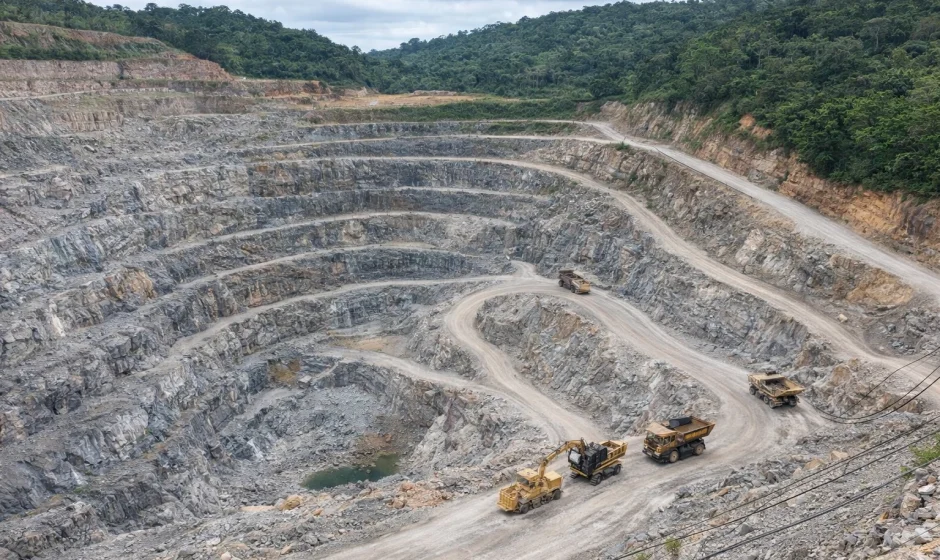
The Bogoso-Prestea Gold Mine is one of West Africa’s most significant gold operations, with a history stretching back to 1912 and cumulative production exceeding 9 million ounces. Located in Ghana’s Western Region, it is an underground and surface operation that has passed through multiple owners over the decades, including Golden Star Resources and a later transfer to London-based Future Global Resources, whose lease was subsequently cancelled, after which the mine was placed on care and maintenance. Heath Goldfields acquired the asset in September 2024.
Heath Goldfields set about repositioning the asset as a modern, globally competitive mining operation, with a stated commitment to sustainable, community-centred operations. The first gold pour took place in February 2026, marking the restart of production after two years. The Trafigura deal, announced just two months later, provides both the financing to scale up oxide ore processing and the assured market access to sell the output.
Patrick Appiah Mensah, Managing Director of Heath Goldfields, noted that the transaction demonstrates strong confidence in Ghana’s mining sector and in the capacity of an indigenous operator to execute at scale. The mine’s restart has already created 1,400 jobs and includes commitments to environmental compliance and infrastructure rehabilitation.
| Deal Parameter | Detail |
|---|---|
| Agreement Date | April 9, 2026 |
| Parties | Trafigura Group Pte Ltd. and Heath Goldfields Ltd. |
| Mine Location | Bogoso-Prestea Gold Mine, Western Region, Ghana |
| Offtake Volume | 700,000 ounces of gold doré |
| Debt Financing Provided | USD 65 million |
| Estimated Offtake Value (at ~USD 3,300/oz) | Approximately USD 2.3 billion |
| Delivery Commencement | Expected later in 2026 |
| Jobs Created at Restart | 1,400 |
| Trafigura’s History on the Continent | Second gold deal in Africa; first in Ghana |
Sources: Trafigura press release, April 9, 2026; Reuters; Bloomberg; Ghana Graphic Online. Gold price estimate as of April 2026 and subject to market fluctuation.
How the Deal Is Structured
The agreement combines two instruments that together solve Heath Goldfields’ core problem: capital and market access.
The debt financing of USD 65 million funds the operational restart of oxide ore processing at the Bogoso-Prestea facility. Oxide ore is generally lower cost to process than sulphide ore, which makes it the logical starting point for a mine returning from care and maintenance. Without this capital, the timeline for full-scale production would have been significantly longer.
The offtake agreement is the second piece. Trafigura commits to purchasing 700,000 ounces of gold doré – a semi-processed gold product – produced at the facility. Doré is the standard output for mid-tier mines before it is sent to a refinery for final processing. By committing to purchase this volume, Trafigura gives Heath Goldfields the revenue certainty needed to plan, hire, and operate at scale.
The transaction was structured by Verdant IMAP, a pan-African investment bank with a focus on metals and mining, with legal advice provided by Sullivan in London and JLD & MB Legal Consultancy in Accra. The involvement of Accra-based legal counsel is noteworthy: it reflects the deal’s grounding in Ghana’s legal and regulatory framework. The mine also holds LBMA (London Bullion Market Association) compliance status, which is effectively a prerequisite for selling gold into major international markets. As Gonzalo De Olazaval, Head of Metals and Minerals at Trafigura, stated in the company’s official release, Bogoso-Prestea’s strong operational team and LBMA compliance made it an asset where their physical trading expertise and market access could add genuine value.
What It Signals for Ghana’s Economy
The deal matters beyond the mine itself. Ghana’s government has been actively pushing reforms to increase state revenues from the mining sector and expand local participation. The gold royalty hike implemented in recent years is part of that direction. The Trafigura-Heath Goldfields deal represents a different lever: indigenous Ghanaian ownership attracting top-tier global capital on commercial terms, without requiring government intervention or subsidy.
That is a meaningful data point. It tells other global commodity traders, private equity firms, and institutional investors that Ghanaian-owned, LBMA-compliant mining operations can clear international due diligence and attract structured financing. The previous barrier was often the perception that indigenous ownership meant higher risk. This deal, structured by an international investment bank and backed by one of the world’s most commercially rigorous commodity traders, challenges that assumption directly.
For the Ghana economy in 2026, the timing is also relevant. Ghana’s macroeconomic recovery and IMF-backed reform programme have gradually improved investor sentiment. A deal of this scale and profile adds to the narrative that Ghana is open, compliant, and commercially viable for global firms at the top of their sectors.
At current gold prices, the royalties, corporate taxes, and employment generated by the restarted Bogoso-Prestea mine will contribute meaningfully to Ghana Revenue Authority collections from the mining sector. Ghana’s Mining and Minerals Law governs royalty rates on gold, and the government’s stated priority is to ensure that more of the upstream value remains within the country.
Opportunities for Ghanaian Businesses and Suppliers
A mine restart of this scale requires an extensive supply chain, and much of it can be sourced locally. The Bogoso-Prestea operation’s restart creates real procurement demand across several categories that Ghanaian entrepreneurs and SMEs can position for directly.
| Supply Chain Category | What Is Needed | Local Opportunity |
|---|---|---|
| Logistics and Transport | Ore haulage, equipment transport, fuel delivery | High – trucking and freight firms in Western Region |
| Catering and Camp Services | Meals, accommodation management for 1,400+ workers | High – local caterers and hospitality operators |
| Engineering and Maintenance | Plant maintenance, electrical, mechanical services | Medium-High – requires certified trade skills |
| PPE and Safety Equipment | Helmets, gloves, boots, protective clothing | Medium – importers and distributors can supply |
| Environmental Compliance Services | Water testing, land rehabilitation, monitoring | Medium – environmental consulting firms |
| Legal and Financial Services | Compliance, audit, tax, contract management | Medium – Accra-based professional services firms |
| Construction and Civil Works | Infrastructure rehabilitation, road maintenance | High – regional contractors |
The key for local suppliers is to register with Heath Goldfields’ procurement department early and to ensure any relevant certifications – health and safety, ISO standards, environmental compliance – are in order. Large mining operations with LBMA compliance and international offtakers have procurement standards that must be met. A Ghanaian supplier that meets those standards is in a strong position, because the mine’s community engagement commitments create a preference for local sourcing where quality and compliance are equivalent.
Beyond direct mine supply, the deal creates indirect opportunities. Trafigura’s physical presence as offtaker means gold doré will be transported, refined, and exported. That creates demand for secure transport logistics, refinery coordination, and export documentation services in Ghana, particularly through the port of Tema.
What Foreign Investors Should Take from This
The Trafigura deal will be read closely in Geneva, London, Singapore, and New York by commodities investors and mining finance professionals. Here is what it actually demonstrates for anyone considering Ghana as an investment destination.
Ghanaian-owned operators can reach LBMA compliance and attract structured international financing. That was not always considered a given. Heath Goldfields’ model – combining indigenous ownership with international operational standards and a pan-African structured finance partner – provides a replicable template.
West Africa is actively competing for gold sector capital. Sierra Leone’s deal with Trafigura in December 2025 and Ghana’s deal in April 2026 show a deliberate regional expansion by at least one major trader. Other producers will follow if the regulatory environment remains predictable.
For foreign investors specifically interested in Ghana, the Ghana Foreign Investment Guide outlines the frameworks under the Ghana Investment Promotion Centre Act (GIPC Act 865) that govern foreign participation. Mining has specific local ownership and community benefit requirements that any incoming investor needs to understand before structuring a transaction. The Trafigura-Heath Goldfields deal is built around a Ghanaian-owned operating entity, which is consistent with Ghana’s policy direction and provides a useful structural reference point.
Corporate tax rates in Ghana’s mining sector are also relevant: Ghana’s corporate tax structure for mining companies includes specific royalty rates, capital allowances, and stability agreement provisions that affect project economics. Foreign investors looking at deals of this type should model those carefully alongside offtake pricing assumptions.
The broader picture is straightforward: a mine that had been on care and maintenance is now producing gold, has 1,400 people employed, has one of the world’s largest commodity traders committed to buying its output, and is backed by USD 65 million in structured debt. That is a complete commercial recovery story. It will be studied by anyone considering Ghana’s extractive sector.
543 Business Ideas to Start in Ghana
Sources
- Trafigura: “Trafigura signs gold offtake agreement and provides debt financing for Bogoso-Prestea mine in Ghana” (April 9, 2026)
- Reuters: “Trafigura signs gold offtake pact and provides debt financing for Ghana mine” (April 9, 2026)
- Bloomberg: “Trafigura Signs Offtake, Financing Deal With Ghana Gold Miner” (April 9, 2026)
- Ghana Graphic Online: “US$2.3billion offtake: Trafigura signs 700,000-ounce gold agreement with Ghanaian-owned Heath Goldfields” (April 2026)
- Trade Finance Global: “Trafigura signs offtake agreement and debt financing with Bogoso-Prestea mine in Ghana” (April 2026)
- CNBC Africa: “Trafigura enters Ghana gold sector with Bogoso-Prestea deal” (April 2026)