


Quick links (related guides):
Table of Contents
- Understanding Ghana’s Climate Zones
- The Two Rainy Seasons of Southern Ghana
- The Single Rainy Season of Northern Ghana
- What Does It Actually Feel Like?
- Regional Variations in Detail
- How Ghanaians Deal with the Rainy Season
- Health Risks During the Rainy Season
- Essential Items for Ghana’s Rainy Season
- Month-by-Month Guide
- The Fishing Season and the Rainy Season
- The Akosombo Dam: When the Rains Overflow Everything
- Children, Schools and the Rainy Season
- Mining, Rainy Season and Environmental Damage
- Women and the Rainy Season: A Gendered Burden
- Flooding in Ghana: The Scale of the Problem
- What to Expect as a Visitor or Expat
- Agriculture, Economy and Climate Change
- Cultural and Social Dimensions of the Rainy Season
- Sources
Ghana, a country straddling the Gulf of Guinea in West Africa, has a tropical climate shaped by its proximity to the equator, the Atlantic Ocean, and the vast Sahara Desert to the north. One of the most defining features of life in Ghana is the Ghana rainy season, or more accurately, the rainy seasons, because unlike many countries, Ghana experiences not one but two distinct wet periods each year across most of the country. Understanding the rainy season is essential whether you are a traveller planning a visit, an expat settling in, a student, a farmer, or simply someone curious about one of West Africa’s most vibrant nations.
This guide covers everything: when it starts, how long it lasts, what it feels like on the ground, how it varies by region, how Ghanaians live through it, what to wear, what to carry, how to stay safe, and much more.
Understanding Ghana’s Climate Zones
Before diving into the rainy season itself, it helps to understand that Ghana is not climatically uniform. The country spans roughly 800 kilometres from north to south, and that stretch encompasses meaningfully different climate patterns.
The South (Coastal and Forest Zones): This includes Greater Accra, Central Region, Western Region, Eastern Region, and the southern parts of Volta Region. The south experiences a bimodal rainfall pattern, meaning two distinct rainy seasons per year. The humid, forested interior (Ashanti, Brong-Ahafo, and parts of Eastern Region) also falls under this pattern.
The North (Guinea Savannah and Sudan Savannah Zones): This includes Northern Region, Upper East Region, and Upper West Region. The north has a unimodal rainfall pattern, one long rainy season, and a pronounced, very dry harmattan season in contrast.
This north-south divide is the single most important thing to understand when discussing rain in Ghana. “Rainy season” means something quite different depending on where you are.
Rainy Season Calendar at a Glance
Note: Season windows are approximate and vary from year to year depending on the movement of the Inter-Tropical Convergence Zone (ITCZ). Dates reflect general long-term patterns as described in peer-reviewed climate literature for Ghana (MDPI, 2023; FAO).
| Zone | Pattern | Major Rainy Season | Minor Rainy Season | August Break | Peak Months | Key Notes |
|---|---|---|---|---|---|---|
| Coastal South (Accra, Cape Coast, Takoradi) | Bimodal | Apr – Jul | Sep – early Nov | Late Jul – Aug (sometimes early Sep) | May – Jun | Highest flood risk; storms typically strike late afternoon |
| Forest Belt (Kumasi, Ashanti, Eastern Region) | Bimodal | Apr – Jul | Sep – Nov | Late Jul – Aug | May – Jun | Higher rainfall totals than Accra; roads become muddy |
| Transition Zone (Brong-Ahafo) | Bimodal (less distinct) | Apr – Jul | Sep – Oct | Aug | May – Jun | August break less pronounced than on the coast |
| Northern Savannah (Tamale, Bolgatanga, Wa) | Unimodal | May – Oct | None | None | Jul – Aug | Long dry season follows; harmattan dominates Nov – Mar |
The Two Rainy Seasons of Southern Ghana
The Major (First) Rainy Season
Transition rains often begin in March, sporadic, uncertain showers that signal what is coming. The major rainy season proper is generally considered to begin in April, building momentum through May and June when it reaches full intensity. May and June are consistently the wettest months in Accra and much of southern Ghana; these two months account for a large proportion of the city’s total annual rainfall. The first season tapers off in late July, leading into the August Break.
Total duration: the major season runs roughly April to July, about four months, with the heaviest activity concentrated in May and June.
The Little Dry Season (August Break)
This interlude deserves its own mention because it is often misunderstood by people who check a rainfall calendar and assume August is reliably wet. Typically occurring from late July through August and sometimes extending into early September, the August Break brings noticeably drier and hotter conditions to the south. Rainfall does not disappear entirely, but it becomes far less frequent and less intense. The skies often take on a hazy, dusty quality. For farmers, this pause can be stressful, and many agricultural communities plan their cropping calendar carefully around it.
The Minor (Second) Rainy Season
Around mid-September, the rains return to southern Ghana. This second season is generally milder and shorter than the first, with October tending to be its wettest month. November sees a gradual drying out, and by December, southern Ghana has largely transitioned into the dry season, which runs through to March. Total duration: roughly mid-September to early November, about two months.
Annual Rainfall Totals in the South
Accra, surprisingly for a coastal capital, is one of the drier parts of southern Ghana. This is partly due to the Dahomey Gap, a coastal dry anomaly caused by cold ocean upwelling, which makes Accra notably drier than cities just a few hundred kilometres east or west. Rainfall figures are approximate and vary by station and reference period; the values below reflect available long-term averages.
| City | Zone | Approx. Annual Rainfall | Wettest Months | Flood Risk Level | Source / Period |
|---|---|---|---|---|---|
| Accra | Coastal South | ~730 mm | May – Jun | High (drainage failure) | Commonly cited figure; varies by station |
| Cape Coast | Coastal South | ~1,100 mm | May – Jun | Medium | GMet approximate |
| Takoradi | Coastal West | ~1,400 mm | May – Jun | Medium – High | GMet approximate |
| Axim | Far Western | ~1,800 mm | May – Jun | Medium | GMet State of the Climate 2023 |
| Kumasi | Forest Belt | ~1,400 mm | May – Jun | Medium – High | GMet approximate |
| Ho | Volta Region | ~1,200 mm | May – Jun | Medium | GMet approximate |
| Tamale | Northern Savannah | ~1,100 mm | Jul – Aug | Medium | FAO; 1991-2020 climate normals |
| Bolgatanga | Upper East | ~900 mm | Jul – Aug | Low – Medium | FAO approximate |
| Wa | Upper West | ~1,000 mm | Jul – Aug | Low – Medium | FAO approximate |
The Single Rainy Season of Northern Ghana
The north operates on a completely different schedule, driven by the northward movement of the Inter-Tropical Convergence Zone (ITCZ), a belt of low pressure, thunderstorms, and rainfall that migrates seasonally across West Africa. Rains begin arriving in the north in April or May, later than in the south. July and August are the wettest months, representing the height of the rainy season. The rains wind down in September and October, fading out by November.
Total duration: roughly May through October, about five to six months. The north is drier overall than the forest belt. Tamale receives approximately 1,100 mm annually (FAO; 1991-2020 climate normals). The Upper East and Upper West regions can receive as little as 700 to 900 mm, making water management a serious concern for farming communities.
After the rains end, the region transitions into a long, intensely dry season. The harmattan, a dry, dusty wind blowing from the Sahara, dominates from November through February or March, reducing visibility, drying out vegetation, and creating conditions that are striking in their contrast to the lush rainy season landscape just months earlier.
What Does It Actually Feel Like?
Heat and Humidity
Ghana is a hot country year-round, but the rainy season brings a particular kind of oppressive heat-humidity combination. Temperatures in Accra typically sit between 27°C and 32°C (80-90°F) during the rainy months, but relative humidity frequently exceeds 80 percent, making the heat feel significantly more intense. Stepping outside at noon in May can feel like walking into a warm, wet blanket. Everything feels slightly damp, clothes take longer to dry, leather goods can develop mould, and sweat does not evaporate efficiently.
Inland and at higher elevations, the Ashanti highlands, the Akwapim ridge, temperatures are slightly lower and the air feels marginally more breathable, but humidity remains high. In the north during the rainy season, temperatures are similarly high but humidity is generally lower than the forest belt, especially outside of active storm systems.
The Character of the Rain
Ghana’s rainy season is not a gentle, steady drizzle like the monsoon of South Asia. The rain comes in convective thunderstorms, explosive, dramatic downpours that can arrive with very little warning. The pattern is often this: the morning begins sunny and hot; by midday or early afternoon, clouds build rapidly and the sky turns dark in places; in the late afternoon or evening, a storm rolls through with high winds, lightning, thunder, and intense rain; within one to two hours, the storm passes and the sky may clear again.
This cycle is not universal, sometimes it rains steadily for hours, and sometimes storms hit at midnight, but the late-afternoon thunderstorm is a classic feature that residents know intimately. Experienced Ghanaians develop an instinct for reading the sky and can often sense when a storm is imminent well before the clouds arrive overhead.
The Smell
One thing visitors often mention is the smell of rain in Ghana. When the first drops hit the hot, dry earth or the red laterite soil, they release a particular earthy fragrance, petrichor, that is intensely evocative to anyone who has lived in Ghana. It is one of those sensory memories that stay with you for years.
Flooding
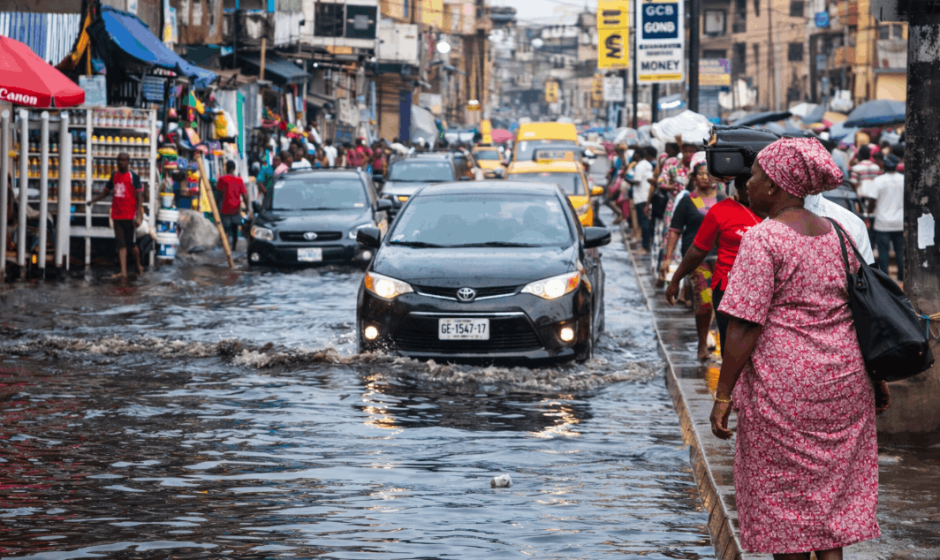
Ghana’s most serious rainy season challenge is flooding, and it is a perennial, deadly problem. Accra in particular has become notorious for its flood vulnerability. Several factors combine: rapid, largely unplanned urbanisation has covered natural drainage land with concrete; drainage infrastructure across most Ghanaian cities is inadequate and poorly maintained; waterways and gutters are frequently blocked with solid waste; and low-lying areas and floodplains have been built on extensively. When heavy rain falls, flooding can occur within minutes. Rural roads wash out. Bridges become impassable. Homes made of mud and adobe, particularly in the north, can collapse.
Regional Variations in Detail
Accra and Greater Accra. Accra’s rains are paradoxically light for a coastal capital, about 730 mm annually, but the city’s drainage infrastructure is wholly inadequate for even moderate storms. The first season (May-June) brings the heaviest showers, and flooding can leave main roads partially submerged within minutes. Traffic during and after rainfall events becomes extremely congested. Experienced residents plan morning departures and leave afternoons flexible during May and June.
Kumasi and the Ashanti Region. Kumasi sits at higher elevation in the forest belt and receives approximately 1,400 mm or more annually. Rain here can be prolonged and heavy. The lush green landscape of Ashanti during the rainy season is striking. Many of Kumasi’s roads, particularly outside the core city, become difficult to navigate in wet conditions.
Cape Coast and the Central Region. The Central Region coast receives more rain than Accra due to different ocean dynamics. Cape Coast and surroundings are notably greener and more humid. The area’s famous forts and castles take on a particularly atmospheric quality during the rains, and dramatic skies and green coastal vegetation are a marked contrast to the dry season.
Western Region (Takoradi, Axim). The far west receives the most rainfall of anywhere in Ghana. Axim averages around 1,800 mm annually and is among the wettest places in the country. The Western Region’s oil industry operations and road infrastructure contend with extremely heavy seasonal rain. This region is lushly forested and remarkably green even by Ghanaian standards.
Volta Region (Ho, Hohoe, Kpando). The Volta Region, particularly around Ho and the Afadzato highland area, receives generous rainfall. Waterfalls become thunderous torrents in the rainy season, the Volta Lake and its tributaries fill, and the landscape turns an intense emerald. The Afadzato area, home to Ghana’s highest peak, is especially lush and worth visiting during or just after the rains for the dramatic scenery.
Northern Ghana (Tamale, Bolgatanga, Wa). The north’s single rainy season transforms the landscape in a way that visitors who have only seen the harmattan-era north would not recognise. What appears as dry, brown savannah from November through April becomes remarkably green from June through September. Rivers that are dusty channels in the dry season run full. The rains are critical for farming, guinea corn, millet, groundnuts, and yams, and the rhythm of life in the north is intimately tied to rainfall patterns. Tamale, Bolgatanga, and Wa all experience significant flooding during heavy rain events, and the region’s many unpaved roads become treacherous with mud.
How Ghanaians Deal with the Rainy Season
Dress and Clothing
Most Ghanaians are remarkably pragmatic about rain. Umbrellas are widely used but frequently forgotten. A common sight during a sudden downpour is people sheltering under shop awnings, trees, roadside canopies, or any available overhang, waiting for the storm to pass, sometimes for an hour or more. This communal sheltering creates its own social atmosphere; strangers talk, vendors sell, and the rain becomes a shared experience rather than an inconvenience to be escaped alone.
Flip-flops (“slippers”) are the dominant footwear for millions of Ghanaians, and the rainy season reveals exactly why: they dry instantly and handle puddles and mud without being ruined. Closed shoes can be soaked through and take days to dry in the humid air. Women who wear traditional fabrics take care during rain to protect them from mud splashes.
Housing and Architecture
In the south, many homes are built around central courtyards with roof overhangs designed to drain water away from walls. Flat roofs on many budget buildings are a perpetual source of leaks and maintenance headaches during the rains, a problem familiar to most Ghanaian families.
In the north, traditional compound homes built of mud-brick or banco (swish) are carefully maintained before the rainy season. Walls are plastered and re-coated to protect against rain erosion, a process families may spend weeks completing. In areas prone to flooding, families raise floors and store valuables on elevated platforms before the rains arrive.
Farming and Agriculture
Ghana is predominantly agricultural, and the rainy season is the lifeblood of farming. In the south, the first rainy season (April-July) is the major planting season for maize, cassava, plantain, cocoa, and vegetables. The second rainy season (September-November) provides a second planting window, particularly for vegetables and some cereals. Cocoa, Ghana’s most important cash crop, is heavily dependent on reliable rainfall in the Western and Ashanti cocoa belts. Too much rain causes fungal disease (black pod); too little stunts growth.
In the north, the single rainy season determines almost everything. Planting happens in May-June and harvesting in September-October. Farmers read the sky carefully and rely on generational knowledge, increasingly challenged by climate unpredictability that is altering the timing and distribution of rains.
Markets and Street Hawking
Ghana’s vibrant street market culture adapts constantly to the rains. Street hawkers carrying goods on their heads can disappear under an awning within seconds when a storm begins. Many large markets, Kejetia in Kumasi, Kaneshie and Agbogbloshie in Accra, have partially covered sections, though market streets themselves remain exposed. Roadside food vendors work under tarpaulin canopies or zinc (corrugated iron) roof structures. The smell of Ghanaian street food, kenkey, waakye, kelewele, mingling with rain on hot asphalt is one of the defining sensory experiences of the season.
Transport
Urban roads in Accra and Kumasi flood quickly. Even a moderate 30-minute downpour can leave major roads underwater. Drivers sometimes attempt to cross floodwater, often with disastrous results for their engines. Experienced Ghanaians know which roads to avoid and can recite the flood-prone spots from memory. Trotros (shared minibuses), the dominant form of public transport, operate from unpaved lorry parks that turn to mud in heavy rain, and the vehicles themselves may have leaking roofs or poorly closing windows. Rural roads, many of which are unpaved laterite tracks, can become completely impassable during peak rains. Four-wheel drive vehicles are essential for rural travel. Motorcycle taxis (okadas), common in the north, are hazardous in heavy rain, roads become slippery, and riders and passengers get thoroughly soaked.
Electricity and Infrastructure
Lightning strikes can damage power infrastructure during storms. Heavy rain can knock out transformers. Many Ghanaians keep torches, candles, and if possible, small generators or solar lanterns for power outage events, a practical precaution that experienced residents treat as a basic household standard during the rainy season.
Health Risks During the Rainy Season
The rainy season brings specific health risks that both Ghanaians and visitors must be aware of. The table below summarises the key risks; note that exact peak windows vary by region (malaria risk, for example, tracks standing water and tends to peak later in the north than in the south). Risk levels are general indicators, not guarantees of annual outbreaks.
| Health Risk | Why Rainy Season Increases It | Who Is Most at Risk | Key Prevention Steps | Typical Peak Window |
|---|---|---|---|---|
| Malaria | Standing water creates Anopheles mosquito breeding grounds | Children under 5, pregnant women, non-immune visitors | Insecticide-treated nets; DEET repellent; prophylaxis medication (visitors) | May – Oct (varies by region) |
| Cholera | Flooding contaminates water sources and overwhelms sanitation | All; higher risk in areas with poor water infrastructure | Treated water only; strict handwashing; avoid food prepared with unclean water | During and after flood periods |
| Typhoid | Contaminated food and water | All | Same as cholera; vaccination available | During and after flood periods |
| Leptospirosis | Bacteria in floodwater contaminated by rodent urine | Anyone wading or working in floodwater | Avoid wading in floodwater; wear rubber boots where unavoidable | Jun – Sep |
| Fungal skin infections | Prolonged humidity and damp clothing | All | Keep skin dry; change wet clothing promptly; use antifungal powder | Apr – Oct |
| Respiratory infections | Temperature variability; mould growth in damp homes | Children, elderly | Ventilate rooms; address mould promptly with diluted bleach | May – Jul |
| Gastroenteritis | Contaminated food and water | All | Cook food thoroughly; peel fruit yourself; drink treated water only | During and after flood periods |
Malaria is the single most significant concern. It spikes dramatically as standing water creates breeding grounds for the Anopheles mosquito, which bites in the evening and at night. The Ghana Health Service and Ministry of Health distribute insecticide-treated nets through health campaigns. Visitors should consult a travel medicine specialist before arriving and take prescribed prophylaxis, use DEET-based repellents, sleep under nets, and wear long sleeves at dusk and dawn.
Essential Items for Ghana’s Rainy Season
Whether you are a long-term resident or a visitor, the following items will make life significantly more manageable during the rainy season. Prices shown are approximate and subject to local market variation.
| Item | Why It Matters in Ghana’s Rainy Season | Who Needs It | Budget Option | Better Option |
|---|---|---|---|---|
| Wind-resistant umbrella | Storms are explosive; cheap umbrellas invert and break immediately | Everyone | GHS 20-40 roadside umbrella (replace often) | Quality compact wind-resistant model |
| Rain poncho | Covers you and your bag; more practical than an umbrella on motorbikes | Outdoor workers, commuters, travellers | Disposable plastic poncho | Lightweight packable nylon poncho |
| Flip-flops / slippers | Dry instantly; handle flooded streets without being ruined | Everyone | Any roadside pair | Quality rubber sandals with grip |
| Rubber boots (gumboots) | Essential for farming, rural roads, and flood zones | Rural travellers, farmers, outdoor workers | Local market gumboots | Mid-height Wellington boots |
| Waterproof phone pouch | A single rainstorm on a motorbike can destroy a smartphone | Everyone | GHS 10-20 sealed plastic pouch | Rated waterproof case with lanyard |
| Waterproof bag cover | Protects documents, laptop, and clothing from sudden downpours | Students, professionals, travellers | Plastic bags layered inside main bag | Dry bag or dedicated backpack rain cover |
| Insecticide-treated net (ITN) | Malaria risk spikes massively during rainy season | Everyone sleeping in Ghana | Government-distributed ITN from health facility | Long-lasting insecticidal net (LLIN) |
| DEET repellent (30%+) | Prevents mosquito bites in the evenings | Everyone | Doom or Peaceful Sleep spray (widely available) | Autan or Jungle Formula 50% DEET |
| Torch / headlamp | Power outages increase during storms | Everyone | Basic LED torch with batteries | Rechargeable LED headlamp |
| Power bank | Keeps phone alive when power is out for hours | Everyone | 5,000 mAh basic model | 20,000 mAh fast-charge model |
| Antifungal powder or cream | Humidity causes athlete’s foot and skin infections | Everyone | Canesten powder (available at pharmacies) | Lamisil cream |
| Oral rehydration salts (ORS) | Diarrhoea and dehydration risk rises during flooding periods | Everyone, especially children | Dioralyte or local pharmacy ORS sachets | Pre-mixed sachets in variety pack |
| Silica gel packets | Prevent mould on clothing, leather goods, and electronics | Expats, long-stay visitors | Small packs from supermarkets or online | Large rechargeable silica canisters |
| Mosquito coils | Backup protection for rooms without nets | Everyone | Doom coils (widely available at markets) | Electric plug-in repellent device |
Month-by-Month Guide
Southern Ghana
| Month | Rain Likelihood | Travel Disruption | Key Notes |
|---|---|---|---|
| January | Very Low | Very Low | Dry season; harmattan haze possible; cool mornings |
| February | Very Low | Very Low | Still dry; harmattan fading; temperatures rising |
| March | Low – Medium | Low | Transition rains begin, sporadic evening showers; humidity rising |
| April | Medium | Low – Medium | Major season begins; thunderstorms increasingly common; vegetation greening |
| May | High | High | Full rainy season; heavy afternoon thunderstorms; flooding risk in low-lying areas |
| June | Very High | Very High | Peak of first season; often the single wettest month; highest flood risk |
| July | Medium | Medium | Rains decreasing; transitioning toward August Break from late July |
| August | Low | Low | August Break, drier and hotter; hazy skies; farmers monitor soil moisture carefully |
| September | Low – Medium (rising) | Low | Break ends mid-month; second (minor) season begins |
| October | Medium – High | Medium | Wettest month of second season; less intense than May – Jun |
| November | Low – Medium | Low | Rains tapering; transitioning to dry season |
| December | Very Low | Very Low | Dry season established; harmattan begins; popular tourist month |
Northern Ghana
| Month | Rain Likelihood | Travel Disruption | Key Notes |
|---|---|---|---|
| January | None | Very Low | Full dry season; harmattan dominant; cool nights, hot days |
| February | None | Very Low | Harmattan continues; very dry and dusty |
| March | None | Very Low | Dry; temperatures climbing sharply toward peak heat |
| April | Very Low | Very Low | First tentative showers possible late in the month |
| May | Low – Medium | Low | Rains establish; planting season begins |
| June | Medium | Medium | Regular thunderstorms; farming in full swing |
| July | High | High | Peak rainy season; rivers run full; roads may become very difficult |
| August | Very High | High | Wettest month; roads at their worst; landscape lush and green |
| September | Medium – High | Medium | Rains tapering; harvest season beginning; roads improving |
| October | Low – Medium | Low | Rains fading; harvest in progress; roads drying |
| November | Very Low | Very Low | Dry season begins; harmattan returning from the north |
| December | None | Very Low | Full dry season; harmattan intensifying; dust reduces visibility significantly |
The Fishing Season and the Rainy Season
Ghana’s coastal communities have a relationship with the rainy season that is distinct from inland farming communities. Ghana has over 500 kilometres of Atlantic coastline and more than 187 fishing communities, with an estimated three million people depending on the fisheries sector for their livelihoods.
Rough Seas and the Natural Fishing Lull
The peak of the first rainy season, May and June, coincides with rough sea conditions that traditionally kept artisanal fishers onshore. Experienced fishers in communities from Jamestown in Accra to Elmina and Axim have long recognised May and June as naturally hazardous months for small canoe fishing. High waves, strong winds, and reduced visibility make launching wooden canoes genuinely dangerous. This period was historically understood as a natural rest, a time for boat repairs, net mending, and family activities.
The Government Fishing Closed Season
Starting in 2016 for industrial trawlers and extended to artisanal fishers in subsequent years, the government introduced a formal closed fishing season intended to allow depleted fish stocks to recover (CSIS). The timing has varied by year and fleet type; recent cycles have often placed industrial trawlers in a July-August window, with artisanal rules changing from year to year (Ghana Graphic Online).
This timing has been deeply controversial. Fisher communities argue that July does not align with the natural fishing lull, which falls in May and June, meaning the government-mandated closure imposes hardship during one of the calmer, more productive months. Research from the University of St Andrews’ Sankofa Project, reported as surveying 833 fisherfolk across 15 landing beaches in 2024, found that about 70 percent of fisherfolk relied on fishing as their sole income source, leaving families acutely vulnerable during the closure. The study documented rising school absenteeism, reduced household food security, and a disproportionate burden on women who assumed full responsibility for household expenses when male fishers lost their income (The High Street Journal, 2024).
Declining Fish Stocks and Climate Change
Ghana’s fish stocks have been declining for decades. A 2021 USAID assessment warned of severe depletion of key small pelagic species, round sardinella, flat sardinella, anchovy, and mackerel, with spawning stock biomass described as unable to replenish itself. Sea surface temperatures along Ghana’s coast have been documented as rising over recent decades, and the ranges of key fish species have been shifting northward as a result, effectively moving Ghana’s fish out of Ghanaian waters. Ghana received a yellow card from the European Union in 2021 for insufficient action against illegal, unreported, and unregulated fishing (Baird Maritime), threatening access to European export markets.
The Akosombo Dam: When the Rains Overflow Everything
No discussion of Ghana’s rainy season is complete without addressing the Akosombo Dam, a relationship that became catastrophically clear in 2023.
The Akosombo Dam, built between 1961 and 1965 on the Volta River, is one of the largest hydroelectric dams in the world. Its reservoir, Lake Volta, covers 3.6 percent of Ghana’s total land area and provides the majority of the country’s electricity. The dam’s filling displaced approximately 80,000 people from 700 villages into 52 resettlement communities. Many of those displaced moved to low-lying areas along the Volta River downstream, areas that are vulnerable to flooding when the dam must release excess water.
Unusually heavy rainfall in 2023 caused the Akosombo reservoir to approach its maximum operating level. To prevent dam failure, the Volta River Authority (VRA) began a controlled spillage on 15 September 2023, initially at a discharge rate of 183,000 cubic feet per second (VRA official statement; B&FT, October 2023). On 10 October 2023, six spillage gates were opened to increase discharge as inflows continued rising. The spillage ended on 30 October 2023 as inflows decreased significantly (Imani Africa, 2024).
Communities in North and Central Tongu districts, including Mepe, Battor, Sogakope, Mafi, Adidome, and Ada, were severely affected. The number of displaced people grew from 8,000 in the initial days to 31,000 by 19 October 2023, and reached 35,857 by 17 November 2023 (Wikipedia; UNICEF Ghana). Schools were converted into emergency shelters. The VRA was criticised for opening gates too late and for not giving communities adequate advance warning, a charge the VRA contested by pointing to the letters it said were sent to district assemblies and communities before the spill began.
The 2023 spillage was among the worst flooding events in the Lower Volta region in recent decades. It illustrates a structural problem that climate change is making more acute: as annual rainfall becomes more intense and variable, the dam may face more frequent situations where spillage is necessary. The communities in the downstream flood plains, many of them descendants of those displaced when the dam was originally built, face recurring flood risk from the very infrastructure that displaced their ancestors.
Children, Schools and the Rainy Season
The impact of the rainy season on children’s education is significant but often invisible in broader discussions of seasonal flooding.
Ghana’s basic school academic year runs from September to July, broken into three terms. This structure means the third term, roughly May through July, falls squarely within the major rainy season. The Basic Education Certificate Examination (BECE) for final-year junior high students is typically held in June or July, at the peak of the rains. For students who walk to school on unpaved paths or cross streams, heavy rain days can mean simply not attending. Schools in low-lying areas are sometimes inaccessible during and immediately after serious floods.
In farming communities, particularly in the north, children’s school attendance and agricultural labour demands interact heavily with the rainy season. Planting and weeding require family labour, and children are often pulled from school to help in poorer households. In the poorest northern districts, food insecurity stretches across the lean season, roughly from the end of the previous harvest to the new one, which can span February to August, creating pressure on families that affects whether children attend school at all.
When floods displace families, children suffer acute educational disruption. The 2023 Akosombo spillage left children in affected communities without access to their classrooms for months. As one 14-year-old girl in Mepe told UNICEF: she saw floodwater coming toward her room, and the family evacuated to a school that was then converted into a shelter. School stopped. She continued learning under a tree on the school compound (UNICEF Ghana, 2023). UNICEF and the Ghana Education Service worked to distribute learning materials and establish temporary learning spaces in the affected districts, but disruption during a BECE examination period has long-lasting consequences.
Mining, Rainy Season and Environmental Damage
Ghana is Africa’s largest gold producer, and the rainy season has significant implications for both formal and informal mining.
Galamsey and the Rains
Illegal artisanal gold mining, known locally as galamsey, is one of Ghana’s most pressing environmental crises. The sector accounts for a significant share of Ghana’s gold production but operates largely outside legal and environmental frameworks. The rainy season forces a partial, temporary slowdown in some galamsey operations, as flooding makes pits and working areas inaccessible. However, the more serious problem is what the rains do to the environmental damage already caused. Mercury and other processing chemicals are washed by rain into rivers and groundwater. During heavy rain, runoff from galamsey sites carries contaminated sediment directly into river systems, accelerating contamination across the Pra, Ankobra, Birim, and Offin river basins.
There is also a seasonal migration dynamic: many farmers from northern Ghana migrate south during the dry season to work at galamsey sites, returning north when the northern rains arrive in April or May to plant their crops. Galamsey operations partially thin out during the northern planting season, though they never fully stop.
Formal Mining and Construction
Large-scale formal mining operations continue year-round, but the rainy season brings challenges: haul roads in open-pit mines become muddy, underground access shafts can flood, and the stability of tailings dams requires close monitoring during heavy rains. Ghana’s construction industry is also heavily curtailed, particularly for earthworks and road construction. Many Ghanaians who build their homes incrementally over years pause projects during the worst of the rains, and road construction projects on unpaved surfaces are damaged by flood water and runoff, requiring costly repair when the dry season returns.
Women and the Rainy Season: A Gendered Burden
The rainy season’s burdens are not distributed equally across society. Understanding the gendered dimension is essential to understanding how communities in Ghana actually experience the season.
In northern Ghana, over 80 percent of residents depend on rain-fed agriculture, and women are the backbone of food production, domestic water collection, fuel gathering, and child-rearing, simultaneously. During the rainy season, women’s workloads intensify dramatically. Women typically manage smaller plots than men with less access to fertiliser and improved seeds, and are more likely to grow food crops for household consumption rather than cash crops. When rains are unreliable or too intense, women’s harvests fail first. Within food-insecure communities, women reduce their own food intake before reducing their children’s, sell assets, and seek casual labour to sustain their families.
In fishing communities, women fish processors, who smoke, salt, and trade fish, and who represent a major part of the coastal food economy, lose their supply during the closed fishing season, and assume full responsibility for household expenses when male fishers lose their income. Many go into debt or draw down savings to sustain households through the closure period.
When floods displace families, women and children are typically the most vulnerable: less likely to have independent access to cash, transport, or social networks outside the immediate community, and at elevated risk in crowded displacement shelters. UNICEF described women, children, and the elderly as the groups least likely to cope with the stress of the 2023 Akosombo displacement and crowded evacuation centres (UNICEF Ghana, 2023).
Flooding in Ghana: The Scale of the Problem and What to Do
Flooding in Ghana’s cities is not a natural disaster in the pure sense, it is a governance failure compounded by climate change. The combination of inadequate drainage, uncontrolled floodplain development, poor solid waste management blocking drains, and increasingly intense rainfall events is a predictable and preventable recipe for disaster.
The worst single urban flood event in Ghana’s recorded history occurred on 4 June 2015 in Accra. Heavy rain overwhelmed the city’s drainage systems, causing widespread flooding. Reported fatalities ranged from over 150 in early counts to over 250 in later tallies, with a widely cited final figure of 256 deaths (The Independent; Wikipedia), many of them people who had sought shelter at a GOIL petrol station near Kwame Nkrumah Circle that subsequently exploded. The event caused severe property damage and forced a national conversation about Accra’s drainage failures that continues to this day, though structural investment remains insufficient.
Known Flood-Prone Areas and What to Do
| City / Area | Typical Flood Issue | When Worst | Practical Tip |
|---|---|---|---|
| Kwame Nkrumah Circle, Accra | Road flooding, drain overflow, traffic standstill | May – Jun | Avoid completely during and at least 2 hours after heavy rain |
| Kaneshie / Odaw River basin, Accra | River flooding, drain overflow | May – Jun | Use elevated alternate routes; avoid the low road |
| Lapaz, Accra | Road and property flooding | May – Jun | Give significant extra travel time; roads can be impassable |
| Tema / Industrial Area | Drainage overflow on flat terrain | May – Jun | Check road reports before driving south of the motorway |
| Kumasi central market area | Market flooding; muddy roads | May – Jun | Allow extra travel time; use covered market sections |
| Tamale low-lying compounds | Compound and road flooding | Jul – Aug | Stay off unpaved roads for several hours after rain |
| Lower Volta (Mepe, Battor, Ada) | Akosombo Dam spillage / river flooding | Aug – Oct (wet years) | Monitor VRA announcements; know your evacuation route |
| Rural northern roads generally | Road washouts; routes impassable | Jul – Aug | 4WD essential; check conditions before travelling |
What to Expect as a Visitor or Expat
Managing Your Schedule
The most practical piece of advice for navigating the rainy season in Ghana is to build weather awareness into your daily schedule. In the south, afternoon appointments made without accounting for rain are frequently disrupted. Many experienced residents plan outdoor activities and important travel for morning hours and leave afternoons flexible during May and June. If you have a meeting at 3 pm during peak rainy season, allow significant extra travel time.
“Ghana time”, the flexible approach to punctuality well known in the country, becomes even more flexible during the rains. Traffic, flooding, and disruption are universally accepted explanations for delays, and most Ghanaians will simply nod knowingly when you say the rain caught you. Take things small small, as the saying goes.
Travel Planning
If you are visiting Ghana and have flexibility, the dry season, November through February in the south, or November through April in the north, offers easier travel. However, the rainy season has its own appeal: the landscape is dramatically green and lush, waterfalls are flowing at their most impressive, and the heat is moderated by the rains (though not eliminated). Wildlife at parks like Mole National Park in the north can be easier to spot during the dry season when vegetation thins, but the rains fill up watering holes and make the park landscape beautiful in a different way.
If visiting during the rains, be prepared for last-minute changes to plans. Road conditions can change rapidly. Local Ghanaians are the best real-time source of information about whether a road is passable. Check updates from the Ghana Meteorological Agency (GMet) and local radio stations, which provide essential information during severe weather events.
Accommodation and Food
In budget accommodation, leaking roofs and damp rooms are common during the rainy season. Check room conditions carefully. Better-quality hotels and guesthouses maintain waterproofing. Air conditioning, which doubles as a dehumidifier, helps with the general dampness of the season. On food safety: the rainy season increases risks at street food stalls. Eating at busy spots where food is prepared fresh and cooked at high temperatures minimises risk. Peel all fruit yourself and wash vegetables in treated water.
Agriculture, Economy and Climate Change
Ghana’s rainy seasons underpin the economy at every level. Cocoa, the largest agricultural export, requires reliable seasonal rain in the Western and Ashanti belts. Hydroelectric power from the Akosombo Dam depends on annual rainfall filling the Volta basin, the same rainfall that, in excess, causes the catastrophic spillage events described above. Food security for millions of smallholder farming families depends on rain arriving on time and in the right quantities.
Climate change is increasingly disrupting these patterns. Research and observations from Ghana and across West Africa document greater variability in the timing of seasonal rains, increasing intensity of individual rainfall events, longer dry spells appearing within the rainy season, and documented changes in the geographic distribution of rainfall. Key marine species are migrating northward as ocean temperatures rise, affecting fisheries. And the Akosombo Dam faces more frequent near-overflow situations as annual precipitation becomes more extreme and variable.
These changes are forcing adaptation in farming communities, planting dates shift, traditional crop varieties are sometimes replaced with more drought-tolerant or faster-maturing options, and conflict over land and water resources can intensify in the north. The government and NGOs are working on irrigation schemes, climate-smart agriculture programs, and improved weather forecasting. But the challenge is growing faster than the adaptation response. Ghana’s vulnerability to climate-related disruption, both from drought and from excess rainfall, is one of the most significant economic and humanitarian risks the country faces in the coming decades.
Cultural and Social Dimensions of the Rainy Season
The rainy season in Ghana is woven into culture, religion, livelihood, and social life in ways that go far beyond meteorology.
In many traditional communities, the onset of the rainy season is marked by ceremonies and festivals that pray for good rains, fertile soil, and bountiful harvests. Among the Dagomba and other groups of the north, traditional practices related to the farming season have deep spiritual significance, and chiefs and traditional leaders play roles in sanctioning planting and harvest seasons that have been maintained across generations. The Homowo festival of the Ga people, celebrated around August-September, has its name rooted in the idea of “hooting at hunger”, a celebration of harvest after a period of lean times, reflecting the anxious relationship between rainfall, food security, and community survival.
The rains bring a kind of social intimacy that is particular to Ghana. When a storm hits suddenly, people shelter together under awnings and engage in conversation that would not otherwise happen. The rhythm of heavy rain on a zinc roof is one of Ghana’s most distinctive sounds, almost deafeningly loud, forcing people to shout to be heard, or simply to stop talking and wait it out together. For many Ghanaians who have left the country, this sound is deeply associated with home.
Children across Ghana associate the rains with freedom and play. Running through warm rain, catching it in buckets and containers, playing in puddles, these are universal childhood experiences in Ghana, even as parents worry about the health risks. The rainy season is, in this way, two things at once: a season of genuine hardship for many, and a season of sensory richness and communal life that residents and returnees often describe with real affection.
Sources
- Ghana Meteorological Agency (GMet): “State of the Climate Ghana 2023”
- Food and Agriculture Organization (FAO): “Background Information on Ghana”
- MDPI Water Journal: “Spatiotemporal Characteristics of Meteorological Drought and Wetness Events across the Coastal Savannah Agroecological Zone of Ghana” (2023)
- StatSClimat: Tamale Climate Normals 1991-2020
- Wikipedia: Accra Climate Data
- The Independent: “Ghana petrol station fire: Accra death toll tops 150” (June 2015)
- Wikipedia: 2015 Accra Explosion
- Volta River Authority: “Controlled Spillage of Water from the Akosombo Dam and Kpong Dam” (September 12, 2023)
- UNICEF Ghana: “The Akosombo Dam Spillage” (2023)
- Wikipedia: 2023 Akosombo Dam Spillage
- Business and Financial Times: “Akosombo Dam Spillage: A Necessary Evil” (October 2023)
- Imani Africa: “A Critique of Disaster Preparedness and Management” (January 2024)
- CSIS: “Ocean Warming: A Livelihood Threat to Ghana’s Coastal Fishers”
- Ghana Graphic Online: “Ministry Changes Fishing Closed Season Period”
- The High Street Journal: “Study Finds Closed Fishing Season Deepening Poverty Among Ghanaian Fishers” (2024)
- Baird Maritime: “European Commission Calls Out Ghana’s Shortcomings in IUU Fishing Campaign” (2021)
Compliance note: All money transfer services must be licensed by the Bank of Ghana.