


Related Ghana guides:
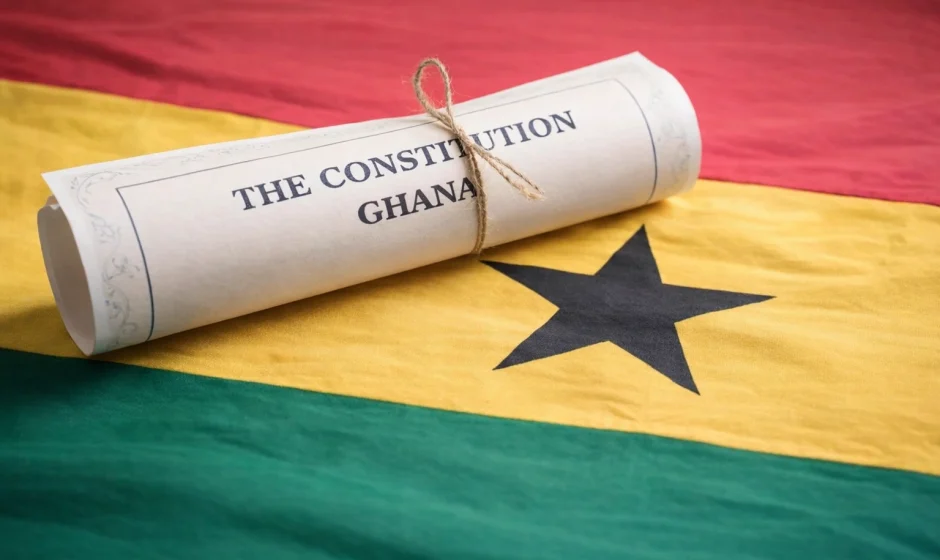
Ghana’s 1992 Constitution is the supreme law of the land – the document that governs how Ghana is run, who holds power, what rights every person in Ghana is entitled to, and what duties citizens owe to the country. Every law, presidential decision, and government action must comply with it. Anything that contradicts the Constitution is void to the extent of that contradiction (Article 1(2)).
Yet most people have never read it – and that is understandable. It is long, technical, and written in formal legal language. This guide explains all 26 chapters in plain English, in a way that is useful whether you are an ordinary Ghanaian, a member of the diaspora, or a foreign investor doing business in Ghana.
Get the official text of Ghana’s 1992 Constitution for your own reference – useful for lawyers, investors, students, and anyone doing business in Ghana.
Table of Contents
- The Republic
- Territories of Ghana
- Citizenship
- The Laws of Ghana
- Fundamental Human Rights and Freedoms
- Directive Principles of State Policy
- Representation of the People
- The Executive
- The Legislature (Parliament)
- The Judiciary
- The Council of State
- Freedom and Independence of the Media
- Finance
- Public Services
- The Police Service
- The Prisons Service
- The Armed Forces
- Human Rights and Administrative Justice (CHRAJ)
- National Commission for Civic Education (NCCE)
- Decentralisation and Local Government
- Lands and Natural Resources
- Chieftaincy
- Code of Conduct for Public Officers
- Transitional Provisions
- Miscellaneous
- Interpretation
Your Rights at a Glance
The table below summarises the key rights guaranteed to every person in Ghana under the 1992 Constitution.
| Right or Guarantee | What It Means in Plain English | Article |
|---|---|---|
| Right to Life | No one can take your life except in execution of a court sentence for a capital offence. | Art. 13 |
| Personal Liberty | You cannot be arrested or detained without lawful reason. If arrested, you must be brought before a court within 48 hours. | Art. 14 |
| Human Dignity | No torture, cruel or degrading treatment is allowed under any circumstance. | Art. 15 |
| Freedom from Slavery | No person may be held in slavery, servitude, or forced labour. | Art. 16 |
| Equality Before the Law | All persons are equal. No discrimination based on gender, race, colour, ethnicity, religion, or social status. | Art. 17 |
| Right to Property | You can own property. The State can only take it for a public purpose and must pay prompt, fair compensation. | Art. 18 & 20 |
| Right to a Fair Trial | If charged with a crime, you are presumed innocent, have the right to a lawyer, and must be tried within a reasonable time. | Art. 19 |
| Freedom of Speech and Press | You can speak freely, publish, and broadcast. The press is constitutionally free. | Art. 21 |
| Freedom of Religion | You can practise any religion or hold any belief. No state religion is established. | Art. 21 |
| Freedom of Movement | Citizens can move freely within Ghana, leave and return, and cannot be expelled from Ghana. | Art. 21(g) |
| Right to Vote | Every citizen aged 18 or above of sound mind can vote in elections and referenda. | Art. 42 |
| Right to Education | Basic education is free and compulsory. Secondary and higher education are to be made progressively accessible to all. | Art. 25 |
| Right to Work | Every person has the right to work in safe conditions, with equal pay for equal work, rest periods, and paid holidays. | Art. 24 |
| Privacy | Your home, property, correspondence, and communications are protected from unlawful interference. | Art. 18 |
Chapter 1: The Republic
This opening chapter establishes three foundational truths about Ghana. First, sovereignty – the ultimate power to govern – belongs to the people of Ghana, not to any president, military general, or political party (Article 1(1)). All government power flows from the people. Second, the Constitution is the supreme law of the land. Any other law, government action, or court ruling that contradicts the Constitution is void to the extent of that contradiction (Article 1(2)). Third, any citizen can go to the Supreme Court to challenge something they believe is unconstitutional (Article 2(1)).
The chapter also takes a firm stance against coups and unconstitutional seizures of power. Suspending or overthrowing the Constitution by any means – including force – constitutes high treason, punishable by death upon conviction (Article 3(3)). Critically, citizens are not only permitted to resist a coup attempt – they are constitutionally obligated to do so (Article 3(4)). Anyone punished for lawfully resisting a coup is entitled to compensation and rehabilitation once constitutional order is restored (Articles 3(6) and 3(7)). Ghana’s framers had lived through multiple coups and wrote these provisions deliberately.
What this means for you: Whether you are a citizen, a diaspora member, or a foreign investor – the Constitution is your ultimate protection. Any government action that violates it can be challenged in the Supreme Court.
Further reading: Ghana History: Essential Guide • Who Is Kwame Nkrumah?
Chapter 2: Territories of Ghana
Ghana is defined as a unitary republic – one country under one central government, not a federation. The territory of Ghana includes the land, the territorial sea, and the airspace above the country (Article 4(1)).
The process for creating new regions, altering regional boundaries, or merging regions is set out in Article 5. It cannot happen by presidential decree alone. A formal process is required: a petition to the President, the advice of the Council of State, a commission of inquiry, and a referendum. For a referendum to approve a change, at least 50% of eligible voters must cast ballots and at least 80% must vote in favour. For a merger of two or more regions, each region involved must separately achieve a 60% vote in favour (Article 5(7)). This high threshold ensures regional restructuring genuinely reflects the will of the people – a provision that was invoked in 2018 when Ghana created six new regions, bringing the total to 16.
What this means for investors: Regional boundaries in Ghana can change through a defined legal process, and those changes can affect land administration, district assembly jurisdiction, and development plans for your investment.
Further reading: Ghana’s Regional Map and Capital Cities
Chapter 3: Citizenship
This chapter answers the question: who is a Ghanaian? The Constitution sets out four routes to citizenship.
The first is citizenship by birth or descent (Article 6(2)): if either of your parents or grandparents is or was a Ghanaian citizen, you are a Ghanaian citizen at birth, regardless of where you were born. Diaspora children born abroad to a Ghanaian parent or grandparent are constitutionally Ghanaian from birth. The second route covers a child under seven found in Ghana whose parents are unknown, who is presumed to be a citizen by birth (Article 6(3)). The third is adoption: a non-Ghanaian child under 16 adopted by a Ghanaian citizen becomes a citizen by virtue of the adoption (Article 6(4)). The fourth is registration: foreign spouses of Ghanaian citizens may apply to be registered as citizens, though men seeking registration must be permanently resident in Ghana and the registering authority may require proof that the marriage was entered into in good faith (Article 7).
Dual Citizenship (Article 8)
Ghana permits dual citizenship under Article 8 of the Constitution. A Ghanaian who acquires the citizenship of another country may retain their Ghanaian citizenship. The primary restriction concerns holding certain senior public offices – positions such as the President, specific ministerial roles, and senior security appointments may require the holder to hold only Ghanaian citizenship. A person who becomes a citizen by registration (as opposed to by birth or descent) must renounce any other citizenship at the time of registration unless granted an extension of time to do so (Article 8(2)).
An applicant for citizenship by registration must also be able to speak and understand an indigenous Ghanaian language at the time of application (Article 9(2)).
What this means for the diaspora: If you were born in the UK, USA, Canada, or elsewhere to a Ghanaian parent or grandparent, you are constitutionally a Ghanaian citizen by birth and may hold both citizenships. If you intend to run for elected office or take up a senior public appointment in Ghana, check whether that role restricts dual-citizenship holders – this is the main practical limitation of dual citizenship under the Ghanaian constitutional framework.
Speak to a Ghana immigration lawyer who can advise on your specific situation – whether you are applying for citizenship, a passport, or dual citizenship recognition.
Related guides: Ghana Citizenship Guide • Dual Citizenship in Ghana • Right of Abode for Diaspora
Chapter 4: The Laws of Ghana
This chapter establishes the legal hierarchy of Ghana – what counts as law and in what order of authority. At the top is the Constitution itself. Below it, in descending order, are Acts of Parliament, subsidiary legislation (Orders, Rules, and Regulations made under statutory powers), the existing law that was in force before the Constitution came into effect, and the common law – which in Ghana includes the rules of equity and customary law (Article 11).
If any source conflicts with the Constitution, the Constitution prevails. A key practical provision is that any subsidiary legislation must be laid before Parliament and published in the official Gazette. Parliament then has 21 sitting days to annul it by resolution. If Parliament does not act within that period, the instrument comes into force (Article 11(7)). This gives Parliament meaningful oversight over executive rule-making.
What this means for investors: When operating in Ghana, the law governing your business may draw from multiple sources – Acts of Parliament, sector-specific regulations, and customary law in land matters. Understanding this hierarchy is essential for legal compliance and contract enforcement.
Chapter 5: Fundamental Human Rights and Freedoms
This is the most important chapter for most people. It guarantees a comprehensive set of rights and freedoms that all organs of government must respect. These rights apply to every person in Ghana, regardless of nationality, race, religion, or gender (Article 12(2)). They are enforceable through the courts: if your rights are violated, you can go to the High Court for a remedy, including writs such as habeas corpus, certiorari, mandamus, and prohibition (Article 33).
Right to Life (Article 13)
No person shall be intentionally deprived of their life except in execution of a court sentence for a criminal offence. The use of reasonable force in self-defence, effecting a lawful arrest, suppressing a riot, or preventing a crime does not contravene this right.
Personal Liberty (Article 14)
You cannot be arrested or detained except in specific circumstances defined by law – for example, upon reasonable suspicion of having committed a crime, by court order, or for reasons related to public health or the welfare of a minor. Anyone arrested must be told immediately, in a language they understand, why they are being held and that they have the right to a lawyer. They must be brought before a court within 48 hours. If not tried within a reasonable time, they must be released unconditionally or on reasonable conditions. Unlawful detention entitles the victim to compensation from the detaining person (Article 14(5)).
Human Dignity (Article 15)
Every person’s dignity is inviolable. No one may be tortured, subjected to cruel, inhuman, or degrading treatment, or held in conditions that demean their worth as a human being – whether or not they have been convicted. Unconvicted persons must be held separately from convicted prisoners. Juvenile offenders must be held separately from adults.
Freedom from Slavery and Forced Labour (Article 16)
No person may be held in slavery or servitude. Forced labour is prohibited. Exceptions not considered forced labour include court-ordered labour as part of a sentence, military duties, labour during wartime or a national emergency, and normal communal or civic obligations.
Equality and Freedom from Discrimination (Article 17)
All persons are equal before the law. No one may be discriminated against on the grounds of gender, race, colour, ethnic origin, religion, creed, or social or economic status. The Constitution permits Parliament to pass laws addressing historical imbalances – for example, affirmative action programmes for women or underrepresented communities – without this constituting unlawful discrimination (Article 17(4)).
Right to Property and Privacy (Articles 18 and 20)
Article 18 protects the privacy of your home, property, correspondence, and communications from interference except where permitted by law in a free and democratic society (Article 18(2)). Property rights – including the right to own property alone or jointly – are more directly addressed in Article 20. The State may compulsorily acquire your property only for a clearly defined public purpose and only if it pays prompt, fair, and adequate compensation. You have the right to challenge both the acquisition itself and the amount of compensation before the High Court (Article 20(2)). Where compulsory acquisition involves displacement of inhabitants, the Constitution provides for resettlement on suitable alternative land with due regard for economic well-being and cultural values, subject to the circumstances and resources available (Article 20(3)).
Right to a Fair Trial (Article 19)
If charged with a criminal offence, you are guaranteed a fair hearing within a reasonable time. You are presumed innocent until proven guilty (Article 19(2)(c)). You must be told in detail, in a language you understand, what you are charged with. You have the right to adequate time to prepare your defence, to be represented by a lawyer of your choice, to examine prosecution witnesses, and to call your own witnesses on equal terms. You cannot be charged for something that was not a crime when you did it. You cannot be tried twice for the same offence (Article 19(7)). You cannot be compelled to give evidence against yourself (Article 19(10)). Treason must be tried before three High Court justices and requires a unanimous verdict (Article 19(2)(i)).
Freedoms of Expression, Assembly, Association, and Movement (Article 21)
Every person in Ghana enjoys freedom of speech and expression – including freedom of the press and other media; freedom of thought, conscience, and belief – including academic freedom; freedom of religion; freedom of assembly including peaceful demonstrations; and freedom of association including the right to form or join trade unions. Citizens have the right to information, freedom of movement within Ghana, the right to leave and return to Ghana, and – as citizens – immunity from expulsion from Ghana (Article 21(1)(g)). Non-citizens may be subject to deportation or removal under applicable law. These rights may be restricted only to the extent permitted by law and only for legitimate reasons such as national security, public safety, or public health (Article 21(4)).
Economic and Social Rights (Articles 22 to 30)
The Constitution also protects economic and social rights. Spouses are entitled to reasonable provision from each other’s estates, and jointly acquired marital property must be distributed equitably on dissolution of the marriage (Article 22). Workers have the right to safe working conditions, equal pay for equal work, rest, leisure, and paid holidays (Article 24). Every person has the right to equal educational opportunities; basic education is free and compulsory (Article 25). Cultural rights are guaranteed: every person may practise their culture, language, and tradition, subject to the prohibition on harmful traditional practices (Article 26(2)). Special protection is provided for mothers (paid maternity leave, childcare facilities) (Article 27), children (protection from exploitation and child labour) (Article 28), disabled persons (equal treatment, access to public facilities, and business incentives) (Article 29), and medically vulnerable persons (Article 30). Emergency powers can temporarily restrict some of these rights but only under strict parliamentary oversight (Articles 31 and 32).
Whether it’s a property dispute, a business setup question, or a citizenship matter, a Ghana-based lawyer can guide you through your specific situation.
Chapter 6: Directive Principles of State Policy
Unlike the enforceable rights in Chapter 5, the Directive Principles are policy goals that guide – rather than legally bind – every organ of government, political party, and citizen (Article 34(1)). The President is required to report to Parliament at least once a year on steps taken to realise these objectives (Article 34(2)).
Key principles include: Ghana shall be a democratic state where sovereignty resides in the people (Article 35(1)); the State shall protect Ghana’s independence and territorial integrity; regional and gender balance must be pursued in public appointments (Article 35(6)(b)); the State shall manage the economy to maximise welfare, create employment, and provide for the needy (Article 36(1)); foreign investment shall be encouraged within Ghana subject to applicable law (Article 36(4)); agriculture and industry shall be developed (Article 36(3)); women must be fully integrated into economic life (Article 36(6)); the environment must be protected for future generations (Article 36(9)); basic education shall be free and universal (Article 38(2)); and the State shall combat corruption and abuse of power (Article 35(8)). Citizens in turn have constitutional duties – to defend the Constitution, pay taxes honestly, protect public property, and safeguard the environment (Article 41).
What this means: These principles cannot generally be enforced in court, but they set the constitutional standard against which government policy is measured. An investor or development partner can legitimately reference them when engaging government on economic development, environmental protection, or gender-inclusive projects.
Chapter 7: Representation of the People
This chapter governs elections, political parties, and the Electoral Commission (EC). Every citizen aged 18 or above and of sound mind has the right to vote (Article 42). Voting is by secret ballot. The EC is an independent body appointed by the President on the advice of the Council of State. Its functions include maintaining the voters’ register, demarcating constituencies, conducting and supervising all public elections and referenda, and educating the public on the electoral process (Article 45).
Ghana is divided into constituencies, each returning one Member of Parliament. Constituency boundaries must be reviewed at least every seven years or within twelve months of a census, whichever is earlier (Article 47(5)). For certain referenda under the Constitution, at least 35% of eligible voters must cast ballots and at least 70% must vote in favour of the issue (Article 49(4)). Note that referenda on entrenched constitutional provisions carry higher thresholds under Article 290.
Political parties are constitutionally guaranteed but regulated. Every party must have a national character and cannot be based on ethnic, religious, regional, or sectional divisions (Article 55(4)). Parties must register with the EC, demonstrate presence in all regions and at least two-thirds of districts in each region (Article 55(7)(b)), and must not use names or symbols carrying ethnic or regional connotations (Article 55(7)(c)). Internal party organisation must be democratic (Article 55(5)). Parties must publicly declare their revenues and sources annually and publish audited accounts (Article 55(14)). Only Ghanaian citizens may donate to a registered political party (Article 55(15)). Parliament cannot establish or authorise any body to impose a common political or religious programme on the people of Ghana (Article 56).
Further reading: The Structure of Ghana’s Government Explained
Chapter 8: The Executive
Ghana operates a presidential system. The President is the Head of State, Head of Government, and Commander-in-Chief of the Armed Forces (Article 57(1)). All executive authority vests in the President and is exercised in accordance with the Constitution (Article 58(1)). The President is directly elected and must win more than 50% of valid votes cast to be elected outright (Article 63(3)). If no candidate achieves this, a runoff is held between the top two candidates within 21 days.
To be eligible for the presidency, a person must be a Ghanaian citizen by birth, at least 40 years old, and otherwise qualified to be an MP (Article 62). A President may serve a maximum of two four-year terms (Article 66(2)). The President must not hold any other office of profit or emolument while in office (Article 68(1)).
The Vice-President is designated by the presidential candidate before the election and elected jointly with the President (Articles 60(2) to 60(4)). If the President dies, resigns, or is removed from office, the Vice-President assumes the presidency for the remainder of the term (Article 60(6)). Where both the President and Vice-President are unable to perform presidential functions, the Speaker of Parliament performs those functions temporarily (Article 60(11)). If the Speaker assumes the presidency following the death or removal of both the President and Vice-President, a fresh presidential election must be held within three months (Article 60(13)).
The President may be removed from office by a two-thirds secret ballot of all MPs, following a formal inquiry by a tribunal composed of the Chief Justice and the four most senior Supreme Court justices – or, for incapacity cases, a medical board of at least four eminent specialists (Article 69). Parliament must act on the tribunal’s or board’s findings within 14 days (Article 69(10)).
The Cabinet consists of the President, Vice-President, and between 10 and 19 Ministers of State (Article 76(1)). A majority of Ministers of State must be Members of Parliament (Article 78(1)). The Attorney-General is a Minister of State and the government’s principal legal adviser, as well as the head of all criminal prosecutions (Article 88). The National Security Council, chaired by the President, coordinates national security policy across all civilian and military agencies (Articles 83 and 84). The National Development Planning Commission advises the President on development strategy and monitors implementation of development policies (Articles 86 and 87).
Further reading: Starting a Business in Ghana as a Foreigner • Structure of Ghana’s Government Explained
Chapter 9: The Legislature (Parliament)
Parliament is Ghana’s lawmaking body. To be elected an MP, a person must be a Ghanaian citizen, at least 21 years old, and a registered voter. Members serve four-year terms.
Parliament is headed by a Speaker who must be a person qualified to be elected as a Member of Parliament. The Speaker is elected by MPs from among themselves or from outside Parliament. If a sitting Member of Parliament is elected as Speaker, they vacate their parliamentary seat upon election to that office. Two Deputy Speakers are similarly elected. Parliament has broad legislative powers but cannot pass a law that violates the Constitution, establishes a one-party state, or surrenders national sovereignty.
All bills passed by Parliament require presidential assent to become law. The President can withhold assent and return a bill with comments; Parliament can override this by passing the bill again with a two-thirds majority of all members, at which point it becomes law without presidential assent. Parliament scrutinises executive action through debates, committee inquiries, and the right to question Ministers. It approves the national budget and authorises all public expenditure. It approves ministerial appointments and international treaties. It can pass a vote of censure on a Minister by a two-thirds majority (Article 82(1)), and it can remove the President from office. Members of Parliament enjoy freedom of speech within Parliament – no MP can be sued or prosecuted for anything said during proceedings.
Chapter 10: The Judiciary
The Judiciary is constitutionally independent. No person or authority may interfere with a judge in the performance of judicial duties. The Superior Courts are the Supreme Court, the Court of Appeal, and the High Court. Below these are Circuit Courts and District Courts.
The Supreme Court is the highest court in Ghana. It has exclusive original jurisdiction to interpret the Constitution and to rule on the constitutionality of laws and government actions. It also serves as the final appellate court. The Chief Justice heads the entire judiciary. Justices of the Supreme Court are appointed by the President acting in consultation with the Council of State and with parliamentary approval. The Court of Appeal hears appeals from the High Court. The High Court has general jurisdiction over all civil and criminal matters except those exclusively reserved for the Supreme Court. Judges serve until mandatory retirement age (70 for Supreme Court and Court of Appeal justices) and can only be removed for stated misbehaviour or incapacity following a formal inquiry – a structural protection against political pressure on the courts.
What this means for investors: Ghana’s judiciary provides a constitutional avenue for resolving disputes with government agencies. Compulsory acquisition of property, contract disputes with state entities, and constitutional challenges can all be litigated before independent courts.
Chapter 11: The Council of State
The Council of State is a constitutional advisory body to the President. Its members include former presidents who served under a constitutional government, one representative from each region elected by a regional electoral college, and other distinguished citizens appointed by the President. Its role is to counsel the President on matters of national importance.
The Constitution requires the President to consult the Council of State before taking a range of important actions – including appointing senior public officials (such as members of the Electoral Commission, the Commissioner for CHRAJ, and the Auditor-General), declaring a state of emergency, granting pardons, and various other decisions specified throughout the Constitution. The Council provides experienced, non-partisan advice and acts as an informal check on the executive. It does not pass laws or issue binding orders – but its constitutional role in the appointments process gives it real influence over the independence of major institutions in Ghana.
Chapter 12: Freedom and Independence of the Media
Chapter 12 constitutionally guarantees freedom of the press and independence of the media. It establishes the National Media Commission (NMC) as an independent body with the primary function of promoting and ensuring the freedom and independence of the media for mass communication, including newspapers, radio, and television.
The NMC is specifically charged with ensuring that state-owned media – government radio, television, and newspapers – operate in the public interest and are not used as propaganda tools by the ruling party. State media must give fair access to all political parties, particularly during elections. The Commission’s membership is drawn from a broad range of civil society organisations, preventing domination by any single political interest. This constitutional framework is why Ghana’s state broadcaster, the Ghana Broadcasting Corporation, is required to cover all sides of political debate. Ghana has a strong constitutional framework supporting media freedom, and this has underpinned a competitive private media sector of radio stations, TV channels, and online publications.
What this means: For businesses and investors, Ghana’s open media environment means public discourse, political risk, and investor sentiment are freely reported and debated. It also means reputational issues can spread quickly through a competitive media landscape.
Chapter 13: Finance
This chapter governs Ghana’s public finances. The centrepiece is the Consolidated Fund – the government’s main account into which all public revenues flow and from which all authorised government expenditure is drawn. No money may be paid out of the Consolidated Fund except as authorised by Parliament through an Appropriation Act (the annual national budget) or a separate specific act of Parliament.
The President must present the budget to Parliament for approval before the start of each financial year. Parliament scrutinises and approves all public expenditure. The Auditor-General is an independent constitutional officer who audits the accounts of all ministries, departments, district assemblies, and public corporations, and reports findings to Parliament. The Bank of Ghana is the central bank; it is responsible for monetary policy and currency management, and oversees overall financial system stability. A contingency fund provides for urgent unforeseen expenditure, subject to parliamentary approval after the fact.
What this means for investors: Ghana’s fiscal transparency framework – parliamentary budget approval and independent auditing – directly affects its sovereign credit rating, exchange rate stability, and the overall business environment. Monitoring Ghana’s budget process and public debt management is essential for any investor with long-term exposure in the country.
Further reading: Best Banks in Ghana • Money and Finance in Ghana • Mobile Money in Ghana
Chapter 14: Public Services
This chapter covers the civil service and Ghana’s wider public services – including the Ghana Education Service, Ghana Health Service, and associated institutions. The Public Services Commission is an independent body responsible for advising on conditions of service and ensuring that recruitment and promotion across the public services are based on merit, not political patronage.
Public servants are expected to be politically neutral, serving the government of the day regardless of its political affiliation. The constitutional framework for filling senior public service positions – typically through presidential appointment in some cases on the advice of the Public Services Commission – is designed to prevent cronyism and preserve institutional continuity across changes of government. The independence of the public service from partisan control is a structural element of Ghana’s system of governance.
Chapter 15: The Police Service
The Ghana Police Service is a national civilian force responsible for internal security, prevention and detection of crime, maintenance of law and order, and protection of life and property. The Inspector-General of Police heads the service and is appointed by the President in consultation with the Council of State.
The Police Council oversees the service and insulates it from partisan political interference. Police officers must exercise all powers within the law. The constitutional rights in Chapter 5 – including the 48-hour rule for bringing arrested persons before a court and the right to a lawyer – apply directly to all police conduct. Complaints against police officers may be investigated by CHRAJ (Chapter 18) as well as through internal disciplinary processes.
Further reading: Police Bribery in Ghana: What to Do • Crime in Ghana • Safety Tips for Visiting Ghana
Chapter 16: The Prisons Service
The Prisons Service is responsible for the custody, safe-keeping, and rehabilitation of convicted persons and those on remand. This chapter requires prisons to be managed humanely and in full compliance with the rights guaranteed in Chapter 5 – particularly the prohibition on torture and degrading treatment (Article 15). Prisoners retain their human dignity, subject to the conditions of their lawful detention. Juvenile offenders must be held in separate facilities from adult offenders. The Director-General of the Prisons Service is appointed by the President in consultation with the Council of State, and the Prisons Service Council provides institutional oversight.
Chapter 17: The Armed Forces
The Ghana Armed Forces – the Army, Navy, and Air Force – exist to defend Ghana’s sovereignty and territorial integrity and to assist civil authorities in maintaining law and order when constitutionally called upon. The Constitution places the military firmly under civilian command: the President is Commander-in-Chief, and a Defence Council governs the Armed Forces. No member of the Armed Forces on active duty may engage in partisan political activity.
The chapter prohibits the establishment of any armed force outside the constitutional framework – private militias and parallel armed forces are unconstitutional. The Armed Forces may be deployed domestically in aid of civil authority only under defined conditions and with appropriate oversight. This represents a direct constitutional response to Ghana’s pre-1992 history of military coups.
Chapter 18: The Commissioner for Human Rights and Administrative Justice (CHRAJ)
CHRAJ is Ghana’s constitutional ombudsman and anti-corruption body – an independent institution that investigates complaints against the government and its officials. It carries three overlapping mandates: investigating alleged violations of fundamental human rights by any government body or public official; investigating complaints of unfair, unreasonable, or unjust treatment by any government institution (the ombudsman function); and investigating corruption and misconduct among public servants.
CHRAJ has the power to summon witnesses, require access to information and documents, and make recommendations to remedy injustice. Any person who believes their rights have been violated by a government authority can file a complaint with CHRAJ as an alternative or complement to going to court. CHRAJ reports to Parliament and its Commissioner is appointed by the President in consultation with the Council of State and with parliamentary approval. The integration of human rights, ombudsman, and anti-corruption functions in a single constitutional body is a distinctive feature of Ghana’s institutional architecture.
What this means for you: If a government agency treats you unfairly, ignores a legitimate application, or a public official solicits a bribe, CHRAJ is the constitutional complaints avenue. Diaspora investors and foreign businesses dealing with government entities can also make use of CHRAJ’s processes.
Chapter 19: National Commission for Civic Education (NCCE)
The National Commission for Civic Education is a constitutional body established to educate Ghanaians about their rights, responsibilities, and the Constitution itself. Its mandate covers creating and sustaining public awareness of constitutional rights, fostering a democratic culture, promoting political tolerance, and advancing respect for the rule of law and human rights across all segments of Ghanaian society.
The NCCE runs public education programmes through community outreach, schools, media partnerships, and civic events across all of Ghana’s regions and districts. It provides voter education alongside the Electoral Commission during election cycles. It also promotes awareness of the code of conduct for public officers and the obligations of citizenship under Chapter 23. The NCCE is independent of government control and reports to Parliament.
Chapter 20: Decentralisation and Local Government
The Constitution is firmly committed to decentralisation – decisions should be made as close as possible to the people they affect. This chapter establishes District Assemblies (including Metropolitan and Municipal Assemblies for larger urban areas) as the basic units of local government. Each assembly has elected members chosen directly by local voters and government-appointed members, with elected members constituting at least two-thirds of the total.
Each district is headed by a District Chief Executive (DCE) appointed by the President and approved by at least two-thirds of the assembly members. Assemblies are responsible for local planning, infrastructure, public health, basic education, environmental management, and a wide range of local services. They have local revenue-raising powers (rates, levies, and fees) and also receive a share of national tax revenue through the District Assemblies Common Fund – which the Constitution mandates to be at least 5% of total national tax revenues. The objective is that communities have direct input into decisions affecting them and that development is spread across Ghana, not concentrated in Accra.
What this means for investors: Development permits, land use approvals, business operating licences, and local infrastructure decisions all sit at the district assembly level. Understanding which district assembly has jurisdiction over your investment site is essential for project planning and stakeholder engagement in Ghana.
Further reading: Ghana’s Regions, Districts and Capital Cities
Chapter 21: Lands and Natural Resources
This chapter is of critical importance to investors, developers, and anyone dealing with land or natural resources in Ghana. The central constitutional principle is that all public lands in Ghana, and all minerals, water, and natural resources in, under, and upon any land in Ghana – including its continental shelf and exclusive economic zone – are vested in the President in trust for, and on behalf of, the people of Ghana. No private individual or company owns Ghana’s mineral deposits, petroleum, or water resources outright. Rights to extract these resources can only be obtained through a licence or concession granted by the government.
Stool lands – land held in trust by traditional chiefs (stools) for their communities – are managed by the relevant stool on behalf of the community. Revenue from stool lands is constitutionally allocated among the stool, the traditional authority, the local district assembly, and a national stool lands fund. The Lands Commission is the constitutional body responsible for managing public lands, maintaining a comprehensive register of all interests in land, and advising the government on land policy. Restrictions on land acquisition by non-citizens are set by statute (currently the Lands Act, 2020) rather than the Constitution itself, though the Constitution expressly permits Parliament to impose such restrictions (Article 17(4)(c)).
What this means for investors: Foreign land ownership in Ghana is regulated by statute rather than the Constitution directly, and is typically structured as leasehold interests rather than freehold ownership. Mining, oil, and gas operations require concessions from the state. All transactions affecting land must be registered with the Lands Commission. Thorough due diligence on land title – including verification of stool land arrangements and prior encumbrances – is essential before any real estate or agricultural investment in Ghana.
Further reading: Buying Property in Ghana Through a Developer • Renting an Apartment in Ghana as a Foreigner • Housing in Ghana
A qualified Ghanaian property lawyer can help you verify title, navigate stool land arrangements, and structure your transaction correctly under the Lands Act 2020.
Related guides: Buying Land in Ghana • Property Ownership for Foreigners • Money and Finance in Ghana • Setting Up a Business in Ghana
Chapter 22: Chieftaincy
Ghana’s Constitution gives formal constitutional recognition to the institution of chieftaincy – the traditional system of authority that predates the colonial era and remains central to Ghanaian society, particularly in land administration and community governance. Chieftaincy is constitutionally guaranteed and protected. Parliament may not enact any law that confers on any person or authority the right to accord or withdraw recognition from a chief.
The National House of Chiefs is the supreme body of traditional authority in Ghana, and there is a Regional House of Chiefs in each of Ghana’s 16 regions. These houses deal with chieftaincy disputes, promote and safeguard the culture, customary law, and traditions of communities, and advise the government on customary matters. The National House of Chiefs may also undertake the progressive codification and development of customary law.
What this means for investors: In matters of stool land – which covers a large proportion of land in Ghana – the relevant chief and traditional authority are key stakeholders alongside the Lands Commission and the district assembly. Engaging the appropriate traditional authority early in any land-based investment is both legally prudent and an operational best practice.
Chapter 23: Code of Conduct for Public Officers
This chapter establishes constitutional rules governing the conduct of public officers, including asset declaration, conflicts of interest, and ethical obligations. Every public officer – a broad category encompassing the President, ministers, MPs, judges, civil servants, military officers, and all persons holding public office – must declare their assets and liabilities on entering office, annually while in office, and upon leaving office. These declarations are submitted to the Auditor-General and CHRAJ.
Public officers are prohibited from using their official positions for personal gain, from placing themselves in conflicts of interest between private interest and public duty, from using public property for private purposes without authority, and from engaging in conduct likely to bring their office or Ghana into disrepute. A public officer who acquires property in circumstances that raise a reasonable suspicion of corruption may be required to provide a satisfactory explanation. Enforcement sits with CHRAJ and the criminal courts. This chapter underpins Ghana’s broader legislative anti-corruption framework, including the Public Officers and Accountability legislation.
What this means: The constitutional requirement for annual public officer asset declarations is a significant transparency mechanism. Investors should be aware that facilitation payments to public officials – even when solicited – may expose both the official and the company to legal liability under this framework and related anti-corruption statutes.
Chapter 24: Transitional Provisions
This chapter managed the practical transition from military rule under the Provisional National Defence Council (PNDC) to the democratic constitutional order that came into force in January 1993. It addressed the continuity of existing laws and institutions and provided for the formal handover of power. While much of this chapter is now of primarily historical interest, it contains an indemnity clause that shielded participants in the 1981 coup and the subsequent PNDC government from prosecution for certain acts committed before the Constitution came into force. This clause has been the subject of sustained debate in Ghana regarding accountability and transitional justice. It is an entrenched provision and cannot be altered without going through the full constitutional amendment process including a referendum.
Chapter 25: Miscellaneous
This chapter contains important provisions that do not fall neatly under any other chapter – most significantly, the rules for amending the Constitution itself. The Constitution distinguishes between entrenched and non-entrenched provisions. Non-entrenched provisions may be amended by a two-thirds majority vote of all Members of Parliament, following consultation with the Council of State and publication in the Gazette. Entrenched provisions – which include the fundamental rights chapter, the independence of the judiciary, the presidential term limits, and the electoral framework – require additionally a national referendum in which at least 40% of eligible voters participate and at least 75% of those voting vote in favour of the amendment (Article 290).
This deliberately high threshold means that the most important structural features of Ghana’s democracy cannot be dismantled by a parliamentary majority alone. Other provisions in this chapter cover Ghana’s national symbols (the flag, coat of arms, national anthem, and national pledge), the official and presidential seals, and procedural rules governing the making and citation of constitutional instruments.
Chapter 26: Interpretation
The final chapter defines the key terms used throughout the Constitution, ensuring that legal language is applied consistently across all provisions. It defines terms such as “citizen,” “public officer,” “Consolidated Fund,” “enactment,” “district,” “Parliament,” “spouse,” and many others. It also sets out general rules of constitutional interpretation – for example, that words in the singular include the plural; that references to a person include both natural persons and corporate entities; that references to a written law include subsidiary legislation made under it; and that where a provision is ambiguous, an interpretation that promotes the spirit and purpose of the Constitution shall be preferred. When courts, officials, or practitioners need to understand what a term in another chapter means, Chapter 26 is the authoritative starting point.
Final Word: Why This Constitution Matters to You
Whether you are a Ghanaian citizen, a member of the diaspora, a foreign investor, or a migrant considering making Ghana your home, the 1992 Constitution affects your life directly. It guarantees your rights if you are arrested (Article 14), your entitlement to fair treatment by government officials (Article 23), your ability to own and protect property (Articles 18 and 20), your right to vote and participate in civic life (Article 42), and the institutional framework – from the courts to the Electoral Commission – within which all business and public life in Ghana operates.
Ghana’s Constitution is widely regarded as a stable and democratic framework that has demonstrated genuine resilience across contested elections, economic cycles, and political transitions. That resilience is structural: it is built into the document’s multiple checks and balances, its independent institutions, and the fundamental commitment in Article 3 that every citizen has not only the right but the constitutional duty to defend it.
Start here: Daily Life in Ghana • Ghana Living Essentials • How to Get Ghanaian Citizenship • Download Ghana Guides (PDF)