

Quick links (related guides):
What Happened
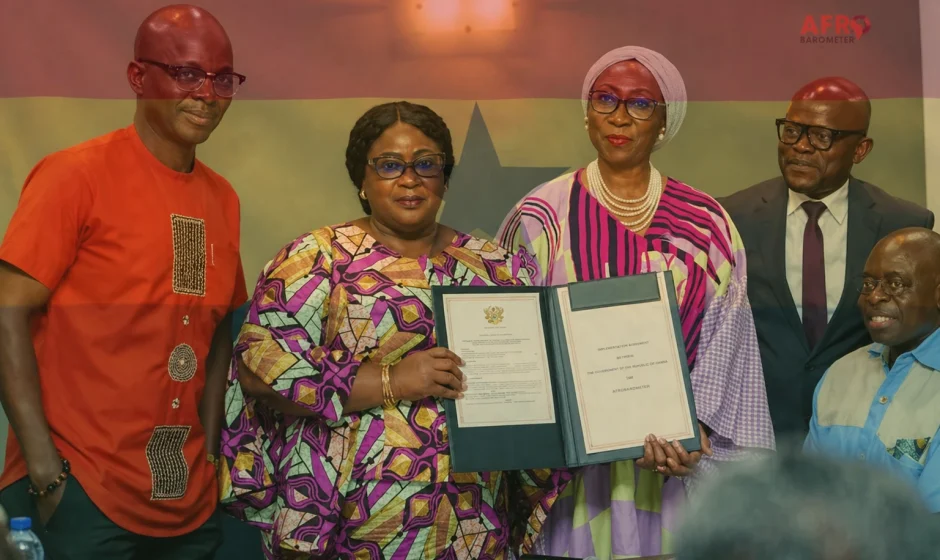
Ghana signed a formal headquarters agreement with Afrobarometer at a ceremony in Accra on April 27, 2026, following bipartisan parliamentary approval of the pact in December 2025.
The signing is not simply a formality. It converts an informal arrangement – Afrobarometer has operated its secretariat out of Accra since 2019 – into a formal legal framework that secures the network’s operational presence in Ghana. Under the agreement, Accra is now the formally recognised host city of one of Africa’s leading public opinion research networks.
Ambassador Khadija Iddrisu, Chief Director of the Ministry of Foreign Affairs, represented the government at the ceremony. Afrobarometer Board Chair Amina Oyagbola attended alongside senior network leadership.
What Is Afrobarometer?
Afrobarometer is an independent, non-partisan research network that measures public attitudes toward democracy, governance, the economy, and society across Africa. It was founded in 1999 through a collaboration between the Ghana Center for Democratic Development (CDD-Ghana), the Institute for Democracy in South Africa (Idasa), and Michigan State University. The network has since expanded into a continent-wide operation involving national research partners in dozens of countries.
The core work is straightforward: trained field teams conduct face-to-face interviews with nationally representative samples of citizens in each country, asking standardised questions about how people experience government, public services, corruption, elections, and economic conditions. Because the methodology is consistent across countries and survey rounds, the data can be compared both across borders and over time – making it possible to track whether governance in a given country is improving or deteriorating from the perspective of ordinary citizens, not just official statistics.
That citizen-level focus is what sets Afrobarometer apart. Most governance indices rely on expert assessments or institutional data. Afrobarometer goes directly to the people affected. When a survey round finds that trust in the police has fallen sharply in a particular country, or that most citizens in a region believe elections are not free and fair, that signal reaches policymakers, donors, and civil society organisations in a way that aggregate statistics rarely do.
The network does not advocate for specific policies or political positions. Its role is to produce and publish the data, then make it freely available. Governments, development banks, academic researchers, and journalists draw on Afrobarometer findings to inform decisions and reporting. The Ibrahim Index of African Governance, Transparency International’s Global Corruption Barometer, and the World Bank’s Worldwide Governance Indicators all incorporate Afrobarometer data into their methodologies.
What the Agreement Covers
The headquarters agreement formalises Afrobarometer’s operational framework under Ghanaian law. In practical terms, this means the secretariat now has a structured legal basis for managing staffing, grants, contracts, and regional operations from Accra – the same legal certainty that international organisations based in cities like Nairobi or Geneva rely on to function across multiple jurisdictions.
Ambassador Iddrisu, speaking at the signing ceremony, framed the agreement as a direct expression of Ghana’s democratic identity: “Ghana’s democratic journey, spanning over three decades of constitutional rule, continues to be anchored in transparency, accountability, and citizen participation.” She described organisations like Afrobarometer as central to that commitment.
Board Chair Oyagbola called the parliamentary vote a watershed moment, noting that the bipartisan endorsement gave the network the institutional foundation it needs to sustain its continental research programme with greater certainty.
Afrobarometer by the Numbers
Founded in 1999, Afrobarometer has grown into the continent’s primary source of citizen-level governance data. Its survey programme now covers 45 African countries, representing the views of more than 75 percent of the African population. More than 429,000 interviews have been documented across the network’s survey rounds, with Round 10 – launched in January 2024 – still adding to that total as of the agreement signing.
The data produced feeds directly into the indices that shape international assessments of African governance and development, including the Ibrahim Index of African Governance, Transparency International’s Global Corruption Barometer, and the World Bank’s Worldwide Governance Indicators. Governments, development banks, civil society organisations, and foreign investors draw on Afrobarometer findings when assessing country risk, policy performance, and public sentiment.
| Detail | Figure |
|---|---|
| Year founded | 1999 |
| Countries covered | 45 |
| Population represented | Over 75% of Africa |
| Total interviews documented | More than 429,000 (Afrobarometer, 2025); Round 10 ongoing |
| Survey rounds completed | 9 fully completed; Round 10 launched January 2024 |
| Secretariat location | Accra, Ghana (since 2019) |
| Parliamentary approval (HQ agreement) | December 2025 |
| Agreement signed | April 27, 2026 |
Ghana’s Role as a Research Hub
Ghana’s connection to Afrobarometer runs deeper than hosting. The Ghana Center for Democratic Development (CDD-Ghana) is the organisation’s Core Partner in the country and has been involved in every one of the 10 survey rounds conducted to date. CDD-Ghana also coordinates Afrobarometer survey implementation across West, Central, and North Africa – a regional management role that has positioned Accra as the operational nerve centre for a large part of the network’s continental fieldwork.
That depth of institutional involvement is part of why Ghana was the natural choice for a permanent headquarters. When the secretariat relocated to Accra in 2019, it was not moving to a neutral location – it was consolidating around an established partner with demonstrated capacity and reach.
Economic Footprint in Accra
The agreement also has a measurable economic dimension. Since establishing the secretariat in Accra, Afrobarometer has routed all network grants through Ghanaian financial institutions. That flow of foreign funding contributes to foreign-exchange inflows and provides revenue to local hospitality, tourism, and professional services businesses that support the network’s operations and visiting researchers.
For diaspora members and investors watching Ghana’s institutional development, the headquarters agreement is a signal worth noting. It reflects a pattern of international organisations choosing Accra as a base for continental operations – a trend that strengthens the city’s position as a hub for governance, research, and development work across Sub-Saharan Africa.
What Comes Next
With the agreement in force, Afrobarometer’s secretariat now has a permanent legal home in Ghana. The next phase of the network’s work – including future survey rounds and expanded country coverage – will proceed from a more stable institutional base than at any point in the organisation’s history.
For Ghana, the agreement reinforces a decades-long positioning as one of West Africa’s most stable democracies and a credible host for international institutions. Readers interested in the structure of Ghana’s government and democratic framework can find more context in the Ghana government structure guide on this site.
Sources
- News Ghana: “Ghana Formally Signs Afrobarometer Headquarters Agreement” (April 27, 2026)
- Afrobarometer: “Afrobarometer and Government of Ghana formalise headquarters agreement following parliamentary approval” (April 27, 2026)
- Afrobarometer: Annual Report 2024 – Key statistics and survey coverage
- World Bank: Worldwide Governance Indicators – Frequently Asked Questions (confirms Afrobarometer as a listed data source)
- Ghana Center for Democratic Development (CDD-Ghana): Official Website